

Drawings and documents
National Archives restored drawings: drawing
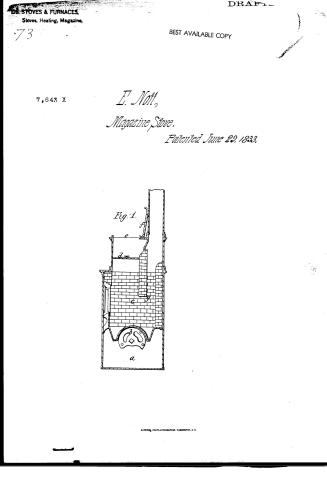
E. Nott's Patent Drawing for an Improvement in Preventing the Escape of Heat from the Top of a Pile

National Archives, Restored Patent Drawings (Record Group 241) · Full-size scan at the National Archives · Catalog record
Show the text on the drawing Hide (139 words)
Words on the drawing as machine-read by the National Archives; not checked. Useful mainly for searching.
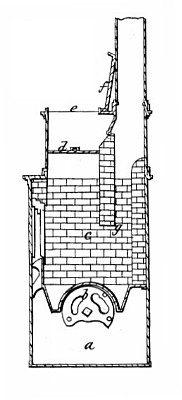
126. STOVES & FURNA / BB,St. / [154] Cax- Magazine Stoves. / E.NOTT / 7643-+ / DIVISION / IMP " / In preventing the escape of heal from lhe lop of a pile / of igmied fuel, by placing over the same a moveable flar. / Paíeníed June 29th 1833. / Case Ne 5- / Fig.1. / oler / REFERERENCES. / IF / Fig.1. Transverse secdion of a coal sťove having it's chamber of commision / elongaied it's inlel for fuel al lop, it's outler for flame at boďrom and / a movåble horizomal flat placed over the com'ained fuel. / a. ashpil. Ь. grate. / C. chamber of combustion. / d. moveable flat on pile of fuel. / e. inler for fuel at top / f. lid governing inler for fuel / S. outher for Ilame at bollom.
USPTO scan
The patent as scanned by the USPTO
-
 Page 1
-
 Page 2
-
 Page 3
-
 Page 4


U.S. Patent and Trademark Office · Google Patents
Show the transcription Hide (799 words)
Machine transcription (LightOnOCR) of the pages as scanned by the USPTO, most of them the handwritten copies made when the records were restored after the 1836 fire. Not checked; it can misread handwriting, so compare it with the scan.
Page 1.
DRAFT
73
BEST AVAILABLE COPY
7,643 X
E. Nott,
Magazine Stove.
Patented June 22, 1833.
Fig. 1.

W. PETERS, PHOTO-LITHOGRAPHER, WASHINGTON, D. C.
Page 2.
Eliphalet Nott.
Letters Patent.
The Schedule referred to in these Letters Patent and making part of the same, containing a description in the words of the said Eliphalet Nott, himself of his improvement in the material, form and construction of stove pipe, to be employed where anthracite coal is the fuel in use.
Case No. 9.
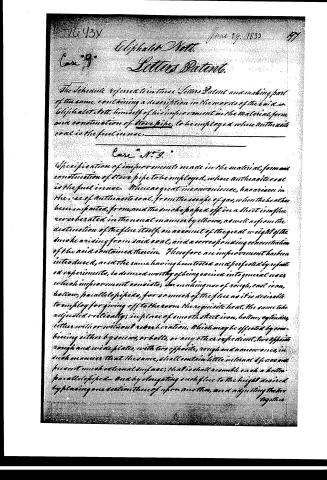
Specification of improvements made in the material, form and construction of stove pipe to be employed, where anthracite coal is the fuel in use. When a great inconvenience, has arisen in the use of anthracite coal, from the escape of gas, when the heat has been imparted, from, and the smoke passed off in a sheet in the flue neverberated in the usual manner by elbows, as well as from the destruction of the flue itself, on account of the great weight of the smoke arising from said coal, and a corresponding concentration of the acids contained therein. Therefore an improvement has been introduced, and the same having been tested and perfected by repeated experiments, is deemed worthy of being carried into general use, which improvement consists; In making use of rough, cast iron, hollow, parallel pipes, for so much of the flue as it is desirable to employ for giving off to the room the requisite heat, the same to be adjusted vertically, in place of smooth sheet iron, hollow, elliptical, either with or without reberberation. Which may be effected by combining either by screws, or bolts, or any other expedient, two opposite rough and wide plates, with two opposite, rough and narrow ones, in such manner that the same, shall contain little internal space and present much external surface; that is shall resemble such a hollow parallel pipe. And by elongating such flue to the height desired by placing one section thereof upon another, and adjusting the two together.
Page 3.
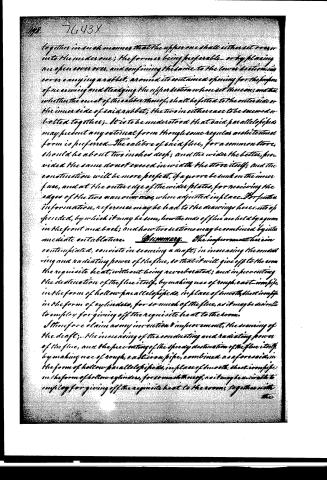
together in such manner that the upper one shall either set over into the under one; the former being preferable—or by placing an open cover over, and confining the same to the lower section in covering a rabbit, around its contained opening for the purpose of receiving and leading the upper section when set thereon, and that whether the end of the caliper thereof, shall be fitted to the outer side or the inner side of said rabbit; the two in either case to be screwed or bolted together. It is to be understood that said parallelopiped may present any external form though some regular architectural form is preferred. The calibre of said flue, for a common stove, should be about two inches deep; and the wider the better, provided the same do not exceed in width the stove itself; and the construction will be more perfect, if a groove be sunk on the inner face, and at the outer edge of the wider plates, for receiving the edges of the two narrow ones, when adjusted in place. For further information, reference may be had to the drawings hereunto appended, by which it may be seen, how the ends of flue are held by a gum in the front and back; and how two sections may be combined by intermediate entablature.
Summary. The improvement herein contemplated, consists in securing a draft; in increasing the conducting and radiating power of the flue, so that it will give off to the room the requisite heat, without being reverbated; and in preventing the destruction of the flue itself, by making use of rough, cast-iron pipe, in the form of hollow parallelopipeds, in place of smooth, sheet-iron pipe in the form of cylinders, for so much of the flue, as it may be advisable to employ for giving off the requisite heat to the room.
I therefore claim as my invention & improvement, the securing of the draft; the increasing of the conducting and radiating power of the flue, and the preventing of the speedy destruction of the flue itself, by making use of rough, cast-iron pipe, combined as aforesaid, in the form of hollow parallelopipeds, in place of smooth, sheet-iron pipe in the form of hollow cylinders, for so much thereof, as it may be advisable to employ for giving off the requisite heat to the room; together with
Page 4.
7643X
The uses to which the same has been or may hereafter be employed in towns and parishes.
Al. H. Boyd
D. Boyd, M.D.
648
(Granted June 29, 1838)
Or in folio
199
5th 18
Elkht. Stott
Published accounts: journal notice
Notice in the monthly list of patents, with remarks
Journal of the Franklin Institute, new ser., vol. 12 (1833), p. 406 · View the page
34. For the Material form, and construction of stove pipe, to be employed where anthracite coal is the fuel in use; Eliphalet Nott, Schenectady, New York, June 29.
Remarks. CLAIM. "I therefore claim as my invention and improvement, the securing of the draft; the increasing of the conducting and radiating power of the flue, and the preventing of the speedy destruction of the flue itself, by making use of rough cast iron pipe combined as aforesaid, in the form of hollow parallelopipeds, in place of smooth sheet iron pipe, in the form of hollow cylinders, for so much thereof as it may be desirable to employ for giving off the requisite heat to the room; together with the uses to which the same has been, or may be hereafter, employed in stoves and furnaces." This last concludes the series of nine patents appertaining particularly to the stove for the combustion of anthracite. Although we believe that there is, in most of them, sufficient novelty upon which to sustain a patent, we think, that as respects some of them, this point is, at least, a doubtful one; but the utility, merit, and originality of the stove into the composition of which they enter, does not depend upon this circumstance: this is a point which we believe the courts, and public opinion have both settled in favour of the patentee.
DATAMP: illustration
Illustrations from DATAMP

DATAMP (Directory of American Tool and Machinery Patents), via the Internet Archive · Archived DATAMP page
About this record
- Patentee
- DATAMP
- Date
- DATAMP, USPTO records, Burke's List of Patents (1847)
- Invention
- DATAMP
- Listed in
- the Name and Date index of patents, DATAMP, USPTO records, Jim Shaw's X-patent list, the Journal of the Franklin Institute, Burke's List of Patents (1847)
- The sources give different dates; the date shown is the one most of them agree on.
- The Franklin Institute's journal confirms the date shown.
- Burke's 1847 Patent Office list gives the same patent.