

Drawings and documents
National Archives restored drawings: drawing
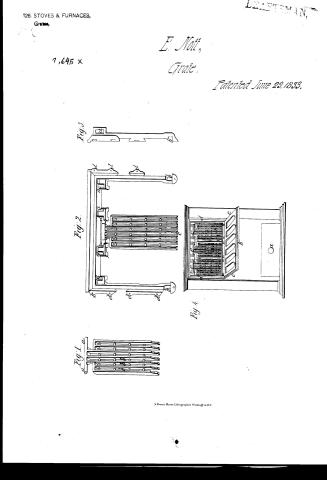
Eliphalet Nott's Patent Drawing for a Vertical Grate

National Archives, Restored Patent Drawings (Record Group 241) · Full-size scan at the National Archives · Catalog record
Show the text on the drawing Hide (241 words)
Words on the drawing as machine-read by the National Archives; not checked. Useful mainly for searching.
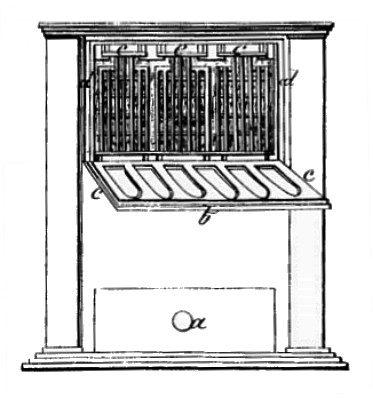
2- / 126. STOVES & FURNACES / [154] / Grates. / E L I N T / CLASSIFICATION / 7645-x / V E R L GRATE. / SION. / Putent N°3. / Patented 29th June. 1833. / FIG.1. / FIG. 2. / FIG. 3. / FIG. 4. / d. / d. / )d. / Nb. / b. / a, / C. / REFERENCES. / Fig. 1. One vertical section of front grate. / Fig. 2. Back frame, which being attached to / Fig. 4. Front plate, with Fig 2. attached; and / a. a. Gudgeons, by which the same is hung / the front plate forms the sockets, at top, and bottom; / front grate, and its exterior sash, in place. / in place. / for hanging both the vertical grate; and its exteri / a. Ashdrawer operating in closed ashpit, as / b.b.b. Vertical grate bars. / -or sash ; and, also, the rabbit, for the latter to shut a- / a valve. / gainst. / b. Sash for mica, hung at bottom opened, and held / Fig. 3. End view of Fig 2. / a.a.a.a. Interior sockets, at top, for gudgeons of grate. / in a horizontal position. / a. Interior socket, at top, for grate. / b.b. { rior sockets, at bottom for gudgeons of sash. / C.C. fixed latch, for holding sash, when shut in place. I' / b. Exterior socket, at bottom, for sash. / 0.0 / ertical grate, hung in place. / d.d. Ketch in front plate for latch to take hold of. / d.d. / ment to front plate. / e.e.e Sections of front grate, hung at top in place. / leb.
USPTO scan
The patent as scanned by the USPTO
-
 Page 1
-
 Page 2
-
 Page 3
-
 Page 4
-
 Page 5
-
 Page 6


U.S. Patent and Trademark Office · Google Patents
Show the transcription Hide (1,532 words)
Machine transcription (LightOnOCR) of the pages as scanned by the USPTO, most of them the handwritten copies made when the records were restored after the 1836 fire. Not checked; it can misread handwriting, so compare it with the scan.
Page 1.
126. STOVES & FURNACES,
Grates,
1,645 x
E. Nott,
Grate.
Patented June 29, 1833.
Fig. 3
Fig. 2
Fig. 4
Fig. 1
N. Peters Photo-Lithographer Washington, D.C.
Page 2.
Case I.
The Schedule referred to in these Letters Patent, and making but of the same, containing a description in the words of the said Elphicald of himself of his improvement, in the treatment of metallic bodies, and of bodies generally; as well those which admit of motion while under treatment, as those which require to be at rest.
Case II.
Specification of improvements made in the treatment of metallic bodies and of bodies generally; as well those which admit of motion while under treatment as those which require to be at rest.
It having been discovered that metallic bodies oxidize less when exposed to the action of the products of combustion, than when exposed to the action of the elements of combustion; and it having also been discovered that contiguous bodies at different temperatures, and moving in opposite directions, exchange temperatures, therefore certain improvements for causing these discoveries into effect have been made; which improvements consist,—In preventing the oxidizing of metallic bodies by treating the same in all cases, in a chamber separate from the chamber of combustion; and in economizing the expenditure of heat generally by concentrating all the processes to which the same can be conveniently applied; and in arranging the whole in a series according to the degree of temperature required in each, always proceeding from the greater to the less, and in dividing the material to be treated into portions and arranging the same in successive localities and in passing the same (so far as they admit of being moved from one compartment to another) towards the chamber of treatment along the same channel through which the flame is passed.
Page 3.
7645Y
evacuate the form, and to act as it evacuates unless prior to under treatment, till the whole available temperature has been expended, before the same enters the chimney; all of which is effected, either, by means of a vertical reverberatory or zigzag chamber of treatment consisting of a series of compartments separated by solid and fixed floors more or less inclined and arranged one above another, and furnished with appropriate rests or ways for sustaining incumbent bodies under treatment and for passing the same down to the next locality when treated; and furnished also with apertures for inspection and for the ingress and egress of bodies, and the introduction of the requisite instruments for adjusting and removing the same.
Or.—By means of a vertical reverberatory chamber of treatment consisting, in like manner, in a series of compartments arranged one above another and separated by floors in part solid and fixed, and in part of not movable, either by floors, or eccentric axes, piercing the crusts worked from without, in such manner that the contents of each superior compartment can at pleasure be passed down into the next inferior compartment. Or, by means of a vertical chamber of treatment without reverberation consisting in like manner of a series of compartments arranged one above another and separated by floors more or less open and wholly movable either by eccentric or by central axes, piercing the crust and worked as aforesaid from without in such manner that the contents of each superior compartment, can be emptied by a revolution of its floor into the compartment under it. Which several chambers of treatment must be connected each at its lower extremity with the outlet for flame from the chamber of condensation, or with the outlet for flame from a syphon, having an inlet for flame thereto from a separate chamber of
conclusion
Page 4.
combustion, or with a cupola or other furnace constructed in the usual manner. And each must also be connected at its upper extremity with an additional section of a horizontal chamber of treatment exhibited in one or more channels for the application of the surplus heat in the treatment of additional bodies requiring lower temperatures, as pit coal and rosin contained in retorts for the production of gas, and water in boilers for the generating of steam, to be simply used for driving an engine and thereafter for heating additional water for dyeing, bleaching, or any other process. For further information reference must be had to the drawings and explanations hereunto prefixed.
Summary
The improvement herein contemplated consists, in preventing the oxidizing of metallic bodies by heating them, whether in cupolas, forges, or other furnaces, in a chamber separate from the chamber of combustion, and in economizing the expenditure of heat in the treatment of bodies generally that admit of being exposed naked to the action of the fire, and of being so moved from one locality to another during the process, by concentrating all the processes to which the same heat can conveniently be applied, and arranging the order thereof according to the intensity of temperature required by each, proceeding always from the greater to the less; and by dividing into portions the bodies to be treated, and arranging the same in successive localities, and moving such as admit of motion during the process successively nearer to the chamber of treatment; and by putting the new material to be treated, and exclusive of that contained in the cupola, forge or furnace, into the compartment furthest from the chamber of combustion and withdrawing the material when treated, from the compartment nearest the chamber of combustion; and in causing the flames from a common chamber of combustion to be applied to every one.
Page 5.
proceed in continuity, until the whole available temperature thereof is expended, before the same is passed to the chimney, by means of a chamber of treatment interposed between a cupola, forge or other furnace, and a boiler; or chimney, if no boiler be in use; the same being constructed, connected, and managed either as exhibited in fig. 1, or in fig. 2, or in fig. 3, or in fig. 4, or partly as exhibited by the one, and partly by the other; or by any other means, provided only the chambers of treatment be separated from the chamber of combustion throughout.—And provided the different processes to which the same heat can be applied be concentrated, and the succession ordered according to the degree of temperature required by each, and provided also the material to be treated apart from the cupola, forge or furnace be divided into parcels arranged in successive localities, and if capable of motion, be moved in one direction towards the chamber of combustion along the same channel through which the flame is passing from the chamber of combustion in an opposite direction.—I therefore claim as my invention and improvement the diminishing of the oxidizing of metallic bodies by treating them whether in cupolas, forges, or other furnaces, in a chamber distant from the chamber of combustion, and the economizing of their expenditure of heat in the treatment of bodies generally by concentrating all the processes to which the same heat can conveniently be applied, and arranging the order thereof according to the intensity of the temperature required by each.—And the dividing of the bodies to be treated exclusive of those contained in the cupola, forge, or other furnace into portions and arranging the same successively in successive localities, and in moving the bodies that admit of motion while under treatment, towards the chamber of combustion, along the same channel through which the flame is passing off from said chamber in an opposite direction;—always putting the
Page 6.
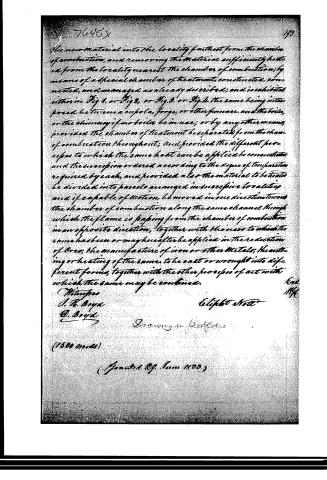
The new material into the locality farthest from the chamber of combustion, and removing the material sufficiently heated from the locality nearest the chamber of combustion, by means of a special chamber of treatment, constructed, connected, and managed as already described; and is exhibited either in Fig 1. or Fig 3, or Fig 3. or Fig 4. the same being interposed between a cupola, forge, or other furnace and the boiler, or the chimney if no boiler be in use; or by any other means, provided the chamber of treatment be separated from the chamber of combustion throughout; and provided the different processes to which the same heat can be applied be consecutive and the succession ordered according to the degree of temperature required by each, and provided also the material to be treated be divided into parcels arranged in successive localities and if capable of motion, be moved in one direction towards the chamber of combustion along the same channel through which the flame is passing from the chamber of combustion in an opposite direction, together with the uses to which the same has been or may hereafter be applied in the reduction of ores; the manufacture of iron or other metals; the melting or heating of the same to be cast or wrought into different forms, together with the other processes of art with which the same may be combined.
Witnesses
J. W. Boyd
D. Boyd
Eliphet Scott
Drawing on Backside
(1500 words)
(Granted 29. June 1833)
Published accounts: journal notice
Notice in the monthly list of patents, with remarks
Journal of the Franklin Institute, new ser., vol. 12 (1833), p. 407 · View the page
36. For improvements in the treatment of metallic bodies, and of bodies generally, as well those that admit of motion while under treatment, as those that require to be at rest; Eliphalet Nott, Schenectady, New York, June 29.
Remarks. (See the specification.)
Published accounts: journal notice
Notice in the monthly list of patents, with remarks
Journal of the Franklin Institute, new ser., vol. 12 (1833), p. 423 · View the page
Specification of a patent for improvements made in the treatment of metallic bodies generally; as well those that admit of motion while under treatment, as those which require to be at rest. Granted to ELIPHALET NOTT, Schenectady, New York, June 29, 1833.
Remarks. It having been discovered that metallic bodies oxidize less when exposed to the action of the products of combustion, than when exposed to the action of the elements of combustion; and it also having been discovered that contiguous bodies at different temperatures, and Norr's Management of Heat. moving in opposite directions, exchange temperatures, therefore certain improvements for carrying these discoveries into effect have been made: which improvements consist;--In preventing the oxidizing of metallic bodies by treating the same in all cases in a chamber separate from the chamber of combustion: and in economising the expenditure of heat generally by concentrating the processes to which the same can be conveniently applied; and in arranging the whole in a series according to the degree of temperature required in each, always proceeding from the greater to the less, and in dividing the material to be treated into portions, and arranging the same in successive localities, and in passing the same (so far as they admit of being moved from one compartment to another) towards the chamber of treatment along the same channel through which the flame is caused to escape therefrom, and to act as it escapes on successive bodies under treatment, till the whole available temperature has been expended before the same enters the chimney; all of which is effected either by means of a vertical reverberatory, or zig zag chamber of treatment, consisting of a series of compartments separated by solid and fixed floors, more or less inclined and arranged one above another, and furnished with appropriate rests or ways, for sustaining incumbent bodies under treatment, and for passing the same down to the next locality when treated; and furnished also with apertures for inspection, and for the ingress and egress of bodies, and the introduction of the requisite instruments for adjusting and removing the same-or by means of a vertical, reverberatory chamber of treatment, consisting, in like manner, in a series of compartments arranged one above another, and separated by floors in part solid and fixed, and in part open and movable, either by levers, or eccentric axes, piercing the crust and worked from without, in such manner, that the contents of each superior compartment can at pleasure be passed down into the next inferior compartment; or by means of a vertical chamber of treatment without reverberations, consisting in like manner of a series of compartments arranged one above another and separated by floors, more or less open, and wholly movable, either by eccentric or by central axes, piercing the crust, and worked as aforesaid, from without, in such manner that the contents of each superior compartment can be emptied by a revolution of its floor into the compartment under it:-which several chambers of treatment must be connected, each at its lower extremity, with the outlet for flame from the chamber of combustion; or with the outlet for flame from a cupola, having an inlet for flame thereto from a separate chamber of combustion; or with a cupola, or other furnace, constructed in the usual manner: and each must also be connected at its upper extremity with an additional section of a horizontal chamber of treatment exhibited in one or more channels for the application of the surplus heat in the treatment of additional bodies requiring lower temperatures, as pit coal and rosin contained in retorts for the production of gas: and water in boilers for the generation of steam, to be employed for driving an engine, and thereafter for heating additional water for drying, bleaching, or any other process. BALDWIN'S Manufacture of Wheels.
DATAMP: illustration
Illustrations from DATAMP

DATAMP (Directory of American Tool and Machinery Patents), via the Internet Archive · Archived DATAMP page
About this record
- Patentee
- DATAMP
- Date
- DATAMP, USPTO records, Burke's List of Patents (1847)
- Invention
- DATAMP
- Listed in
- the Name and Date index of patents, DATAMP, USPTO records, Jim Shaw's X-patent list, the Journal of the Franklin Institute, Burke's List of Patents (1847)
- The sources give different dates; the date shown is the one most of them agree on.
- The Franklin Institute's journal confirms the date shown.
- Burke's 1847 Patent Office list gives the same patent.