

Drawings and documents
National Archives restored drawings: drawing
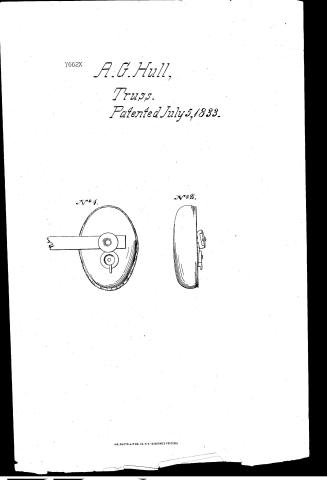
Amos G. Hull's Patent Drawing for an Improvement in the Truss

National Archives, Restored Patent Drawings (Record Group 241) · Full-size scan at the National Archives · Catalog record
Show the text on the drawing Hide (146 words)
Words on the drawing as machine-read by the National Archives; not checked. Useful mainly for searching.
trusses SURGERY. - Surg / 156] Trusses / 75 / CLASSIFICATION / 7662-+ / DIVISION / AMOS, G,HULL'S / Improvement in the Truss. / Patented 5 "July 1833. / N°1. / N°2. / No. / and ? represents the upper Surface of the Varicocle Isad yelaw- re / 3 w the button head through which the spring Masey 4 5 and 6. / presents Ourcular wedge with an inclined laced Theame cut shoulder refrow the marg the / button head of a revolution on its fivot g-has the affects levate / which of this wedge being the upon to of / it and thereby Cause the plane of the Spring to make an angle / with the plane of the frad plate. 7. and 8 represents @ fronte / N2, of Referevents the steel Spring ablede crew of the Bultow head and Wedge shewing / the paint and mode of changing the prodition of the spad by / the wedge
USPTO scan
The patent as scanned by the USPTO
-
 Page 1
-
 Page 2
-
 Page 3


U.S. Patent and Trademark Office · Google Patents
Show the transcription Hide (767 words)
Machine transcription (LightOnOCR) of the pages as scanned by the USPTO, most of them the handwritten copies made when the records were restored after the 1836 fire. Not checked; it can misread handwriting, so compare it with the scan.
Page 1.
7662X
A.G. Hull,
Truss.
Patented July 5, 1833.
No. 1.
No. 2.
A.M. PHOTO-LITHO. CO. N.Y. (OSBORNE'S PROCESS)
Page 2.
July 5, 1833
Amos G. Hull.
Letters Patent.
The Schedule referred to in these Letters Patent, and making part of the same, containing a description in the words of the said Amos G. Hull himself, of his improvement in the surgical instrument called the Buss, to be used in varicocele, and in some cases, of General, or Scrotal Hernia.
This improvement is intended particularly for the cure of varicocele which is an enlargement of the blood vessels connected with the spermatic chord. In the application of the Buss to this disease, the object is to compress the enlarged blood vessels, so as nearly to close up their calibre. For which purpose, the disease vessels which lie in the cavity of the scrotum, the bag containing the testicles must be gathered and raised up under the integuments, and brought opposite the abdominal ring when they may be subjected to pressure by applying the pad directly upon them. The form and structure of the parts to which the pad is applied in case of varicocele, are such that a flat or even concave pad may be used with success. The lower portion of the pad might too press upon the bone called in books of anatomy "os pubis" at that place where the spermatic chord runs over that bone, it is essential to the successful application of this instrument, that the degree of pressure made upon the chord should be diminished or increased by the patient according to his sensations in the seat of the disease it being important to avoid injury to the nerve while it is indispensable, however, to make pressure sufficient to prevent the swelling of these blood vessels, which constitutes the disease. To accomplish this object, a continuation has been made by this applicant which is to be used in connection with the instrument for which his affidavit was heretofore bearing date August 7th, A.D. 1831, or an instrument conforming thereto, the parts thereof the most important of which is the manner
Page 3.
7/5/1833 7662x
connection of the spring to the pad by means of a metallic head or button thereon, which is attached to the spring, and the pivot passing through the pad plate, upon which the button is movable to admit of the movement of the spring, and the means by which the planes of the steel spring, and the plates may be inclined, to each other at different angles with one another. In addition, if combined with a joint or joint motion upon the principle described in the before mentioned Patent of this applicant. The parts before described, this applicant has added a circular wedge, the operation of which is to depress the lower portion of the pad, which is applied to the varnished. This wedge is a metallic plate of 3/4 inch in diameter & 1/4 of an inch in thickness on the upper surface of which the margin is cut away to form a spiral inclined plane; of about one eighth of an inch in width. It is placed on the pad plate at such distance from the center as to bring the margin of the wedge, which forms the inclined plane under the button head and is attached to the pad plate by a sort of screw or screw round which it revolves like a wheel round its axle by revolution of this circular wedge, the plane of the spring to which the pad is attached is made to form an angle with the plane of the pad of from one to twenty five degrees. By this feature the patent is enabled to increase or diminish the pressure of the leverage of the pad which produces upon the formation of the varnish of his case may require. For a more explicit understanding of this construction, reference is made to the drawing of the circular pad here annexed which is to be taken as a part of this specification. The feature in the specification described may also be applied with success in some cases of Shiner & Sootal thorns, when it is necessary to vary the degree of pressure more than can be done by the instrument commonly used in those kinds of thorns.
New York June 8th 1833
Witness
Shiner S. Hutt
(On in portfolio)
754
Published accounts: journal notice
Notice in the monthly list of patents
Journal of the Franklin Institute, new ser., vol. 13 (1834), p. 26 · View the page
(Some remarks on this patent will appear in the next number.) 2, For an improvement in the Truss for Varicocele; Amos Hull, city of New York, July 5.
About this record
- Patentee
- DATAMP
- Date
- the Name and Date index of patents, DATAMP, USPTO records
- Invention
- DATAMP
- Listed in
- the Name and Date index of patents, DATAMP, USPTO records, Jim Shaw's X-patent list, the Journal of the Franklin Institute, Burke's List of Patents (1847)
- Burke's 1847 Patent Office list gives the same patent.