

Drawings and documents
USPTO scan
The patent as scanned by the USPTO
-
 Page 1
-
 Page 2
-
 Page 3
-
 Page 4


U.S. Patent and Trademark Office · Google Patents
Show the transcription Hide (1,178 words)
Machine transcription (LightOnOCR) of the pages as scanned by the USPTO, most of them the handwritten copies made when the records were restored after the 1836 fire. Not checked; it can misread handwriting, so compare it with the scan.
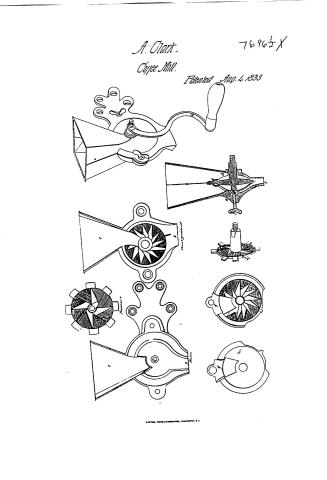
Page 1.
A. Clark.
Coffee Mill.
Patented Aug. 4, 1833
7696½X
E. PETER, PHOTO-LITHOGRAPHER, WASHINGTON, D.C.
Page 2.
8/14/1833 7696½x
Aug. 14, 1833
Ammi Black's Coffee Mill
Letters Patent
The Schedule refers to in these Letters Patent an accompanying part of the same containing a description in the words of the said Ammi Black himself of his improvement in the Coffee Mill.
Be it known that Ammi Black of Boston in the county of Westford and State of Massachusetts have invented a new and useful improvement in machinery for grinding coffee and other substances, and that the following is an exact description of the same as invented or improved by one. The mill thus improved may consist of five pieces. First: The back part which is composed of the back shell, the half of the hopper, the plate, the ears and one half of the spout. Secondly: The back grinder which is movable and of a conical concave form, of a size suited to the back shell (and resting with its concave side on the concave side of the back shell). Thirdly: A convey-convey runner with grinding teeth, on both sides, having an axle with bearings at both ends, with a flange on the grinding, and divided as herein after specified. Fourthly: The front grinder of a conical concave form, from which extends the front half of the hopper, spout, and ears. Fifthly: The circular segment curved so as to form a bead on one side, and a flute on the other with an ear by which it is secured or otherwise attached to the back.
Sixthly: The back shell is concave on one side, and convex on the other, with a circular flute, on the outer circle to admit the corresponding bead, on the back grinder, and the guard rim of the same, to a depth nearly of the thickness of the flange, segment, on the runner within the outer circle of the shell. The circular flute of the back shell is cut away, on the upper side, sufficiently to admit the back half of the hopper, the lower part which projects on the concave surface of the shell, below the circular flute, a competent length, to prevent the substance to be ground, from passing between the grinder and the shell. The back grinder, being for convenience as the second piece has a grinding surface on the concave side, with a circular flute turning the grinding surface, will run against about one third of the grinding face.
Page 3.
7696 ½x
between which is open. The outer edge of this flate from the grainer rim, which is true, the same distance on the periphery of the flate. On the upper side of the back grainer, where it passes through the hopper and above the grainer rim is a small projection, about half the thickness of the flange, on the inner, to which projection is attached, an ear. Between the circular flate, and the center of the back grainer, near the upper side thereof, is an opening sufficient to admit the lower extremity of the hopper, where it projects as a forepart on the surface of the back shell, and to permit the substance to be ground to pass to the runner.
The flange of the inner grainer, is not continuous, but separated into segments at convenient distances from each other, and extends from the edge of the grainer rim, across the circular flate, so as to bear upon the grainer rim, and prevent the graining surfaces from wearing each other, while it facilitates the cleaning of the mill. The inner, a concave surface of the front grainer, is similar to the inner, a concave surface of the back grainer, then this front grainer extends in their proper places, one half of the front, one half of the hopper, and the ears by which the mill is secured together. On the outer edge of the circular grainer, and projecting a little beyond it, is another circular rim, corresponding with a like rim, on the back shell and applying there, when the mill is fastened together. The hopper being inserted near the upper side, makes a breakage or vacancy in the circular flate. The circular segment, with a flate, and bead, being, to be inserted, as the fifth piece, fills out and supplies this vacancy, making by its insertion the circular flate, continuous through the hopper. The mill is regulated by means of a screw, passing through the center of the back shell, and pressing against the back grainer, more or less, as the substance to be ground may require. The mill, stands of course in a vertical position, and is turned by a crank.
The mill above described, consists of five pieces, but the arrangement is applicable to mills having a greater or less number of pieces than five, and the forms may be various. For example, a mill may be made with the flate, on the front grainer, and a step or bar of iron, to fit the back grainer, to supply the place of a back shell, with a grainer on the back grainer, or to admit the back half of the hopper, or a mill may be made with the hopper separate from the front grainer, a space being left thereon to admit
Page 4.
7696½X
a part of the hopper with one near the top, though to secure the parts together, and on this form the circular flutes can be continued through the hopper into the circular segment, as in the mill herein first described; or, the part of the circular flutes of the back grinder, passing through the hopper (and equal in size to the circular segment) may be made separate from the grinder, and inserted therein, being screwed to the circular segment, or the said part of the said circular flutes, and the circular segment may be united and made a whole circular piece, so that in either case the segments of the flange will pass through a continuous circular flute. In the mill may be cast, as to be applied to a board with a hopper of tin or any suitable material. The present specification describes an improvement of the double mill, for grinding coffee, for which I have already obtained Letters Patent. The pieces, comprising this double mill, and improvement, are of cast iron, but may be made of any other suitable materials.
I claim herein as my invention or improvement the following things, namely, the carrying of the circular flute, and the grains run through or over the hopper and the application to mills for grinding coffee and other substances, of the flange or the runner, separated into segments at convenient distances from each other as herein before described. Dated at Berlin, aforesaid this 17th day of June A.D. 1833.
Witnesses
Leon Dames
S. H. Bullsey
H. M.
(1162-1833)
Published accounts: journal notice
Notice in the monthly list of patents, with remarks
Journal of the Franklin Institute, new ser., vol. 13 (1834), p. 117 · View the page
The main objection to a chisel of this description is the extreme difficulty of keeping it in order, a difficulty which the practical workman will readily perceive; but for this it would undoubtedly operate well. It should have been observed, that the cutting edge of the added side, is above that of the main cutting chisel, and that the side cutters, of course, slope up to it, the whole face forming an inclined plane. 20. For a Coffee Mill; Ammi Clark, Berlin, Hartford county, Connecticut, August 14.
Remarks. This patent is for an improvement on the double mill for which a patent was obtained by Mr. Clark, at a former period. The double mill has flutes, or teeth, on both sides of the runner, and the improvement now patented consists in the manner in which what is called the circular flute, and the guard rim, are formed: the claim is in the following words"I claim herein as my invention or improvement, the following things merely; to wit, the carrying of the circular flute and the guard rim, through, or across, the hopper; and the application to mills for grinding coffee, and other substances, of the flanch on the runner, separated into segments at convenient distances from each other."
About this record
- Patentee
- the Journal of the Franklin Institute, Journal
- Date
- the Name and Date index of patents, USPTO records
- Invention
- the Name and Date index of patents
- Listed in
- the Name and Date index of patents, USPTO records, the Journal of the Franklin Institute, Burke's List of Patents (1847)
- The Name and Date index has a note on this number.
- The patentee's full name comes from the Franklin Institute's journal.
- The residence comes from the Franklin Institute's journal.
- The Franklin Institute's journal gives a different date.
- Burke's 1847 Patent Office list gives the same patent.
- Burke's 1847 Patent Office list gives a slightly different date; the date shown follows the standard lists.