

Drawings and documents
USPTO scan
The patent as scanned by the USPTO
-
 Page 1
-
 Page 2
-
 Page 3
-
 Page 4


U.S. Patent and Trademark Office · Google Patents
Show the transcription Hide (621 words)
Machine transcription (LightOnOCR) of the pages as scanned by the USPTO, most of them the handwritten copies made when the records were restored after the 1836 fire. Not checked; it can misread handwriting, so compare it with the scan.
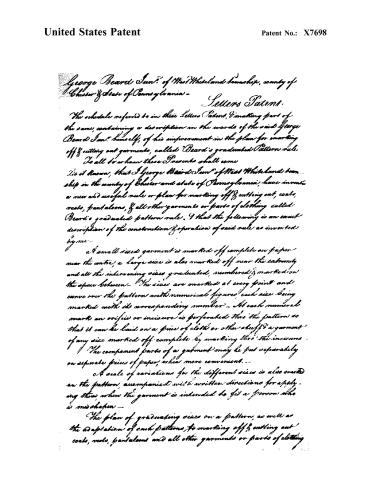
Page 2.
United States Patent
Patent No.: X7698
George Beard, Jr. of West Whiteland Township, county of Chester & State of Pennsylvania
Letters Patent.
The schedule referred to in these Letters Patent, & making part of the same, containing a description in the words of the said George Beard, Jr. himself, of his improvement in the plan for marking off & cutting out garments, called “Beard’s graduated Pattern rule.”
To all to whom these Presents shall come
Be it known, that I George Beard, Jr. of West Whiteland Township in the county of Chester and state of Pennsylvania, have invented a new and useful rule or plan for marking off & cutting out, coats, vests, pantaloons, & all other garments or parts of clothing called Beard’s graduated pattern rule. & that the following is an exact description of the construction & operation of said rule as invented by me—
A small sized garment is marked off complete on paper near the centre; a large size is also marked off near the extremity and all the intervening sizes graduated, numbered & marked on the space between. The sizes are marked at every point and curve over the pattern with numerical figures, each size being marked with its corresponding number. At each numeral mark an orifice or incision is perforated thro’ the pattern so that it can be laid on a piece of cloth or other stuff & a garment of any size marked off complete by marking thro’ the incisions.
The component parts of a garment may be put separately on separate pieces of paper, when more convenient.
A scale of variations for the different sizes is also marked on the pattern, accompanied with written directions for applying them, when the garment is intended to fit a person who is misshapen.
The plan of graduating sizes on a pattern, as well as the adaptation of such patterns, to marking off & cutting out coats, vests, pantaloons and all other garments or parts of clothing
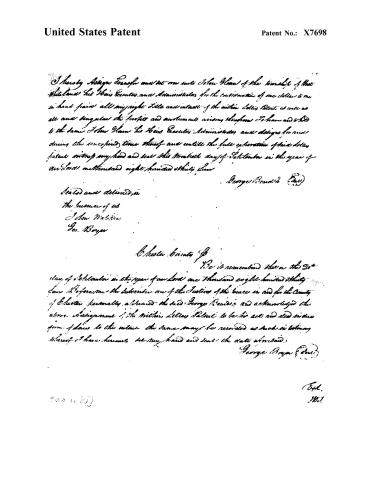
Page 3.
United States Patent
Patent No.: X7698
I hereby Assign Transfer and set over unto John Glenn of the township of Westland his heirs Executors and Administrators for the consideration of one dollar to me in hand paid all my right Title and interest of the within Letters Patent as well as all and singular the profits and emoluments arising therefrom To have and to hold to the same John Glenn his heirs Executors Administrators and assigns for ever during the unexpired time thereof and until the full expiration of said Letters Patent witness my hand and seal this twentieth day of September in the year of our Lord one thousand eight hundred thirty four
George Boudin (Seal)
Sealed and delivered in the presence of us
John Watkins
Geo. Boyer
Chester County Pa
Be it remembered that on the 20th day of September in the year of our Lord one thousand eight hundred thirty four before me the subscriber one of the Justices of the peace in and for the County of Chester personally appeared the said George Boudin and acknowledged this above Assignment of the within Letters Patent to be his act and deed in due form of law to the intent the same may be recorded as such in testimony whereof I have hereunto set my hand and seal the date aforesaid.
George Boyer (Seal)
Exh.
M.1
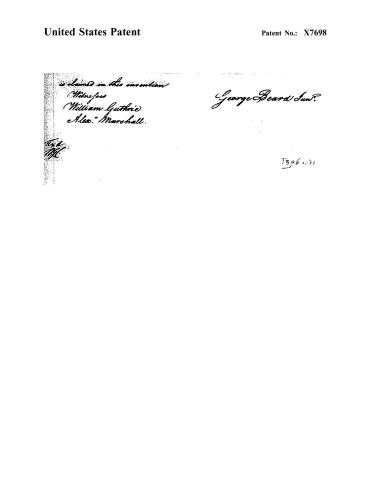
Page 4.
United States Patent
Patent No.: X7698
is claimed in this invention
Witnesses
William Guthrie
Alex. Marshall.
George Beard Junr.
1396 (1.2)
Published accounts: journal notice
Notice in the monthly list of patents, with remarks
Journal of the Franklin Institute, new ser., vol. 13 (1834), p. 111 · View the page
4. For a plan for Marking off and Cutting Garments, called " Beard's Graduated Patent Rule;" George Beard, jr., Whiteland, Chester county, Pennsylvania, August 5.
Remarks. A small sized garment is to be marked on the middle of a piece of paper, and a large sized one at its extremities. The intermediate space is to be occupied by the requisite number of intermediate sizes. The pattern is to be perforated with "orifices or incisures," made through at each pattern, so that it can be laid on the cloth, and marked through, for a garment of any size. We are informed also that "the component parts of a garment may be put separately on separate pieces of paper, when most convenient" "The plan of graduating sizes on a pattern, as well as the adaptation of such patterns to marking off, and cutting out, coats, vests, and pantaloons, and all other garments and parts of clothing, is claimed as this invention." We suppose, that, hereafter, the women must call with their patterns, upon the patentee, and have them stamped, in due form; not for coats, vests, and pantaloons only, but for all other garments. The patentee must, we imagine, have made the notable discovery that not only men and women, but men and boys, are all made to one scale, in length, breadth, and thickness; a thing which had never before been dreamed of, and which, if correct, must lead to very important results. We see no reason, if this be the fact, why by sending to the taylor the exact length of the leg, or of any other member, we may not, without further trouble, have a suit of clothes made with mathematical precision.
About this record
- Patentee
- DATAMP
- Date
- the Name and Date index of patents, DATAMP, USPTO records
- Invention
- DATAMP
- Listed in
- the Name and Date index of patents, DATAMP, USPTO records, Jim Shaw's X-patent list, the Journal of the Franklin Institute, Burke's List of Patents (1847)
- Burke's 1847 Patent Office list gives the same patent.