

Drawings and documents
National Archives restored drawings: drawing
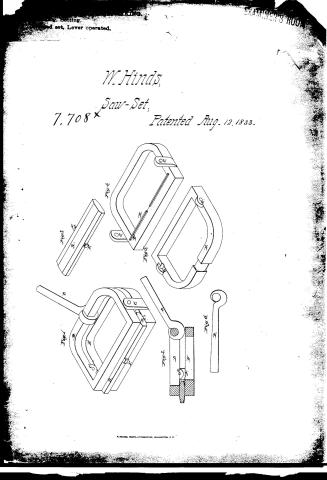
William Hinds' Patent Drawing for a Saw Set

National Archives, Restored Patent Drawings (Record Group 241) · Full-size scan at the National Archives · Catalog record
Show the text on the drawing Hide (112 words)
Words on the drawing as machine-read by the National Archives; not checked. Useful mainly for searching.
o 156 p / 76. Metal Topls and Implements, Making, / Saw Clamps. / Inttiam Hinds / Tol.16.p467. 46% / CLASSIFICATION / law Let, / 7708-X / Patented 12 aught 1893, / DIVISION. / Fig.1. / Fig.3, / RYC / D' / OC / Fight / D' / Fig.5. / or / Fig 2 / II / D' / Fig.6 / Patert offer Dee 9.1841 / Fid1. References. Saw set. Fig.2. section, / Mach undu the direction of the Commision of Patients / Fig 3 "formule". Fir.4. under. D. / Fig.5. upper.- D. Eig.6. lever, / in conforming with act fleon grep 3 March 1834 / A. formale. B. lever, C joint. / D.D' upper &. under "D." Enguide, / It Ellnoith / E.hnobor or spurr, / Commits your of Patents,
USPTO scan
The patent as scanned by the USPTO
-
 Page 1
-
 Page 2
-
 Page 3
-
 Page 4


U.S. Patent and Trademark Office · Google Patents
Show the transcription Hide (792 words)
Machine transcription (LightOnOCR) of the pages as scanned by the USPTO, most of them the handwritten copies made when the records were restored after the 1836 fire. Not checked; it can misread handwriting, so compare it with the scan.
Page 1.
W. Hinds,
Saw-Set,
7,708
Patented Aug. 12, 1833.
Page 2.
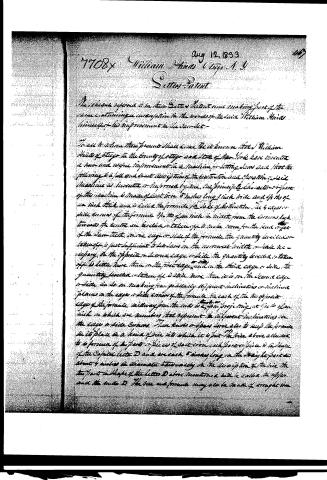
Aug 12, 1833
17708x William Hinds Utica N.Y.
Setten Patent
The scheme referred to in the Setten Patent now making part of the same containing an inscription to the words of the said William Hinds himself of his improvement in the Saw-Set.
To all to whom these presents shall come, He it known that I William Hinds of Utica in the County of Otsego and State of New York have invented a new and useful improvement in a machine for setting saws and that the following is a full and exact description of the construction and operation of said machine as invented or improved by me, the principle character or part of the machine is made of cast iron 5 inches long 1 inch wide and 1/4 of an inch thick and is called the formula plate or table of distinction. The 4 upper or side corners of the formula plate are four inches in width from the corners back towards the centre are bevelled or taken off to make room for the head or feet of the saw teeth, on one edge or side of the formula plate quantity described or taken off is just sufficient to set saws on the narrowest width or side necessary, on the opposite or second edge or side the quantity described or taken off is little more than on the first edge, and on the third edge or side the quantity described or taken off is still more than it is on the second edge or side and so on making four gradually different inclinations or inclined planes on the edge or side corners of the formula plate each of the two opposite edges of the formula plate away from the ends is a four projecting at 45 degrees from such as which are numbers that represent the different inclinations on the edge or side corners. Two kinds or parts serve also to keep the formula in its place in a kind of vice into which it is put. The vice above alluded to is formed of two parts or pieces of cast iron each part or piece is in shape of the capital letter D and are each 5 inches long on the straight part and about 4 inches in diameter transversely. In the description of the vice the two parts in shape of the letter D above mentioned are called the upper and the under D. The vice and formula may also be made of wrought iron.
Page 4.
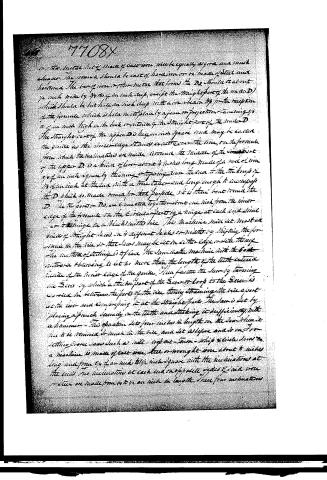
No 87
I have made in the manner before described to detach and remove different scales or skins from the horn or antler to the desired extent, using the principle of using the last described machine is to place it on a truck and place the skin to be removed on the inclined bed and strike the same with a hammer, or if the same is fast in any machine or vice the machine for setting can be held firmly against the skin to be removed as before. The invention or discovery of every part of the machine above specified and described (except the punch to be used in the same) has been made by me, the said William Hicks, in time the knowledge of any machine being in use or patented having any similarity to it, but from information since received it appears probable that a machine similar to this is now in use, especially the part called the "mule," and patented to John Simmons of Philadelphia in 1846, in case of which the invention of the said machine is above specified and described is claimed as an improvement. The invention or discovery of the improvement in the different form or construction hereinafter described to which said machine may be made is also claimed. That a different lever may be made to turn one part or one part of the tree that by turning said levers between the parts of the tree and strain them apart the same as the other levers, or the parts of the tree and strain them apart the same as the other levers, or the parts of the tree may be strained apart by a screw that will draw through one part of the tree and against the other part.
Signed the tree may be made in a different form instead of cast or wrought iron, the parts may be drawn together by a screw or lever in the centre near the handle.
Witnesses
John Jones
George O'Leary
(448 words)
(Patented August 12, 1859)
Published accounts: journal notice
Notice in the monthly list of patents, with remarks
Journal of the Franklin Institute, new ser., vol. 13 (1834), p. 115 · View the page
15. For a Machine for Setting Saws; William Hinds, Otsego, Otsego county, New York, August 12.
Remarks. We shall not undertake to describe the particular form given to this saw set, as it could not be well done without a drawing. The patentee says that he invented it in all its parts, but that he has been since informed that a patent for one very similar to it was obtained in the year 1812, by John Summers, of Pennsylvania; in which case he means only to claim his as an improvement. This does not appear to fulfil the demands of the law, that the inventor should tell in what his improvement consists; a point which he ought definitely to have ascertained before claiming a patent.
DATAMP: illustration
Illustrations from DATAMP
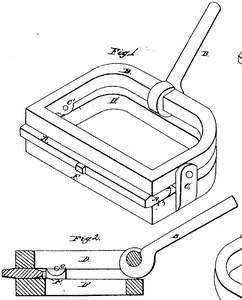

DATAMP (Directory of American Tool and Machinery Patents), via the Internet Archive · Archived DATAMP page
About this record
- Patentee
- DATAMP
- Date
- the Name and Date index of patents, DATAMP, USPTO records
- Invention
- DATAMP
- Listed in
- the Name and Date index of patents, DATAMP, USPTO records, Jim Shaw's X-patent list, the Journal of the Franklin Institute, Burke's List of Patents (1847)
- Burke's 1847 Patent Office list gives the same patent.