

Drawings and documents
National Archives restored drawings: drawing
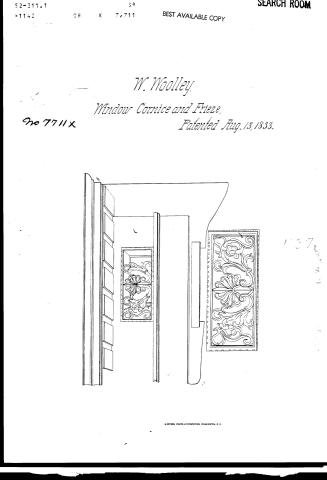
William Woolley's Patent Drawing for a Frieze Window Covering

National Archives, Restored Patent Drawings (Record Group 241) · Full-size scan at the National Archives · Catalog record
Show the text on the drawing Hide (65 words)
Words on the drawing as machine-read by the National Archives; not checked. Useful mainly for searching.
Patd. aug. 13. 1833. / CARPENTRY. / WILLIAMS WOOLLEY'S / #7711 How X / FRIEZE-WINDOWCOVERING / 20. CARPENTRY, / Shutters. / CLASSIFICATION / 7711x / DIVISION. ad / Pat aug 13-1833 / of / XXXX / ALL / EX / OF / 11 / 11 / BY / BY / LA / 11 / Explanations / A. Represents the shade or blind / B. The Cornize / C. The Frieze / F.B.del: F.B. delt. / Irairing madifro the Datent
USPTO scan
The patent as scanned by the USPTO
-
 Page 1
-
 Page 2
-
 Page 3


U.S. Patent and Trademark Office · Google Patents
Show the transcription Hide (411 words)
Machine transcription (LightOnOCR) of the pages as scanned by the USPTO, most of them the handwritten copies made when the records were restored after the 1836 fire. Not checked; it can misread handwriting, so compare it with the scan.
Page 1.
W. Woolley
Window Cornice and Frieze
Patented Aug. 13, 1833.
No 7711X
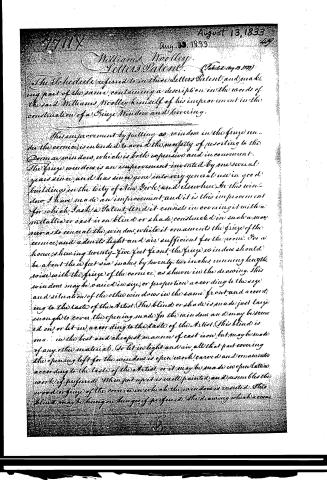
Page 2.
August 13, 1833
William M. Woolley.
Letters Patent. (Patented Aug 13, 1833)
The Schedule referred to in these Letters Patent, and making part of the same, containing a description in the words of the said William M. Woolley himself of his improvement in the construction of a Frize Window and covering.
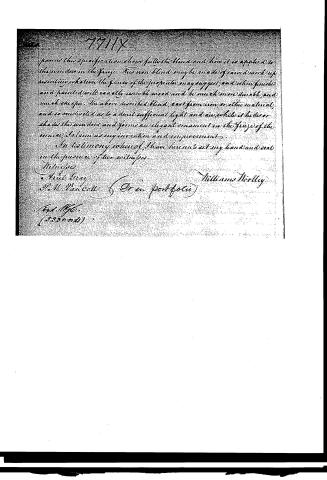
This improvement by putting a window in the frize under the cornice, is intended to avoid the necessity of resorting to the Dormer window, which is both expensive and inconvenient. The frize window is an improvement invented by me several years since, and it has since gone into very general use in good buildings in the city of New York, and elsewhere. In this window, I have made an improvement, and it is this improvement for which I ask a Patent, and it consists in covering it with a metallic or cast-iron blind or shade, constructed in such a manner as to conceal the window, while it ornaments the frize of the cornice, and admits light and air sufficient for the room. For a house, showing twenty-five feet front, the frize window should be about three feet six inches by twenty-two inches running lengthwise with the frize of the cornice, as shown in the drawing. This window may be varied in size, or proportion according to the size and situation of the other windows in the same front, and according to the taste of the Artist. The blind or shade is made just large enough to cover the opening made for the window and may be screwed on, or let in, according to the taste of the Artist. This blind is made in the best and cheapest manner of cast iron, but may be made of any other material. To let in light and air, all that part covering the opening left for the window is open work, carved and ornamented according to the taste of the Artist, or it may be made in open lattice work, if preferred. When put up, it is well painted, and resembles the wood or frize of the cornice in which the window is inserted. This blind may be hung on hinges, if preferred. The drawing which accompanies
Published accounts: journal notice
Notice in the monthly list of patents, with remarks
Journal of the Franklin Institute, new ser., vol. 13 (1834), p. 116 · View the page
16. For a Frieze Window; William Woolley, city of New York, August 13.
Remarks. The patentee states that he some years since invented the frieze window, as a substitute for the dormar window, and that it has gone into extensive use in many of the best houses in New York. It receives its name from being inserted in the frieze, under the cornice, and the present patent is taken for an improvement in the mode of fitting up, or finishing, such windows. For a house of ordinary size, the opening in the frieze may be three feet six inches in length, by twenty-two inches in height. This is to be covered with an ornamental fret work, which may be made of cast iron; and this, when painted white, will appear like an ornament to the frieze, whilst it will admit sufficient light through the frets, and conceal the sash behind it. "The above described blind, cast from iron or other material, and so constructed as to admit sufficient light and air, while it hides or shades the window, and forms an elegant ornament in the frieze of the cornice, I claim as my invention and improvement."
About this record
- Patentee
- DATAMP
- Date
- the Name and Date index of patents, DATAMP, USPTO records
- Invention
- DATAMP
- Listed in
- the Name and Date index of patents, DATAMP, USPTO records, Jim Shaw's X-patent list, the Journal of the Franklin Institute, Burke's List of Patents (1847)
- Burke's 1847 Patent Office list gives the same patent.