

Drawings and documents
National Archives restored drawings: drawing
George Page's Patent Drawing for a Cutting and Cleaning Chisel

National Archives, Restored Patent Drawings (Record Group 241) · Full-size scan at the National Archives · Catalog record
Show the text on the drawing Hide (93 words)
Words on the drawing as machine-read by the National Archives; not checked. Useful mainly for searching.
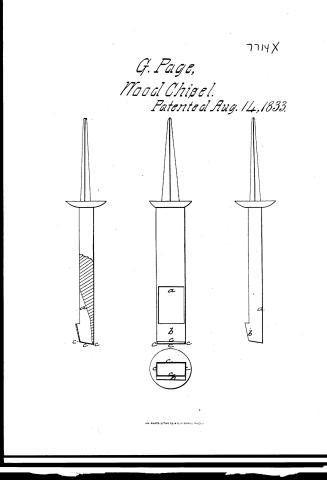
ENE 145. WOOD-WORKING TOOLS. / Sools / [173] / Chisels. / mise Joses / Giorge Page / cutting & cleaning chisel. / Vol. Vol.iq.pz.265 17.ps.265 / Patented aug 14. 1833. / CLASSIFICATION / 7714-X / DIVISION. / Front / view / C... / Section / side view. / Bottom view / Preferences. a /see section) main part of the chisel. B the box. C.C.C.E cutting edges. / Patent office September 10th th 1841. / made under the direction of the Commisioner of Patents / in conformity with act of 3ᵈ march 183% / ch L. Glinhmans fect. / Mengh Sumoth / of Patents
USPTO scan
The patent as scanned by the USPTO
-
 Page 1
-
 Page 2
-
 Page 3


U.S. Patent and Trademark Office · Google Patents
Show the transcription Hide (655 words)
Machine transcription (LightOnOCR) of the pages as scanned by the USPTO, most of them the handwritten copies made when the records were restored after the 1836 fire. Not checked; it can misread handwriting, so compare it with the scan.
Page 1.
7714X
G. Page,
Wood Chipel.
Patented Aug. 14, 1833.

AM PHOTO-LITHO CO. N.Y. (M'ROHNE & PRICES.)
Page 2.
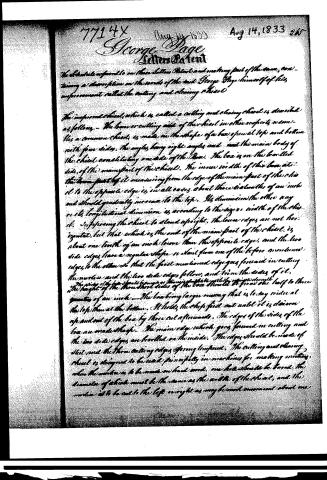
The specification referred to in these Letters Patent and making part of the same, containing a description in the words of the said George Page himself of his improvement called the cutting and cleaning chest.
The improved chest, which is called a cutting and cleaning chest, is described as follows: The box or cutting case of this chest in other respects resembles a common chest; is made in the shape of a box open at top and bottom with four sides, the angles being right angles and with the main body of the chest constituting one side of the box. The box is on the broadest side of the main part of the chest. The inner width of this box at the broadest part of it measuring from the edge of the main part of the chest to the opposite edge is, in all cases, about three and a half inches and should gradually increase to the top. Its dimensions the other way or its longitudinal dimension is, according to the size or width of the chest. Supporting the chest to stand upright, the lower edges are not horizontal, but that which is the end of the main part of the chest is about one tenth of an inch lower than the opposite edge, and the two side edges have a regular slope so that from one of the before mentioned edges to the other so that the first mentioned edge goes forward in cutting the motion and the two side edges follow, and from the sides of it.
The height of the three short sides of the box should be from one half to three quarters of an inch. The box being larger in way that is to say wider at the top than at the bottom. It holds the shape first cut until it is drawn up and out of the box by those cut afterwards. The edges of the sides of the box are made sharp. The main edge which goes forward in cutting and the two side edges are bevelled on the inside. The edges should be made of steel and the three cutting edges forming tempered. The cutting and cleaning chest is designed to be used principally in machines for making matches, when the matches are to be made on hand work, one hole should be bored, the diameter of which must be the same as the width of the chest, and the motion is to be set to the left or right as may be most convenient about one
Page 3.
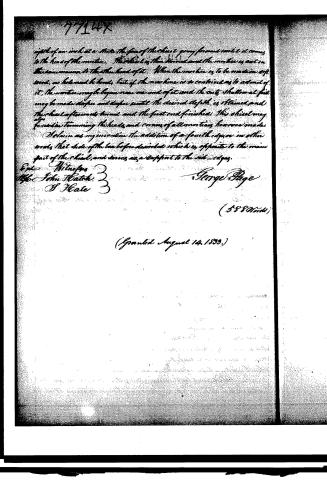
eight of an inch at a stroke the face of the chisel going forward until it comes to the head of the mortice. The chisel is then turned and the mortice is cut in the same manner to the other head of it. When the mortice is to be made in soft wood, no holmwood is used, but if the machine is so contrived as to admit of it, the mortice may be begun near one end of it and the cuts shallower at first may be made deeper and deeper until the desired depth is attained, and the chisel afterwards turned and the first end finished. This chisel may also be used in turning the heads and corners of all mortices however made.
I claim as my invention the addition of a fourth edge or in other words that side of the box before described which is opposite to the main part of the chisel, and serves as a support to the said edges.
George Page
(588 Words)
(Granted August 14, 1839.)
Published accounts: journal notice
Notice in the monthly list of patents, with remarks
Journal of the Franklin Institute, new ser., vol. 13 (1834), p. 117 · View the page
19. For a chisel, called the Cutting and Cleaning Chisel; George Page, Keene, Cheshire county, New Hampshire, August 14.
Remarks. This chisel is intended, principally, to be used with mortising machines, but may be employed for trimming mortises made by hand. It is not very clearly described, although we believe that we understand its construction. A drawing accompanies the specification, but it is without "written references." The main cutting part of the chisel is to be in the ordinary form, but it is to have a second cutting edge, or chisel, in front, and about three sixteenths of an inch in advance of it. These two parts are to be joined together by two sides, with cutting edges, so that the four sides form it into a quadrangular socket or box. The main cutting side, and the two side pieces are bevelled inwards, the other outwards. In hard stuff, a hole is to be bored, the diameter of which is equal to the width of the main chisel. In mortising, a chip of about one-eighth of an inch is to be cut, advancing towards each end of the mortise, which chips will be forced up, one before the other, through the socket. Chisels with three sides have, we believe, been used in mortising machines, and the claim in the present case is to "the addition of a fourth edge; or in other words, that side of the box before described, which is opposite to the main part of the chisel, and serves as a support to the side edges."
DATAMP: illustration
Illustrations from DATAMP

DATAMP (Directory of American Tool and Machinery Patents), via the Internet Archive · Archived DATAMP page
About this record
- Patentee
- DATAMP
- Date
- the Name and Date index of patents, DATAMP, USPTO records
- Invention
- DATAMP
- Listed in
- the Name and Date index of patents, DATAMP, USPTO records, Jim Shaw's X-patent list, the Journal of the Franklin Institute, Burke's List of Patents (1847)
- Burke's 1847 Patent Office list gives the same patent.