

Drawings and documents
USPTO scan
The patent as scanned by the USPTO
-
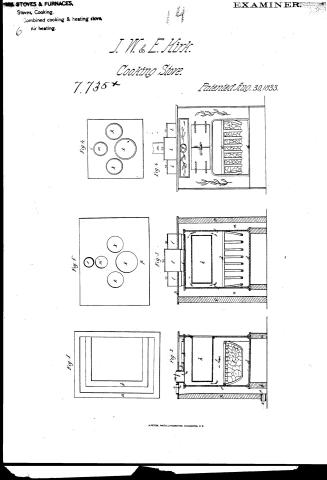 Page 1
-
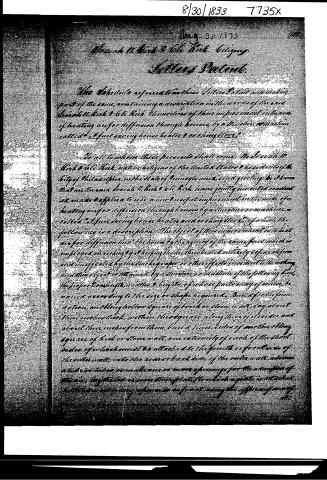 Page 2
-
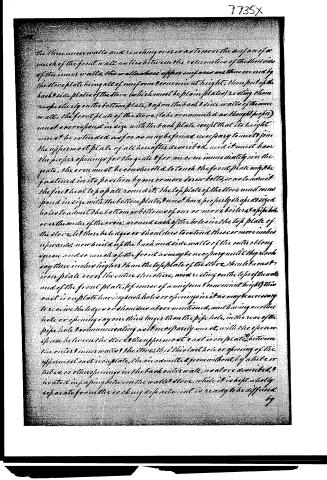 Page 3
-
 Page 4


U.S. Patent and Trademark Office · Google Patents
Show the transcription Hide (1,027 words)
Machine transcription (LightOnOCR) of the pages as scanned by the USPTO, most of them the handwritten copies made when the records were restored after the 1836 fire. Not checked; it can misread handwriting, so compare it with the scan.
Page 1.
STOVES & FURNACES.
Stoves, Cooking,
Combined cooking & heating stove.
6 Air heating.
J. W. & E. Kirk.
Cooking Stove.
7,735
Patented Aug. 30, 1833.
Fig. 4.
Fig. 6.
Fig. 5.
Fig. 3.
Fig. 1.
Fig. 2.
Page 2.
8/30/1833 7735X
Aug. 30 1833
Messrs. M. Kirk & Co. Kirk, Chicago
Letters Patent.
The whole refers to the above Letters Patent and making part of the same, containing a description in the words of the said Messrs. M. Kirk & Co. Kirk, themselves of their improvement in the means of heating air for diffusion through houses by a structure or machine called "a fixed airing house heater & cooking stove."
To all to whom these presents shall come, We, the said M. Kirk & Co. Kirk, native citizens of the United States & residents of the City of Philadelphia in the State of Pennsylvania, do hereby declare that we, the said Messrs. M. Kirk & Co. Kirk, have jointly invented and do make & apply to use a new & useful improvement in the mode of heating air for diffusion through houses by a structure or machine called "a fixed airing house heater and cooking stove," of which the following is a description: The object of this improvement is to heat air for diffusion into the house by the agency of the same fire which is employed in cooking & in heating the air thus heated entirely to be free from and unaffected by the smoke, gas, or other effects incident to the cooking, and this object is attained by a structure or machine of the following kind: the proportions, length, widths, & heights, of whose parts may of course be varied according to the size or shape required. Build for the foundation, an oblong hollow square of brick or stone & all, say about three inches thick, within the square along three of its sides, and about three inches from them, build three sides of another oblong square of brick or stone wall, one extremity of each of the short sides of such must be attached to the fourth or front side of the outer wall; into the rear or back side of the outer wall, insert a tube or tubes, or an air cone or more of any for the admission of the air, by the door or more direct into the which a grate is attached to the house, the air being drawn so as to pass along the upper surface of the
Page 3.
the three inner walls and reaching over so as to cover the surface of so much of the front wall as lies between the extremities of the two sides of the inner walls, the wall whose upper surface is then covered by the stove plate being all of uniform convenient height; then put up the back side plates of the stove (which must be plain plates) resting them respectively on the bottom plate, and on the back side walls of the inner walls. The front plate of the stove (to be ornamented as though proper) must correspond in size with the back plate, except that its height must be extended as far as may be found necessary to meet the uppermost plate of each hereafter described, and it must have the proper openings for the grate or fire oven immediately over the grate; the oven must be constructed to touch the front plate only, be fastened in its position by one or more iron bolts, so as to admit the fire heat to pass all round it. The top plate of the stove must correspond in size with the bottom plate, must have properly shaped sized holes to admit the bottom or bottom of one or more boilers, a pipe hole or the ends of the oven; around each of the holes in the top plate of the stove, let there be ledges or shoulders to extend three or more inches upwards; now build up the back and side walls of the outer shell square and so much of the front as may be necessary until they reach say three inches higher than the top plate of the stove, then let a cast iron plate cover the outer structure, resting on the tops of the walls and of the front plate, (of course of uniform convenient height) this cast iron plate having such holes or openings in it as may be necessary to receive the ledges or shoulders above mentioned, and having another hole or opening of one third larger than the pipe hole, in the rear of the pipe hole communicating as it may be necessary, with the space or space between the stove and the uppermost cast iron plate, between the outer and inner walls of the stove; this is the last hole or opening of the uppermost cast iron plate, the air admitted from without, by a tube or tubes, or other openings in the back outer wall, as above described, heated in passing between the walls of stove, while it is kept wholly separate from the cooking department is ready to be diffused by
Page 4.
7735x
by pipes or other proper means, throughout the house.
We claim as new, as our invention is the object of a Patent, the combination of what we would term an air channel with the working stone, in the manner we have described it, collecting and retaining all the heat thrown out by the back sides & top of the stone, so as to make one fine place, and the same fuel serves the purpose of both heating the air for the house & cooking, preserving the air always firm & all impurity.
In testimony that the foregoing is a true specification of one said improvement we have hereunto set our hands this seventeenth day of August in the year of our Lord, one thousand eight hundred & thirty three.
Witnesses
Jos. Newman
S. Badges
Joseph H. Kirk
S. H. Kirk
Drawn
96210000
Published accounts: journal notice
Notice in the monthly list of patents, with remarks
Journal of the Franklin Institute, new ser., vol. 13 (1834), p. 123 · View the page
We cannot, without a drawing, give a good description of the construction of this temple; the claim made to it is, " the giving this kind of temple a motion in the breast beam, so as to accommodate itself to the motion of the cloth, and to prevent the injuring of the temple, the shuttle, or the cloth, in case of the shuttle being stopped between the reed and the temple." 32. For a Fuel Saving House Heater and Cooking Stove, Josiah W. Kirk and Eli Kirk, city of Philadelphia, August 31.
Remarks. The object of this improvement, we are told, is to perform cooking, and to heat air for diffusion through the house, by the same fuel. The stove is to be in part of brick and in part of plates of iron. A square wall is to built, three or four inches thick, leaving openings on one side for the grate, ash pit, and an oven. Within this first wall, a second is to be built on three sides, leaving a space between the two, for an heated air chamber. Into this openings are to be made to admit fresh air to be heated, and thence diffused over the house in any convenient way. The walls are all to be built to the same height, and a cast iron plate, with suitable openings for a smoke pipe, to receive boilers, and to discharge the heated air. The claim made, is, to the combination by which the same fuel is employed for the process of cooking, and for heating air for diffusion in the house, the latter being kept from commingling with the former.
About this record
- Patentee
- DATAMP
- Date
- the Name and Date index of patents, DATAMP, USPTO records
- Invention
- DATAMP
- Listed in
- the Name and Date index of patents, DATAMP, USPTO records, Jim Shaw's X-patent list, the Journal of the Franklin Institute, Burke's List of Patents (1847)
- The Franklin Institute's journal gives a different date.
- Burke's 1847 Patent Office list gives the same patent.