

Drawings and documents
USPTO scan
The patent as scanned by the USPTO
-
 Page 1
-
 Page 2
-
 Page 3
-
 Page 4


U.S. Patent and Trademark Office · Google Patents
Show the transcription Hide (948 words)
Machine transcription (LightOnOCR) of the pages as scanned by the USPTO, most of them the handwritten copies made when the records were restored after the 1836 fire. Not checked; it can misread handwriting, so compare it with the scan.
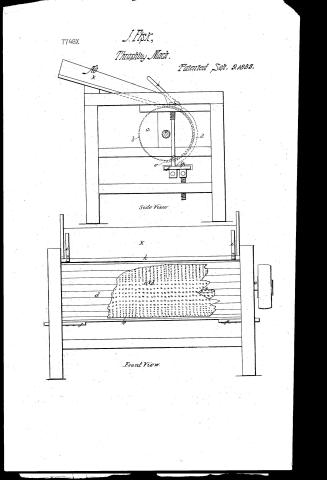
Page 1.
7748X
J. Fisk,
Threshing Mach.
Patented Sept. 9, 1833.
Side View
Front View
Page 2.
Sept. 9, 1833
Jeremiah Fisk
Letters Patent Patented 9, 1833. Sept.
The Schedule referred to in these Letters Patent, and making part of the same, containing a description in the words of the said Jeremiah Fisk himself of his improvements in the Threshing Machine.
To all to whom these presents shall come. Be it known that I, Jeremiah Fisk, of Wells, in the county of Oxford & State of Maine, have invented a new and useful machine for threshing wheat and other grain from the straw, for threshing hemp, flax from the straw, & for separating clover seed from the chaff or hull & also for threshing rice from the straw & separating it from the hull; & that the following is a full & exact description of the construction and operation of the said machine, as invented & improved by me.
The principle of this improved & useful machine, consists in having a cylinder, very about two feet six inches in diameter and eight feet long, covered with sheet iron, perforated so as to render the external surface completely rough like a grater. This cylinder lies horizontally, and is made of wood, except the sheet iron covering and may be solid. In the center of each end, is an iron or steel gear or pin, on which this cylinder revolves, presenting the rough surface of the sheet iron to a curved bed constantly. This curved bed is situated obliquely backwards of the cylinder, the upper part of it being called the regulator extends to the center of the cylinder superiorly. It is made of good substantial wood, should be about two inches in thickness, and in length equal to that of the cylinder. The curvature of this bed is such, that when properly applied to the cylinder, there shall exist a uniform space between them, of about one fourth of an inch; and will encircle about one half of the circumference of the cylinder. This curved bed is supported at the ends by two plates. Through each of these
Page 3.
7748X
The holes are two holes near the ends made large enough to admit screws with large shoulders; the holes being large enough to admit a little play or movement when the screw is turned a little back. The inferior or upper screws in each plank enter a top or cap piece in the frame (in which the cylinder moves) above the cylinder, while each of the inferior or lower screws enters a middle short post below. By this arrangement the bed piece may be approached nearer to, or further removed from the cylinder at pleasure. The concave surface of this bed piece is covered with perforated short iron riveted together like, so that the concave surface of the bed piece shall correspond to the convex surface of the cylinder for many turns. The upper part of this covered bed piece, called the regulator is six or seven inches in width, detached from the other wood part of the bed and joined only by the short iron, which also covers the inner surface of this, and serves also as a hinge on which the regulator turns; so that this regulator may be raised or depressed, enlarging or lessening the space between it and the cylinder, to admit more or less food at pleasure, hence it is called the regulator. On the external side iron handles or bars may be attached, so as to guard it to its elevation or depression. Above the cylinder, and over the side opposite to the curved bed is a slide or hopper made in the form of a plane inclined towards the cylinder with side pieces, to prevent the grain from falling off; preventing the grain from to greater surface of the cylinder, as fast as admitted by the regulator. This slide is about five feet six inches in length, six inches in width, equal to the length of the cylinder. One of the pins on which this cylinder revolves, serves as an axle to a wheel fastened on the outside, to which the power is communicated to revolve the cylinder; that of the infinite is always approaching the one over bed above, and receding below.
This machine may be put into operation by means
Page 4.
of hand, horse, steam or water power, and the dimensions of each part diminished or enlarged accordingly.
This cylinder being put in rapid motion as above described, the grain or other matter to be threshed or hullled, is placed on the slide, and thrust forward to the rough surface of the cylinder, and carried there by the motion between the opposing surfaces of the cylinder and the curved bed which completely sends the hull & separates the grain or seed from it. In separating rice & smaller seeds from the hull it may be necessary to apply the curved bed nearer the cylinder than when threshing from the straw. This is done by means of the screws with large shoulders as before described. A wooden frame is to be constructed of joint or strong timbers, of dimensions adapted to the size and length of the cylinder & curved bed; with parts supported by two short posts for the pins in each end of the cylinder to hang or play on.
Dated at Wells aforesaid this sixth day of April Anno Domini 1833.
Witnesses
Joan Winship
Joshua Eaton
(924 words) — Patented September 9, 1833 —
Published accounts: journal notice
Notice in the monthly list of patents, with remarks
Journal of the Franklin Institute, new ser., vol. 13 (1834), p. 175 · View the page
12. For a Thrashing Machine; Jeremiah Fisk, Weld, Oxford county, Maine, September 9.
Remarks. We have had more breathing time than usual between this and the last thrashing machine, but there has not much of novelty resulted from the respite, as the difference between this and its predecessors is very slight. There are the usual cylinder and concave, both of which are to be covered with sheet iron, punched so as to give to its surface the form of a grater. As it is without beaters, it resembles many of the rubbing machines, excepting in its form, and mode of feeding, which do not differ from most of the patented thrashing machines. There is no claim made, or any thing pointed out as sustaining the character of novelty.
About this record
- Patentee
- DATAMP
- Date
- the Name and Date index of patents, DATAMP, USPTO records
- Invention
- DATAMP
- Listed in
- the Name and Date index of patents, DATAMP, USPTO records, Jim Shaw's X-patent list, the Journal of the Franklin Institute, Burke's List of Patents (1847)
- Burke's 1847 Patent Office list gives the same patent.