

Drawings and documents
USPTO scan
The patent as scanned by the USPTO
-
 Page 1
-
 Page 2
-
 Page 3
-
 Page 4


U.S. Patent and Trademark Office · Google Patents
Show the transcription Hide (385 words)
Machine transcription (LightOnOCR) of the pages as scanned by the USPTO, most of them the handwritten copies made when the records were restored after the 1836 fire. Not checked; it can misread handwriting, so compare it with the scan.
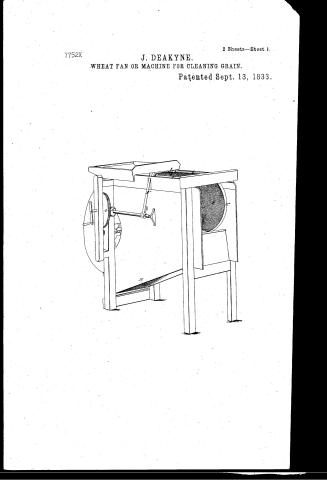
Page 1.
7752X
J. DEAKYNE.
WHEAT FAN OR MACHINE FOR CLEANING GRAIN.
Patented Sept. 13, 1833.
2 Sheets—Sheet 1.
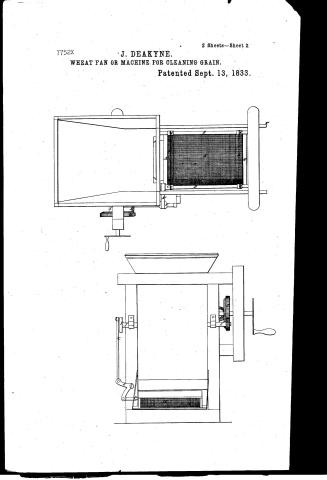
Page 2.
7752X
J. DEAKYNE.
WHEAT FAN OR MACHINE FOR CLEANING GRAIN.
Patented Sept. 13, 1833.
2 Sheets—Sheet 2.
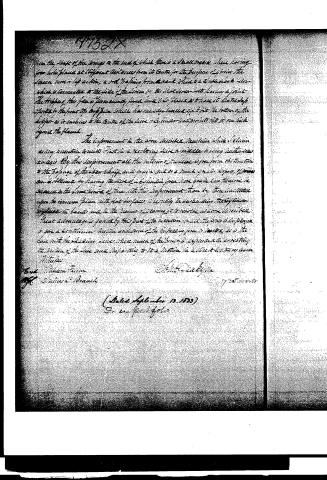
Page 4.
from the shaft of the driving or the head of which there is a small track wheel running from hole plates at different distances from its centre for the purpose of giving the lever more or less action; a rod passing from the track wheel to a track wheel also which is connected to the side of the lever so that the lever will have a joint. The tipping of the lever is permanently fixed and is placed so to have its centre shop directly by the front of the shaft which has one edge beveled so as to fit the bottom of the hopper as it slides to the centre of the line of cylinder and projects into the back against the plates.
The improvement in the above described machine which I claim as my invention consists in a revolving disk or rotatable moving member and means by this improvement all the interior of the line is free from obstruction to the passage of the iron chips and gives not so much friction as before. I have an intention of having the disk of a cylinder from iron bars constructed as shown in the plans and of use with this improvement then by this invention upon the common piece with flat surfaces and only the revolving the cylinder against the bars and in the manner of having it to revolve without friction. Great advantage is gained by this part of the invention in all the bars is employed to give a continuous motion and none of the revolving piece is locked, so is the case with the disk piece where the motion of the iron is dependent in arresting the motion of the line and depending to its motion in a direct but to no more friction.
Tested: William Farrow
Filed: Charles C. Branch
A. R. Oakley
7 of 30 words
(Dated September 13, 1853)
For one patent folio
Published accounts: journal notice
Notice in the monthly list of patents, with remarks
Journal of the Franklin Institute, new ser., vol. 13 (1834), p. 176 · View the page
16. For an improvement in the Wheat Fan; John Deakyne, Petersburg, Dinwiddie county, Virginia, September 13.
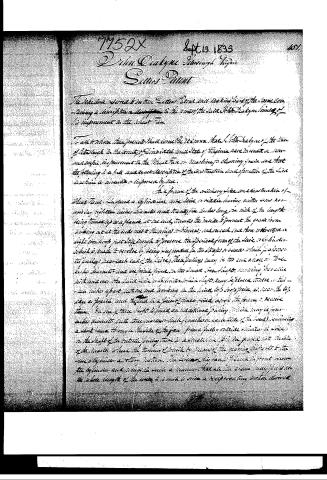
Remarks. The improvement which forms the subject of this patent is clearly set forth, and distinctly claimed. It consists of a cylindrical wire sieve, open at each end like a bolter, and revolving without either arms or axis. This cylinder may be eighteen inches in diameter, and twenty-five inches long; it has on each end a hoop of sufficient strength to enable it to retain its cylindrical form. Above it there are two shafts with whirls on them, over which straps or bands pass, which descend, and embrace the periphery of the cylindrical revolving sieve, near each of its ends. The improvement claimed, "consists, first, in a revolving sieve, or riddle, having neither arms nor axis. By this improvement, all the interior of the sieve is free from any obstruction to the passage of the straw, chaff, or grain; and as a much greater surface can be obtained by having the sieve of a cylindrical form, more grain can be cleaned in the same period of time with this improvement, than by those constructed upon the common plan, with flat surfaces. Secondly, in suspending the cylinder, or sieve, in bands, and in the manner of gearing it to revolve as above described."
About this record
- Patentee
- DATAMP
- Date
- the Name and Date index of patents, DATAMP, USPTO records
- Invention
- DATAMP
- Listed in
- the Name and Date index of patents, DATAMP, USPTO records, Jim Shaw's X-patent list, the Journal of the Franklin Institute, Burke's List of Patents (1847)
- Burke's 1847 Patent Office list gives the same patent.