

Drawings and documents
USPTO scan
The patent as scanned by the USPTO
-
 Page 1
-
 Page 2
-
 Page 3


U.S. Patent and Trademark Office · Google Patents
Show the transcription Hide (1,203 words)
Machine transcription (LightOnOCR) of the pages as scanned by the USPTO, most of them the handwritten copies made when the records were restored after the 1836 fire. Not checked; it can misread handwriting, so compare it with the scan.
Page 1.
7797X
J. G. Driscoll
Cracker Machine.
Patented Nov 19, 1833.
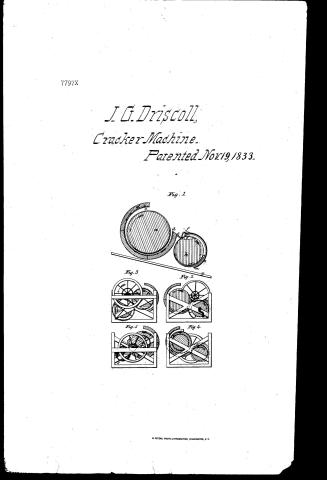
Fig. 1
Fig. 3
Fig. 2
Fig. 5
Fig. 4
Page 2.
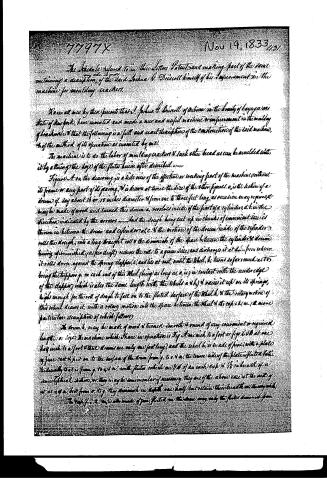
The Schedule referred to in their Letters Patent, and making part of the same, containing a description of the said Machine &. D. Brice himself of his Improvement in the machine for moulding crackers.
Have all seen by their patents that J. Joshua L. Brice of Auburn in the county of Cayuga, State of New York, have invented and made a new and useful machine or improvement in the moulding of crackers & that the following is a full and exact description of the construction of the said machine, & of the method of its operation as invented by me.
The machine is to do the labor of moulding crackers & such other bread as can be moulded with it by a turning the shape of the flutes herein after described.
Figure A in the drawing is a side view of the effective or working part of the machine without its frame or any part of its gearing, & is drawn at twice the size of the other figures. a, is the section of a drum of say about 16 or 18 inches diameter & from one to three feet long, as occasion may require & may be made of wood and turned this drum a, revolves inside of the part of a cylinder, d, b, in the direction indicated by the arrows — and the dough being put up in chunks of convenient size is thrown in between the drum and cylinder etc. & the motion of the drum inside of the cylinder rolls the dough into a long straight roll & the diminution of the space between the cylinder & drum being diminished (as per draft) reduces the roll to a given size and discharges it at d. From whence it rolls down against the spring clapper, e, and lies at rest, until the wheel, h, turns so far round as to bring the trappers g, on each end of this wheel (being as long as a, is,) in contact with the under edge of the clapper, which is also the same length with the wheel a & h,) & raises it up on its springs, high enough for the roll of dough to fall on to the fluted surface of the wheel h, & the rotary motion of this wheel draws it, with a rotary motion, into the space between the wheel & the cup e, k, m. (A more particular description of which follows)
The drum, h, may be made of wood & turned smooth & round of any convenient or required length. or size the machine which I have in operation is Fig A one inch to a foot or fig. 6 & b at one half inch to a foot & three drums are only one foot long) and the wheel h, is made of pine, with a plate of pine cast & fast on to the surface of the drum from g, to o & n, the lower side of the plate is fluted laterally that is from g, to o & n, with flutes which are 1/16 of an inch deep & 1/8 inch wide of a semicircular section, or they may be semicircular if necessary they are of the above size at the end of it at a, g, a, b, & from o, to g, they diminish in depth one half but retain their breadth all the way wide.
The cup, f, e, k, m, is also made of pine, fluted on the same way only the flutes diminish from
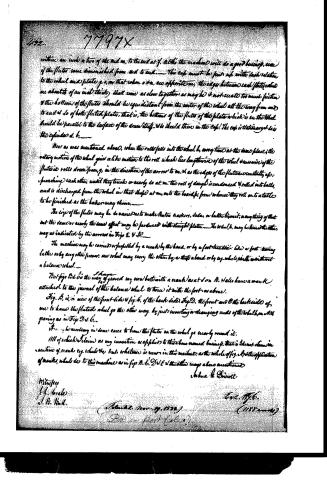
Page 3.
within an inch or two of the end m, to the end at g. All this the machine will do a good business, even if the flutes were diminished from end to end. This cap must be fixed with such relation to the wheel and plate g, a, as that when o & n, are opposite m, the edges between each flute (which are about 1/8 of an inch thick) shall come as close together as may be & not create too much friction & the bottoms of the flutes should be equidistant from the center of the wheel all the way from end to end & so of both fluted plates, that is, the bottoms of the flutes of the plate which is in the wheel should be parallel to the surface of the drum itself & so should those in the cap. The cap is stationary & is in the cylinder a, b.
Now as was mentioned above, when the roller falls into the wheel, h, every time at the same place, the rotary motion of the wheel gives a like motion to the roll which lies lengthwise of the wheel & across of the flutes it rolls down from g, in the direction of the arrow to m, & as the edges of the flutes are constantly approaching each other, until they touch or nearly do at m, the roll of dough is condensed & rolled into balls, and is discharged from the wheel in that shape at m, onto the board, from whence they roll on to a table to be finished as the baker may choose.
The size of the flutes may be so varied as to make Boston crackers, soda, or butter biscuits; anything of that sort the same or nearly the same effect may be produced with straight plates. The wheel, h, may be turned the other way as indicated by the arrow in Figs. E & D.
The machine may be carried or propelled by a crank by the hand, or by a foot treadle like a foot-treading lathe or by any other power; our wheel may carry the other by a strap around or by cap wheel, with or without a balance wheel.
That figs. D & E in the way of gearing my own bottom with a crank as at 1 on B. Nalls have a crank attached to the journal of the balance wheel to turn it with the foot as above.
Fig. B, is a view of the front side & fig. b, of the back side. Fig. D, the front and E the back side of one to have the fluted wheel go the other way, by just inverting or changing ends of the wheel, or not gearing as in Figs. D & E.
It is not necessary in some cases to have the flutes on the wheel go nearly round it.
All of which I claim as my invention as applied to the above named business, that is I do not claim the motion of cranks, etc., while the hub whatever is seen in this machine, as the whole of fig. A is the application of cranks, while as to this machine as in figs. A, B, D, E & the other ways above mentioned.
John H. Driscoll
Witnesses
J. H. Coles
J. H. Nalls
Patented Nov. 29, 1852
See Part Folio 9
Cert. My S.
(1852)
Published accounts: journal notice
Notice in the monthly list of patents, with remarks
Journal of the Franklin Institute, new ser., vol. 13 (1834), p. 266 · View the page
19. For an improvement in Moulding Crackers; Joshua G. Driscol, Auburn, Cayuga county, New York, November 19.
Remarks. This cracker machine differs entirely in its construction from all those which we have before seen, but without the drawings we can give only a very general description of it. All that is proposed to be effected by the machinery is to roll the dough into round balls, thus preparing it to be finished by hand. The first part of the apparatus consists of a cylinder of wood, which may be sixteen inches in diameter, and three feet in length. This is made to revolve within a hollow cylinder of equal length, but larger in diameter. About one-fourth of this cylinder is removed for its whole length, and that which revolves within it is placed eccentrically, so that the space between the two may be at least as wide again on one side as it is on the other. When the inner cylinder is revolving, lumps of dough are thrown in at the wide part, and these come out in long rolls at the narrow one. They are thence conducted into a second apparatus, constructed somewhat like the former, but smaller, and fluted round, in such a way as to convert the long rolls into balls. The claim is to the particular arrangements of the various parts of the machinery for producing the effects described.
About this record
- Patentee
- DATAMP
- Date
- the Name and Date index of patents, DATAMP, USPTO records
- Invention
- DATAMP
- Listed in
- the Name and Date index of patents, DATAMP, USPTO records, Jim Shaw's X-patent list, the Journal of the Franklin Institute, Burke's List of Patents (1847)
- The Franklin Institute's journal spells the name differently.
- Burke's 1847 Patent Office list gives the same patent.