

Drawings and documents
USPTO scan
The patent as scanned by the USPTO
-
 Page 1
-
 Page 2
-
 Page 3
-
 Page 4
-
 Page 5
-
 Page 6
-
 Page 7
-
 Page 8


U.S. Patent and Trademark Office · Google Patents
Show the transcription Hide (2,441 words)
Machine transcription (LightOnOCR) of the pages as scanned by the USPTO, most of them the handwritten copies made when the records were restored after the 1836 fire. Not checked; it can misread handwriting, so compare it with the scan.
Page 1.
7817X
B.J. Lewis
Tailoring
Patented Nov. 19, 1853

Page 2.
7817X Nov. 19, 1833 457
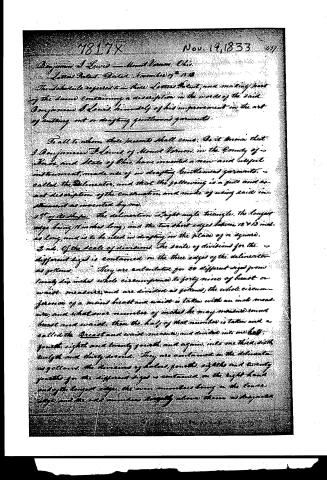
Benjamin I Lewis — Mount Vernon, Ohio.
Letter Patent Dated November 19th 1833
The Schedule referred to in these Letters Patent, and making part of the same containing a description in the words of the said Benjamin I Lewis, himself of his improvement in the art of cutting out or drafting gentlemen's garments.
To all to whom these presents shall come: Be it known that I Benjamin I Lewis, of Mount Vernon, in the County of Knox, and State of Ohio, have invented a new and useful instrument, made use of in drafting gentlemen's garments, — called the Delineator, and that the following is a full and exact description of the construction and mode of using said instrument as invented by me.
1st. Of its shape. The delineator is a right angle triangle, the longest edge being 18 inches long, and the two short edges between 12 & 13 inches long, and is to be used in drafting in the place of a square.
2nd. Of the scale of divisions. The scale of divisions for the different sizes is contained on the three edges of the delineator as follows: They are calculated for 24 different sizes from twenty six inches whole circumference to forty nine of breast or waist measure, and are divided as follows; the whole circumference of a man's breast and waist is taken with an inch measure, and whatever number of inches he may measure round breast and waist; then the half of that number is taken and is called the Breast and waist measure, and divided into one half, fourth, eighth and twenty fourth, and again, into one third, sixth, twelfth and thirty second. They are contained on the delineator as follows, the divisions of halves, fourths, eighths and twenty fourths for the different sizes is contained on the right hand edge of the longest edge, the even numbers being on the lower edge and the odd numbers directly above them as designated.
Page 3.
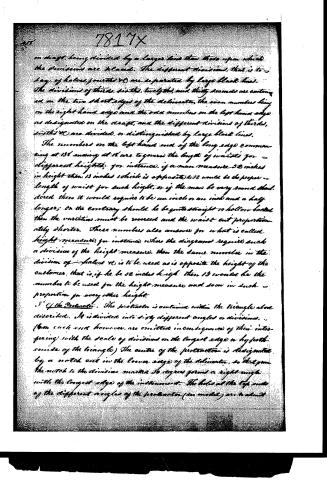
on draft, being divided by a larger line than those upon which the divisions are placed. The different divisions, that is to say, of halves, fourths &c are separated by large black lines. The divisions of thirds, sixths, twelfths, and thirty seconds are contained on the two short edges of the delineator, the even numbers being on the right hand edge and the odd numbers on the left hand edge as designated on the draft, and the different divisions of thirds, sixths &c are divided, or distinguished by large black lines.
The numbers on the left hand end of the long edge commencing at 138 ending at 18 are to govern the length of waist for different heights; for instance, if a man measure 52 inches in height then 13 inches which is opposite to 52 would be the proper length of waist for such height, or if the man be very sound and broad then it would require to be an inch or an inch and a half longer; on the contrary should he be quite straight or hollow backed then the variation must be reversed and the waist cut proportionately shorter. These numbers also answer for what is called height measure, for instance where the diagrams require such a division of the height measure, then the same number in the division of halves &c is to be used as is opposite the height of the customer, that is, if he be 52 inches high, then 13 would be the number to be used for the height measure and so on in such proportion for every other height.
5° of the Protractor. The protractor is contained within the triangle above described. It is divided into sixty different angles or divisions. (from each end however, are omitted in consequence of their interfering with the scale of divisions on the longest edge or hypotenuse of the triangle) The centre of the protractor is designated by a notch cut in the lower edge of the delineator, so that from the notch to the divisions marked 90 degrees forms a right angle with the longest edge of the instrument. The holes at the top ends of the different angles of the protractor (see model) are to admit
Page 4.
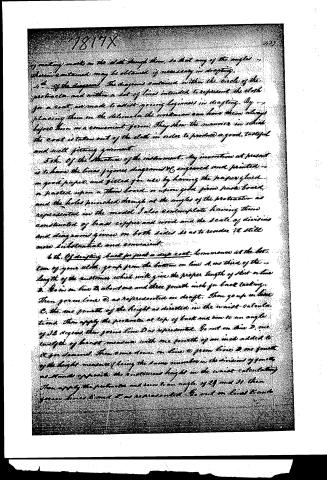
of making marks on the cloth through them, so that any of the angles therein contained may be obtained if necessary in drafting.
4th. Of the diagrams. The diagrams contained within the circle of the protractor and within a set of lines intended to represent the cloth for a coat, are made to assist young beginners in drafting. By placing them on the delineator the workman can have them always before him in a convenient form. They show the manner in which the coat is taken out of the cloth in order to produce a good, tasteful and well fitting garment.
5th. Of the structure of the instrument. My invention at present is to have the lines, figures, diagrams &c. engraved and printed on good paper, and fitted for use by having the paper glued or pasted upon a thin board or upon good firm paste board, and the holes punched through at the angles of the protractor as represented in the model. I also contemplate having them constructed of brass, copper and wood and the scale of divisions and diagrams given on both sides so as to render it still more substantial and convenient.
6th. Of drafting back for just a deep coat. Commence at the bottom of your cloth, go up from the bottom on line A, one third of the length of the customer which will give the proper length of skirt on line B. Go in on line B, about one and three fourth inch for back taking. Then go on line C, as represented on draft. Then go up on line C, the one fourth of the height as denoted in the waist calculations. Then apply the protractor at top of back and run to an angle of 32 degrees then go on line D as represented. Go out on line D, one twelfth of breast measure with one fourth of an inch added to it for seam. Then come down on line E from line D one fourth of the height measure (being the same number in the division of points as stands opposite the customer's height in the waist calculation). Then apply the protractor and run to an angle of 29 and 31, then go on lines E and F as represented. Go out on lines E and F
Page 5.
and 1 one third of breast measure) with nearly a quarter of an inch added to it for seams. Then form A and B lines as shown on drafts. Go out on line B, from line C, one twelfth of waist measure, with one fourth of an inch added to it for seams. Then sweep curve I by the length of waist or the distance from line B to line D. Go out on the bottom of back from line A, one third of waist measure and form line I as represented.
7th. Of the for back, directions for drafting, commence by squaring the cloth at the bottom opposite to where the back comes out. Then go up from bottom to the lower point of side seam or point 8, one fourth of waist measure. Then apply the protractor and draw to an angle of 38 degrees, then form line A, as shown on drafts. Then go out on line A, from point 8, one sixth of waist measure, with one fourth of an inch added for every inch that the customer measures more round the breast than waist, or a fourth of an inch less he measures more round the waist than breast. Then square line B, from line A, then apply the back to get the proper distance from point 8 to line C, or upper point of side seam. Then square line C from line B. Then go up on line B, from line C, one eighth of the height measure. Then apply the protractor and draw to an angle of 17 degrees, then form line D, as shown on drafts. Then come up from line B on line D, one fourth of ... breast measure, for the back point of shoulder seam; then apply the back to get the front point of shoulder seam; then apply the protractor at the back point of shoulder seam on line D, and draw to an angle of 14 degrees and form line E, as shown on draft. Then come down on line E from line D, one half and one fourth of breast measure with one fourth of an inch added to it, which gives top of breast or top of curve O; and a twelfth more will give the top of line H. Then come out on line O, from line B, one fourth of breast measure to line H. Then come from line H, one sixth
Page 6.
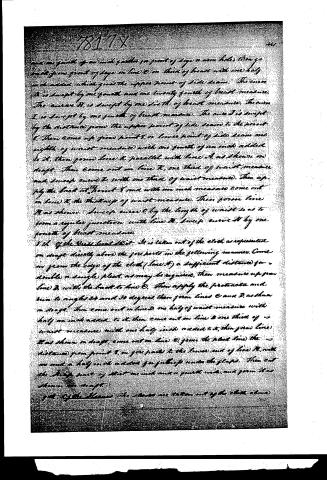
and one fourth of an inch greater for front of legs or arm holes, then go back from front of legs on line D, one third of breast with one half inch added, which gives the upper point of side seam. The curve G is swept by one fourth and one twenty fourth of breast measure. The curve H is swept by one sixth of breast measure. The curve I is swept by one fourth of breast measure. The curve J is swept by the distance from the upper point of side seam to the point G. Then come up from point G, or lower point of side seam one eighth of waist measure with one fourth of an inch added to it, then form line K parallel with line A, as shown on draft. Then come out on line K, one third of waist measure and sweep curve L, with one third of waist measure. Then apply the back at the point L and with an inch measure come out on line K, the thickness of waist measure. Then form line M as shown. Sweep curve O by the length of waist so as to form a regular junction with line H. Sweep curve N by one fourth of breast measure.
8th of the Dress coat skirt. It is taken out of the cloth as represented on draft directly above the fore parts in the following manner. Come in from the edge of the cloth (line A) a sufficient distance for double or single pleat, as may be required, then measure up from line B, with the back to line C. Then apply the protracta and draw to angles 24 and 30 degrees, then form lines C and D, as shown on draft. Then come out on line D, one half of waist measure with half an inch added to it, then come out on line B one third of waist measure with one half inch added to it, then form line E as shown on draft, come out on line C from the waist line the distance from point B, or fore parts to the lower end of line H, with one and a half inch added for fulcrum under the pleats. Then cut the single parts of skirt one inch and a fourth wide, and form them shown on draft.
9th of the Skirt. The Skirts are taken out of the cloth above
Page 7.
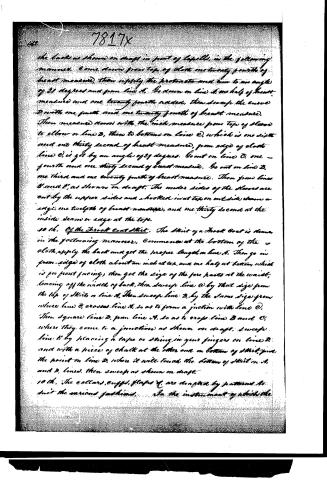
the back as shown on draft in part of lapelle, in the following manner. Come down from top of cloth one twenty fourth of breast measure, then apply the pattern and run to an angle of 21 degrees and from line A. Go down on line A one half of breast measure and one twenty fourth added, then sweep the curve D with one fourth and one twenty fourth of breast measure. Then measure down with the inch measure from top of sleeve to elbow or line B, then to bottom on line C, which is one sixth and one thirty second of breast measure, from edge of cloth line C, is got by an angle of 29 degrees. Go out on line C, one fourth and one thirty second of breast measure. Go out on line B, one third and one twenty fourth of breast measure. Then from lines B and C, as shown on draft. The under sides of the sleeves are cut by the upper sides and hooked in at top on outside seam or edge, one twelfth of breast measure, and one thirty second at the inside seam or edge at the top.
10th. Of the Frock Coat Skirt. The Skirt of a Frock Coat is drawn in the following manner, commence at the bottom of the cloth, apply the back and get the proper length on line A. Then go in from edge of cloth about an inch at top, and one half at bottom, which is for front facing, then get the size of the fore parts at the waist, leaving off the width of back, then sweep line C by that size from the top of skirt, or line A. Then sweep line B, by the same size from where line C crosses line A, so as to form a junction with line C. Then square line D, from line A, so as to crop line B and C, where they come to a junction as shown on draft. Sweep line E by placing a tape or string in your fingers on line D, and with a piece of chalk at the other end on bottom of skirt, give the point on line D, where it will touch the bottom of skirt on A, and D, lines, then sweep as shown on draft.
10th. The collars, cuffs, flaps &c. are drafted by patterns to suit the various fashions. In the instrument of which the
Page 8.
7817X
463
above is a description, I claim to be the inventor and discoverer of the protractor, also the manner of drafting by all the diagrams attached to the instrument, except the diagram of the Snook coat skirt. Also the addition of the thirty seconds to the scale of divisions, and also the form of the instrument, as well as the combination of numbers calculated for height and waist.
Witnesses
Benjamin J. Lewis
Henry O. Lewis
Edwin Hartrop.
(2772 wds.)
Pat. & Recorded August 13, 1842. 2 Ed. 176.
Published accounts: journal notice
Notice in the monthly list of patents, with remarks
Journal of the Franklin Institute, new ser., vol. 13 (1834), p. 317 · View the page
The improvements described in the specification of this patent do not appear to be of a very important character, nor is their general utility obvious; in addition to this, the patentee has not designated them, but has merely told us how he makes his spindle, his drivers, his bridge tree, &c.; mixing together, without discrimination, the new and the old. 39. For Cutting out, or Draughting Gentlemen's Garments, Benjamin J. Lewis, Mount Vernon, Knox county, Ohio, November 19.
Remarks. After describing "the delineator" with its scale of divisions; "the protractor," and a considerable number of "diagrams," representing the individual pieces which in their aggregate state are to form a garment, through six well filled pages, the patentee "claims to be the inventor and discoverer of the protractor; also the manner of drafting by all the diagrams attached to the instrument, except the diagram of the frock coat skirt; also the addition of the thirty seconds to the scale of divisions; and also the form of the instrument; as well as the combination of numbers calculated for height and waist." Were we to form a judgment from the practice of our own little tailor, we should be led to conclude that the multiplication of mathematical scales, protractors, delineators, squares, and other instruments intended to render judgment and practice unnecessary in the art and mystery of cutting garments, had made it difficult to choose among them, and thus tended to cause them all to be laid upon the shelf. For five or six years past, whenever a new coat was to be made by our professor of cutting, the requisite dimensions have been taken by different instruments, some of them quite formidable, if not terrific, in appearance; we recollect one very much like a gibbet, and others resembling sundry instruments of torture; but the same apparatus was seldom, if ever, used a second time; and a few days since, having ourselves to undergo a similar operation, nothing was applied but a simple tape, divided into inches; and yet the coat, to the uninitiated, at least, appears to set as well as those which were mathematically elaborated. This does not look well for the development of genius.
DATAMP: illustration
Illustrations from DATAMP

DATAMP (Directory of American Tool and Machinery Patents), via the Internet Archive · Archived DATAMP page
About this record
- Patentee
- DATAMP
- Date
- the Name and Date index of patents, DATAMP, USPTO records
- Invention
- DATAMP
- Listed in
- the Name and Date index of patents, DATAMP, USPTO records, Jim Shaw's X-patent list, the Journal of the Franklin Institute, Burke's List of Patents (1847)
- Burke's 1847 Patent Office list gives the same patent.