

Drawings and documents
USPTO scan
The patent as scanned by the USPTO
-
 Page 1
-
 Page 2
-
 Page 3
-
 Page 4
-
 Page 5
-
 Page 6
-
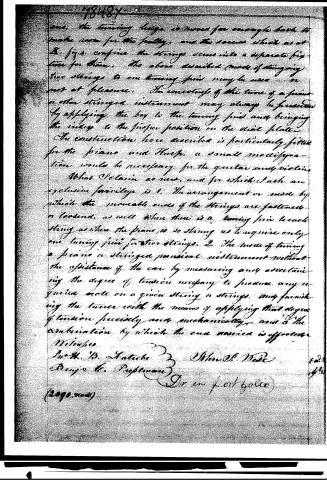 Page 7


U.S. Patent and Trademark Office · Google Patents
Show the transcription Hide (1,985 words)
Machine transcription (LightOnOCR) of the pages as scanned by the USPTO, most of them the handwritten copies made when the records were restored after the 1836 fire. Not checked; it can misread handwriting, so compare it with the scan.
Page 1.
7848X
J.J. Wise,
Tuning Pianos,
Patented Nov. 19, 1833.
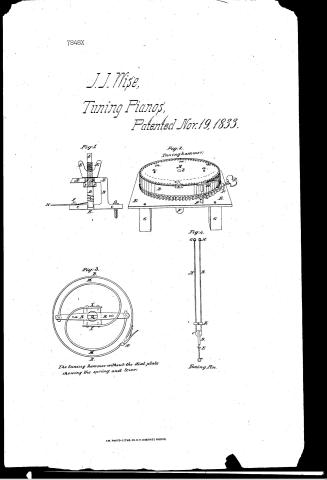
Fig. 1.
Fig. 2.
Tuning hammer.
Fig. 3.
B.
The tuning hammer without the dial plate
shewing the spring and lever.
Fig. 4.
Tuning Pin.
A.M. PHOTO-LITHO. CO. N.Y. (OSBORNE'S PROCESS)
Page 2.
Nov 19, 1833
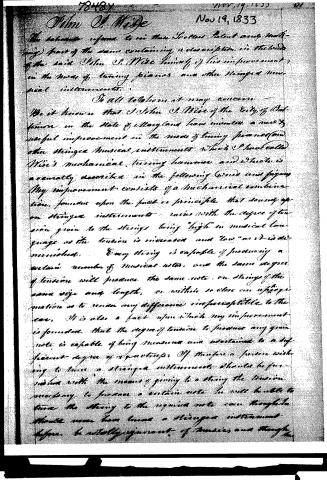
The above refers to my New Stringed Patent and (nothing) part of the same containing a description in the words of the said John S. Wise himself of his improvement in the mode of tuning pianos and other stringed musical instruments.
To all to whom it may concern —
Be it known that I John S. Wise of the City of Baltimore in the State of Maryland have invented a new & useful improvement in the mode of tuning pianos and other stringed musical instruments which I have called Wise’s mechanical tuning hammer and which is accurately described in the following words and figures.
My improvement consists of a mechanical combination, founded upon the fact or principle that sound upon stringed instruments rises with the degree of tension given to the strings being “high” in musical language as the tension is increased and “low” as it is diminished. Every string is capable of producing a certain number of musical notes, and the same degree of tension will produce the same note on strings of the same size and length, or within so close an approximation as to render any difference imperceptible to the ear. It is also a fact upon which my improvement is founded, that the degree of tension to produce any given note is capable of being measured and ascertained to a sufficient degree of exactness.
If therefore a person wishing to tune a stringed instrument should be furnished with the means of giving to a string the tension necessary to produce a certain note he will be able to tune the string to the required note even though he should never have tuned a stringed instrument before. He will be ignorant of music and though
Page 3.
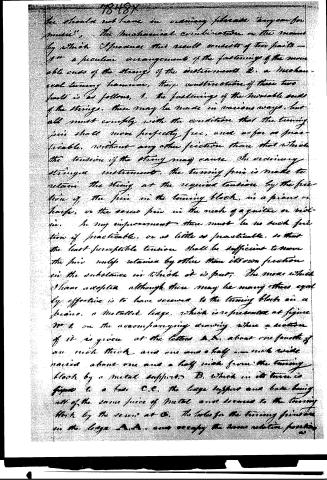
The should not have an ordinary fibrous "anyon for music". The mechanical combination on the means by which I produce this result consists of two parts—1st a peculiar arrangement of the fastening of the movable ends of the strings of the instruments 2. a mechanical turning hammer. The construction of these two parts is as follows. 1. The fastening of the movable ends of the strings, these may be made in various ways, but all must comply with the condition that the turning pin shall move perfectly free, and as far as practicable, without any other friction than that which the tension of the string may cause. In ordinary stringed instruments, the turning pin is made to retain the string at the required tension by the friction of the pin in the turning block, in a piano or harp, or the same pin in the neck of a guitar or violin. In my improvement there must be no such friction if practicable, or as little as practicable, so that the least perceptible tension shall be sufficient to move the pin solely retained by other than its own friction in the substance in which it is put. The mode which I have adopted although there may be many others equally effective is to have screws to the turning block in a piano, a metallic ledge, which is represented at figure No. 1. on the accompanying drawing. Where a section of it is given at the letters A.A. about one fourth of an inch thick, and one and a half an inch wide, raised about one and a half inch from the turning block by a metal support B, which in its turn is figured to a base C.C. the ledge support and base being all of the same piece of metal and secured to the turning block by the screw at D. The holes for the turning pin are in the ledge A.A., and occupy the same relative position
Page 4.
7848X
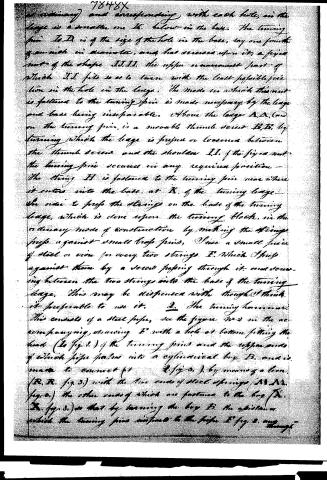
as ordinary) and corresponding with each hole, in the large is a smaller one L below in the base. The tuning pin I.D. is of the size of the hole in the base, say one fourth of an inch in diameter, and has screwed upon it, a fixed nut of the shape I.I.I. the upper movement part of which I.I. fits so as to turn with the least possible friction in the hole in the large. The mode in which this nut is fastened to the tuning pin is made necessary by the large and base being inseparable. Above the large A.A. (and on the tuning pin, is a movable thumb screw B.B. by turning which the large is pressed or loosened between the thumb screw and the shoulder I.I. of the fixed nut, the tuning pin secures in any required position—the string II is fastened to the tuning pin near where it enters into the base, at K. of the tuning large—the order to press the strings on the base of the tuning large, which is done upon the tuning block, in the ordinary mode of construction by making the strings press against small brass pins, I use a small piece of steel or iron for every two strings E. which I press against them by a screw passing through it, and screwing between the two strings into the base of the tuning large. This may be dispensed with though I think it preferable to use it. 2. The tuning harmonium. This consists of a steel pipe, see the figure No 2 in the accompanying drawing E with a hole at bottom fitting the head (to fig. 1.) of the tuning pin and the upper ends of which pipe passes into a cylindrical box D. and is made to connect (1 2 fig. 3.) by means a lever (R.R. fig. 3.) with the two ends of steel springs (M.M. fig. 3.) the other ends of which are fastened to the box (X. R. fig. 3.) so that by turning the box D. the position in which the tuning pins are fixed to the pipe E fig. 2. may be changed.
Page 5.
7848
attached to the lever B.B. fig. 2, causes the springs M.M. to contract, or expand as may be, fastening to the lever by means of small screws at (a, a, figs. 2 & 3.) only forming the top of the box is a dial plate A fig. 2, marked with lines divisions to indicate, through the agency of the spring, the force a tension applied at any moment, and the scale of which has been previously ascertained by experiment; The edge of the dial plate (m, m, m, fig. 2.) is notched so that it may be retained in any given position by a catch fixed on the box F.F. figs. 2 & 3. forming the well known contrivance of a catchet snap click. The index C.C. fig. 2. is made fast to the box. The box with its contents is placed upon a frame of metal B.B. fig. 2. so made as to raise the box by small legs G.G. fig. 2. a proper distance from the ledge A.A. fig. 1. The pipe F fig. 2. passes through this frame permitting the box to move on the frame around it as an axis.
The mode of applying the mechanical tuning hammer and the manner of its operation is as follows. The pipe is put upon the tuning fork, when the frame will be found to rest on its legs on the ledge A.A. fig. 1 and the tuner turns the box B. fig. 2. to tighten the string to be tuned, first loosening the thumb screw D.D. fig. 1. The tuning pin moves freely in the ledge, until the string begins to pull when the spring is contracted and the dial plate necessarily travels forward. The tuner then continues to turn the box until the index points to the mark on the dial plate, which indicates the degree of tension necessary to produce the required note on the particular string. The catch then holds the dial plate from traversing backwards, while the tuner turns the thumb screw, and confines the tuning pin in the position to which he has brought it, thereby permanently fixing the proper degree of tension to produce the note required.
Page 6.
78487
supplied. Should the metal holder B fig. 1 be used it is next screwed down on the strings — — —
In addition to the ratchet and click of the dial plate on box, I use an endless screw D, fig. 2 for the purpose of making more minute divisions. This is fastened to the frame at P.P. fig. 2, and works into a key projecting from the box. The key it will be understood moves round the pipe through the frame. The points on the dial plate indicating the tension for all required notes, are previously ascertained by trials and appropriate instructions for the application of the instrument to the different strings accompany it.
In connection with the mode of fastening the movable ends of the strings hereinbefore described, and for the purpose of simplifying the operation of the mechanical tuning harmonie, I use a new mode of stringing the piano, by which one tuning pin is made to answer for two strings, by which the number of tuning pins is reduced to one half and the time required to tune the piano is shortened. Two adjoining strings as A.B. fig. 4, are formed of the same piece of wire, the two ends of which are fastened to the adjacent hitch pins G.H. fig. 4. In the loop which is formed in the wire by this arrangement a pulley whose diameter is equal to the proper distance between the two strings when stretched is placed C fig. 4, which pulley has a strap and hook D.E. to which, or — — — — fastened the wire that goes round the tuning pin. The motion of the tuning pin draws back the pulley, and stretches the string on either side of it equally, and when a sufficient tension is given the piece of wire or steel E fig. 4, is screwed down and confines the strings. The making use of this mode of stringing a piano
Page 7.
one, the tuning bridge is turned far enough back to make room for the footpeg, and the screw which as at B, fig. 4, confines the strings screws into a separate fixture for them. The above described mode of stringing two strings to one tuning pin may be used... or not at pleasure. The correctness of the tune of a piano or other stringed instrument may always be preserved by applying the box to the tuning pins and bringing the index to the proper position on the dial plate. The construction here described is particularly fitted for the piano and Harp, a small modification would be necessary for the guitar and violin. What I claim as new, and for which I ask an exclusive privilege is 1. The arrangement or mode by which the movable ends of the strings are fastened or loaded, as well when there is a tuning pin to each string as when the piano is so stringed as to require only one tuning pin for two strings. 2. The mode of tuning a piano or stringed musical instrument without the assistance of the ear by measuring and ascertaining the degree of tension necessary to produce any required note on a given string or strings, and furnishing the tuner with the means of applying that degree of tension precisely and mechanically, and is the combination by which the end service is effected.
Witnesses
Jno H. B. Hatcher
Benj'n G. Payntman
John H. Wade
(2090.000)
Published accounts: journal notice
Notice in the monthly list of patents, with remarks
Journal of the Franklin Institute, new ser., vol. 13 (1834), p. 328 · View the page
67. For an improvement in the mode of Tuning Piano Fortes, and other stringed instruments; John J. Wise, city of Baltimore, November 19.
Remarks. We are very apprehensive indeed that the main end which it is proposed to accomplish by the invention before us, will never be attained, namely, the enabling a person without a musical ear to tune a piano forte, or other stringed instrument, by mechanically measuring the tension given to the respective strings; and we are quite sure that the apparatus here patented for the purpose will not effect it. There is some ingenuity about the thing, but more fancy, and although this latter quality may operate very well in poetry, it is of but little avail in such prosaical articles as mechanical contrivances, even when they are applied to musical instruments. A barrel, like that for containing a watch spring, but about four inches in diameter, has the socket of the turning hammer passing through its centre as an axis. On the upper side of this box, which may be called the handle of the hammer, is a dial plate, with an index to point out the tension of the string, which is to be determined by the corresponding tension of springs within the box, these springs being acted on by turning it. We cannot, without the drawings, attempt to describe the particular arrangements, and these, after the opinion which we have given we shall not be expected to furnish. The tuning pins are to be fixed by a very complex contrivance, so that each of them may be loose whilst the tension of the string is ascertained, and then tightened by a thumb screw. It is also proposed, in some instances, to draw up two strings at once, by allowing one continued wire to form two unisons; the doing of this, however, was made the subject of a special patent by Mr. Babcock, some three or four years ago, and cannot therefore be again legitimately claimed. The claims made are to "the arrangement or mode by which the movable ends of the strings are fastened or HALL'S Mode of Lubricating Steam Pistons. loosened, as well where there is a tuning pin to each string, as where the piano is so strung as to require only one tuning pin for two strings. The mode of tuning a piano, or stringed musical instrument, without the assistance of the ear, by measuring and ascertaining the degree of tension necessary to produce any required note upon a given string, or strings, and furnishing the tuner with the means of applying that degree of tension precisely, and mechanically, and the combination by which the end desired is effected."
About this record
- Patentee
- DATAMP
- Date
- the Name and Date index of patents, DATAMP, USPTO records
- Invention
- DATAMP
- Listed in
- the Name and Date index of patents, DATAMP, USPTO records, Jim Shaw's X-patent list, the Journal of the Franklin Institute, Burke's List of Patents (1847)
- Burke's 1847 Patent Office list gives the same patent.