

Drawings and documents
USPTO scan
The patent as scanned by the USPTO
-
 Page 1
-
 Page 2
-
 Page 3


U.S. Patent and Trademark Office · Google Patents
Show the transcription Hide (633 words)
Machine transcription (LightOnOCR) of the pages as scanned by the USPTO, most of them the handwritten copies made when the records were restored after the 1836 fire. Not checked; it can misread handwriting, so compare it with the scan.
Page 1.
7853X
N. Adams,
Pug Mill,
Patented Dec. 16, 1833.

A.M. PHOTO-LITHO. CO. N.Y. (OSBORNE'S PROCESS)
Page 2.
X-7853 Dec 16, 1833 123.
Nathaniel Adams.
The schedule referred to in these Letters Patent, and making part of the same, containing a description in the words of the said Nathaniel Adams himself, of his improvement in the machine for tempering clay and preparing it for bricks &c.
This machine is intended to operate upon clay placed in a circular bed or pit, a wheel being made to revolve in this bed or pit, by a shifting movement to pass in a spiral direction over the whole bed to within a convenient distance from the centre, while by its straight and form of its circumference it cuts up & makes the clay into a homogeneous mass of the requisite toughness and temper. The advantages of which contrivance are the ease and facility of working the machine and tempering the clay.
The parts and proportions of this machine and the mode of its operation will be understood by reference to the annexed drawing. A is a wheel of iron of about six feet in diameter, the circumference of which consists of one, two, or more rims or sections, separated from each other an inch or more as best suits the manufacturer's purpose, so as to permit some of the clay to pass through, and thereby more effectively to macerate and cut up the mass. The wheel turns on a bush through which one end of the shaft B passes, the other end of the shaft is fastened upon a standard or post C, in the centre of the clay bed, in such manner as to turn upon it easily as the clay wheel revolves. The shaft is a square bar of iron or tough wood, the bush is fitted upon it so as to have no rotary motion, but to slide easily on the shaft.
The contrivance to produce the spiral track of the wheel in the clay bed is as follows,
A toothed wheel D, on the under side of the shaft, the axis of which passes through the shaft, is moved by teeth or cogs made in the standard or post before mentioned when the shaft is put in motion. Upon the axis of this wheel above the shaft, is a pinion
Page 3.
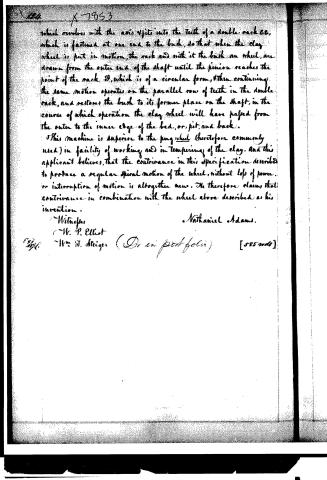
which revolves with the axis & fits into the teeth of a double rack 22, which is fastened at one end to the bush, so that when the clay wheel is put in motion, the rack and with it the bush on wheel, are drawn from the outer end of the shaft until the pinion reaches the point of the rack 22, which is of a circular form, & then continuing the same motion operates on the parallel row of teeth in the double rack, and restores the bush to its former place on the shaft, in the course of which operation the clay wheel will have passed from the outer to the inner edge of the bed, or, pit, and back.
This machine is superior to the pug wheel (heretofore commonly used) in facility of working and in tempering of the clay. And this applicant believes, that the contrivance in this specification described to produce a regular spiral motion of the wheel, without loss of power, or interruption of motion is altogether new. He therefore claims that contrivance in combination with the wheel above described as his invention.
Witnesses
W. P. Elliot
Wm. J. Steiger (Dr. in pict folio)
Nathaniel Adams.
[585 words]
Published accounts: journal notice
Notice in the monthly list of patents, with remarks
Journal of the Franklin Institute, new ser., vol. 13 (1834), p. 386 · View the page
2. For a Machine for Tempering Clay; Nathaniel Adams, Cornwall, Orange county, New York, December 16.
Remarks. The tempering is to be effected by the usual mode of causing a wheel to revolve on a circular bed of clay; and the novelty, or supposed novelty, of the invention, is the construction of the wheel, and the causing it to roll upon the bed of clay, spirally, alternately approaching the vertical shaft in the centre, and the outside of the bed. The wheel is to consist of several separate rims, with a space of an inch, or more, between each, the more perfectly to divide and temper the clay. In order to give it the spiral motion, the horizontal shaft, which is drawn round by the horse, is a square bar, having on it a sliding socket, which is round on the outside, that the wheel may revolve upon it. A toothed wheel on the vertical shaft in the centre, gives motion to a pinion which takes into a double rack, connected with the sliding socket, and moves the wheelin and out in the way required. This "contrivance, in combination with the wheel above described, constitutes the claim. A machine very similar in its construction, and intended for the same purpose, was patented by Mr. O. W. Seely, of Wayne county, New York, on the 20th of July, 1831, and is described in vol. ix. p.
About this record
- Patentee
- DATAMP
- Date
- the Name and Date index of patents, DATAMP, USPTO records
- Invention
- DATAMP
- Listed in
- the Name and Date index of patents, DATAMP, USPTO records, Jim Shaw's X-patent list, the Journal of the Franklin Institute, Burke's List of Patents (1847)
- Burke's 1847 Patent Office list gives the same patent.