

Drawings and documents
USPTO scan
The patent as scanned by the USPTO
-
 Page 1
-
 Page 2
-
 Page 3
-
 Page 4


U.S. Patent and Trademark Office · Google Patents
Show the transcription Hide (1,094 words)
Machine transcription (LightOnOCR) of the pages as scanned by the USPTO, most of them the handwritten copies made when the records were restored after the 1836 fire. Not checked; it can misread handwriting, so compare it with the scan.
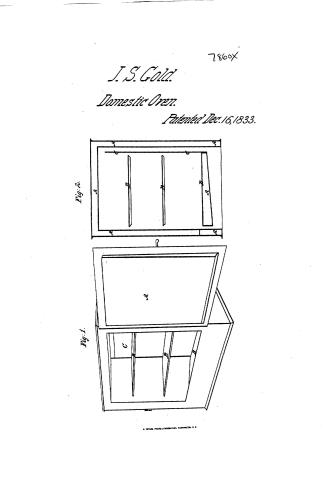
Page 1.
7860X
J. S. Gold.
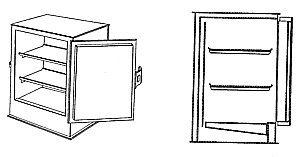
Domestic Oven.
Patented Dec. 16, 1833.
Fig. 2.
Fig. 1.
K. PETER, PHOTO-LITHOGRAPHER, WASHINGTON, D. C.
Page 2.
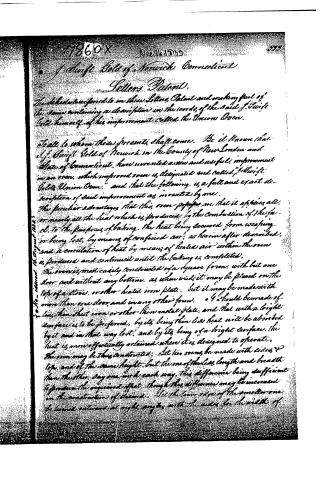
7860X Doc 161533 299
J. Swift Gold of Norwich Connecticut
Letters Patent.
The subscriber is entitled to in these Letters Patent and making part of the same containing a description in the words of the said J. Swift Gold himself of his improvement called the Union Oven.
To all to whom these presents shall come. Be it known that J. Swift Gold of Norwich in the County of New London and State of Connecticut, have invented a new and useful improvement in an oven, which improved oven is designated and called “Swift Gold’s Union Oven,” and that the following is a full and exact description of said improvement as invented by one.
The peculiar advantages that this oven possesses are that it applies all, or nearly all the heat which is produced by the combustion of the fuel to the purposes of baking, the heat being secured from escaping or being lost, by means of confined air, as herein after described, and a circulation of heat by means of heated air within the oven is produced and continued until the baking is completed.
The oven is most easily constructed of a square form, with but one door and without any bottom, as when used it may be placed on the top of a stove, or other heated iron plate, but it may be made with more than one door and in any other form. It should be made of iron, then that iron or other thin metal plate, and that with a bright surface is to be preferred, by its being thin less heat will be absorbed by it and in that way lost, and by its being of a bright surface, the heat is more effectively retained where it is designed to operate.
The oven may be thus constructed: Let two ovens be made with sides & tops, and of the same height, but the one of less length and breadth than the other, say one inch each way, this difference being sufficient to produce the required effect, though this difference may be increased in the construction of desired. Let the lower edge of the smaller one be turned outward at right angles with the sides for the width of
Patent issued 16 August 1825
Page 3.
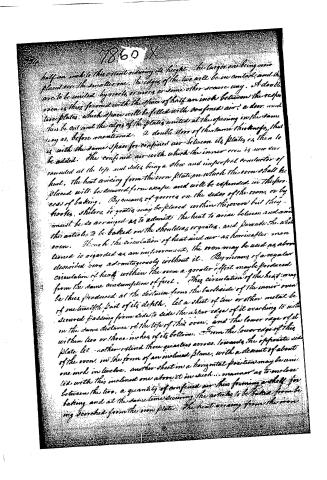
half an inch to this extent reducing its height. The larger one being once placed over the smaller one, the edges of the two will be in contact, and the oven is thus formed with the space of half an inch between the respective plates, which space will be filled with confined air. A door must then be cut and the edges of the plates united at the opening in the same way as before mentioned. A double door of the same thickness, that is with the same space for confined air between its plates, is then to be added. The confined air with which the inner oven is now surrounded at the top and sides, being a slow and imperfect conductor of heat, the heat arising from the iron plate on which this oven shall be placed will be secured from escape, and will be expended in the processes of baking. By means of grooves on the sides of the oven, or by hooks, shelves, or grates may be placed within this oven, but they must be so arranged as to admit the heat to arise between and around the articles to be baked on the shelves or grates, and pervade the whole oven. Though the circulation of heat and air as hereinafter mentioned is regarded as an improvement, the oven may be used as above described very advantageously without it. By means of a regular circulation of heat within the oven a greater effect may be produced from the same consumption of fuel. This circulation of the heat may be thus produced at the distance from the backside of the inner oven of one-twelfth part of its depth. Let a sheet of tin or other metal be secured passing from side to side the upper edge of it overhanging to within the same distance of the top of this oven, and the lower edge of it within two or three inches of its bottom. From the lower edge of this plate let another extend three quarters across towards the opposite side of the oven, in the form of an inclined plane, with a descent of about one inch in twelve. Another sheet in a horizontal position may be united with this inclined one above it in such manner as to enclose between the two, a quantity of confined air thus forming a shelf for baking and at the same time securing the articles to be baked from being scorched from the iron plate. The heat arising from the iron
Page 4.
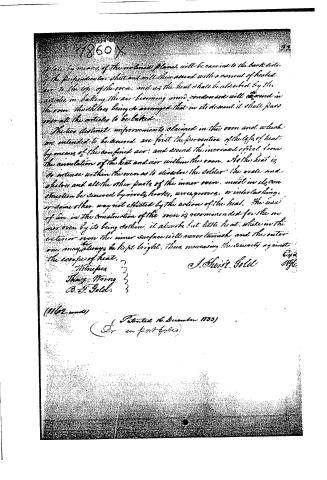
plate by means of the inclined planes, will be carried to the back side of the perpendicular sheet and will then ascend with a current of heated air to the top of the oven, and as the heat shall be absorbed by the articles in baking the air becoming more condensed will descend in the oven the shelves being so arranged that in its descent it shall pass over all the articles to be baked.
The two distinct improvements claimed in this oven and which are intended to be secured are first the prevention of the loss of heat by means of the confined air; and second the increased effect from the circulation of the heat and air within the oven. As the heat is so intense within the oven as to discolor the solder, the walls and shelves and all the other parts of the inner oven, must in construction be secured by irons, hooks, wires, grooves, or interlacing, or some other way not affected by the action of the heat. The use of tin in the construction of the oven is recommended for the inner oven by its being costly, it absorbs but little heat, while in the exterior oven the inner surface will never tarnish and the outer one may always be kept bright, thus increasing the security against the escape of heat.
Witnesses
Henry Waring
B. F. Gold
J. Swift. Gold
(1162 words)
(Patented 16 December 1853)
(See on front page)
Published accounts: journal notice
Notice in the monthly list of patents, with remarks
Journal of the Franklin Institute, new ser., vol. 13 (1834), p. 387 · View the page
4. For a Bake Oven; J. Swift Gold, Norwich, New London county, Connecticut, December 16.
Remarks. This the patentee calls the Union Oven, but the reason for so naming it is not apparent. It is to be made much like the square sheet iron ovens, long used both here and in England, which have a space round them for heated air, and shelves within them to support the articles to be baked. "The two distinct improvements claimed in this oven, and which are intended to be secured, are, first, the prevention of the loss of heat, by means of the confined air; and, second, the increased effect from the circulation of the heat and air within the oven." The circulation of heat is treated in the specification something like that of water under a given pressure, but we are unable to trace its action. The lower shelf is to be made double, in order to prevent the burning of articles placed upon it. The oven may be put over an ordinary fire, or fixed in other ways, and it may, also, be made in various forms.
DATAMP: illustration
Illustrations from DATAMP
DATAMP (Directory of American Tool and Machinery Patents), via the Internet Archive · Archived DATAMP page
About this record
- Patentee
- DATAMP
- Date
- the Name and Date index of patents, DATAMP, USPTO records
- Invention
- DATAMP
- Listed in
- the Name and Date index of patents, DATAMP, USPTO records, Jim Shaw's X-patent list, the Journal of the Franklin Institute, Burke's List of Patents (1847)
- Burke's 1847 Patent Office list gives the same patent.