

Drawings and documents
USPTO scan
The patent as scanned by the USPTO
-
 Page 1
-
 Page 2
-
 Page 3


U.S. Patent and Trademark Office · Google Patents
Show the transcription Hide (666 words)
Machine transcription (LightOnOCR) of the pages as scanned by the USPTO, most of them the handwritten copies made when the records were restored after the 1836 fire. Not checked; it can misread handwriting, so compare it with the scan.
Page 1.
7866X
J. Reichard.
Cultivator.
Patented Dec. 16, 1833.
Page 2.
1866
John Richard Guilford Penn.
Letters Patent
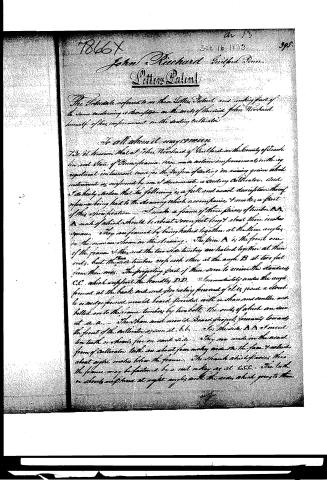
The Petentee referred to in these Letters Patent, and nothing part of the same containing a description in the words of his said John Richard himself of his improvement on the seedling cultivator.
To all whom it may concern
Be it known that I, John Richard of Guilford in the County of Franklin and State of Pennsylvania, have made certain improvements in the agricultural implement used for the purpose of sowing in raising grain which instrument as improved by me is denominated a seedling cultivator. And I do hereby declare that the following is a full and exact description thereof reference being had to the drawing which accompanies & to which a part of this specification.
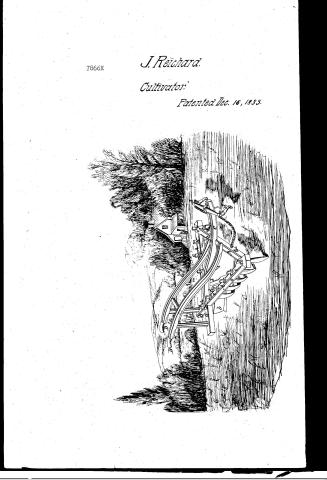
I make a frame of three pieces of lumber AA, A each of which should be about seven feet long & about three inches square. They are framed by being hinged together at the three angles in the manner shown in the drawing. The piece A is the front one of the frame & this and the two side timbers are hinged together at their ends, but the side timbers cross each other at the angle B at two feet from their ends. The projecting front of these serve to receive the standards CC which support the handles DD. Immediately under the angle formed at the back end and not projecting forward of it is joined a double or wedge shaped mould board provided with a share and coulter and bolted on to the frame timbers by two bolts, the ends of which are seen at a.a. The share and mould board project generally beyond the front of the cultivator as seen at b.b. The standards AA of iron or steel or steel, five or six in each side. They are made in the usual form of cultivator, with one about four inches wide on the frame & extend about eight inches below the frame. The share which passes through the frame may be fastened by a nut as at ccc. The bolt or screws are placed at right angles with the shares which pass through.
Page 3.
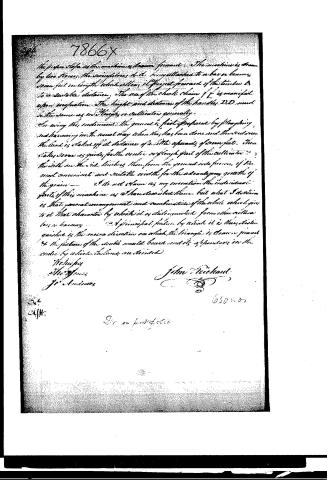
The proper shape of the machine is shown in the figure. The machine is drawn by two horses, the stringlasses d, d, being attached to a bar or beam, seen just in length, which allows it to project forward of the timber A to a suitable distance. The use of the check chain f f is manifest upon inspection. The height and distance of the handles D D must be the same as in Ploughs or cultivators generally.
In using this instrument, the ground is first prepared by ploughing, and harrowing in the usual way when this has been done and the seed sown, the land is marked off at distances of 2 or 3 feet upwards of 2 or 3 feet. These stakes serve as guides for the centre or plough part of the cultivator. The teeth are then set, turning them from the ground into furrows, of the most convenient and suitable width for the advantageous growth of the grain.
I do not claim as my invention the individual parts of this machine as I have described them, but what I do claim is that peculiar arrangement and combination of the whole which gives to it that character by which it is distinguished from other cultivators or hammers.
A principal feature by which it is thus distinguished is the reverse direction in which the triangles b, b, are placed & the position of the double mould board and its attachments in the centre by which the lands are divided.
Witness
The Hon. J. Andrews
John Dickson
650 w. 85
Dr. on patent office
About this record
- Patentee
- Jim Shaw's X-patent list
- Date
- the Name and Date index of patents, USPTO records, Jim Shaw's X-patent list
- Invention
- the Name and Date index of patents
- Listed in
- the Name and Date index of patents, USPTO records, Jim Shaw's X-patent list, Burke's List of Patents (1847)
- Burke's 1847 Patent Office list gives the same patent.