

Drawings and documents
USPTO scan
The patent as scanned by the USPTO
-
 Page 1
-
 Page 2
-
 Page 3
-
 Page 4
-
 Page 5
-
 Page 6


U.S. Patent and Trademark Office · Google Patents
Show the transcription Hide (1,662 words)
Machine transcription (LightOnOCR) of the pages as scanned by the USPTO, most of them the handwritten copies made when the records were restored after the 1836 fire. Not checked; it can misread handwriting, so compare it with the scan.
Page 2.
United States Patent
Patent No.: X7868
United States of America
Department of State
To all to whom these Presents shall come, Greeting
I certify that the annexed is a true copy of the Specification upon which Letters Patent were granted on the 24th day of November 1830 to David Flagg Stowe for his improvement in machinery for threshing small grain called Flagg’s Rotary Rice Thresher.
In testimony whereof I, Asbury Dickins, acting Secretary of State of the United States, have hereunto subscribed my name and caused the Seal of the Department of State to be affixed. Done at the City of Washington, this thirtieth day of June A.D. 1835, and of the independence of the United States of America the eighty ninth.
Asbury Dickins
The Schedule referred to in these Letters Patent and making part of the same containing a description in the words of the said David Flagg Stowe himself of his improvement in machinery for threshing small grain called “Flagg’s Rotary Rice Thresher.”
To all persons to whom these Presents shall come, Be it known that I, David Flagg Stowe of the City County and State of New York, have invented, made, constructed and applied to use a new and useful improvement in a machine for threshing small grains of every description, called “Flagg’s Rotary Rice Thresher” for threshing Rice Wheat and other small grains from off the straw, which machine and its manner of use is as follows: to wit, this machine is constructed having a frame four feet long two wide more or less, according to the power intended to give it motion, if for one horse two by four feet is of any decent size. The frame may be made of iron or any other suitable material.
Page 3.
United States Patent
Patent No.: X7868
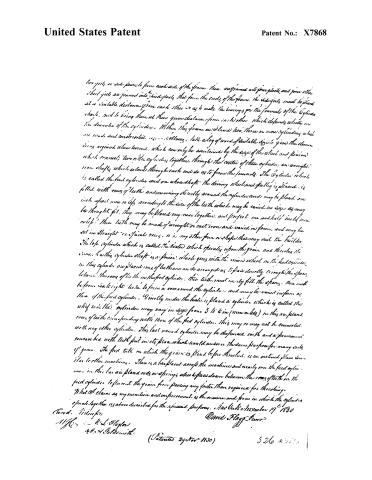
two posts or side pieces to form each side of the frame. These are joined at four places, and four other short girds are joined into said posts, that form the ends of the frame. The side girds must be placed at a suitable distance from each other so as to make the bearings for the journals of the cylinder shafts, and to bring them at their given distance from each other, which depends wholly on the diameter of the cylinders. Within this frame are placed two, three or more cylinders which are made and constructed as follows: take a log of wood of suitable size to give the diameter required when turned, which can only be ascertained by the size of the wheel and pinion which connects two of the cylinders together, through the centre of these cylinders are wrought iron shafts which extend through each end so as to form the journals. The cylinder which is called the feed cylinder and on whose shaft the driving wheel and pulley is placed, is filled with rows of teeth and running directly around the cylinder and may be placed one inch apart now or else, according to the size of the teeth which may be varied in size as may be thought fit. They may be placed very near together, and project one and half inches from the side. These teeth may be made of wrought or cast iron and varied in form, and may be set in straight or spiral rows, or in any other form or shape that may suit the builder. The top cylinder which is called the beater which operates upon the grain and threshes the same. On this cylinder shaft is a pinion which goes with the main wheel on the feed cylinder. In this cylinder are placed rows of teeth and are so arranged as to pass directly through the spaces between the rows of the teeth in the feed cylinder. These teeth must exactly fill the spaces. There must be from one to eight teeth to form a row around the cylinder, and may be varied in form as those of the feed cylinder. Directly under the beater is placed a cylinder which is called the relief or the cylinder may vary in size from 3 to 6 in (more or less) in this are placed rows of teeth corresponding with those of the feed cylinder. This may or may not be connected with any other cylinder. This last named cylinder may be dispensed with and a permanent concave bed with teeth put in its place which would answer the same purpose for many years if grain. The feed table on which the grain is placed before threshed, is an inclined plane similar to other machines. There is a backboard across the machine and nearly over the feed cylinder, in this back are placed rods or springs which pass down between the rows of teeth on the feed cylinder to prevent the grain from passing any faster than required for threshing.
What I claim as my invention and improvement is the manner and form in which the cylinders operate together as above described for the aforesaid purposes.
New York, November 19th 1830
David Flagg Burr.
Patented 29 Nov 1830
5.26
Page 4.
United States Patent
Patent No.: X7868
George H. Richards
Letters Patent.
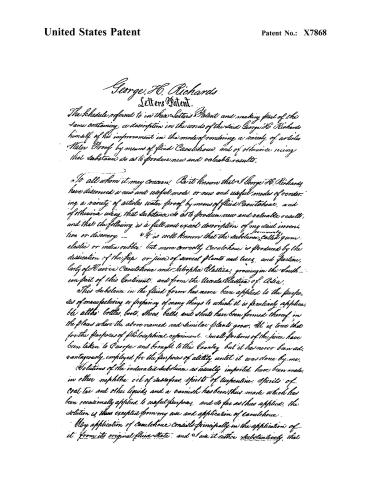
The Schedule referred to in these Letters Patent and making part of the same containing a description in the words of the said George H. Richards himself of his improvement in the mode of rendering a variety of articles Water Proof by means of fluid Caoutchouc, and of otherwise using that substance so as to produce new and valuable results.
To all whom it may concern: Be it known that I George H. Richards have discovered a new and useful mode or new and useful modes of rendering a variety of articles water proof by means of fluid Caoutchouc, and of otherwise using that substance so as to produce new and valuable results, and that the following is a full and exact description of my said invention or discovery — It is well known that the substance commonly called gum elastic or india rubber; but more correctly Caoutchouc is produced by the dessication of the sap or juice of several plants and trees, and particularly of Heavica Caoutchouc and Siphra Elastica, growing in the South-east part of this Continent, and from the Uncle Elastica of Asia.
This substance in the fluid form has never been applied to the purposes of manufacturing or preparing of many things to which it is peculiarly applicable; bottles, boots, shoes, balls, and sheets have been formed thereof in the places where the above-named and similar plants grow, it is true that for the purposes of philosophical experiment, small portions of the juice have been taken to Europe and brought to this country, but it has never been advantageously employed for the purposes of utility until it was done by me.
Solutions of the indurated substance as usually imported, have been made in ether, naphtha, oil of terebinth, spirits of turpentine, spirits of coal tar and other liquids, and a varnish has been thus made which has been occasionally applied to useful purposes, and so far as thus applied, the solution is thus excepted from my use and application of Caoutchouc.
My application of Caoutchouc consists principally in the application of it from its original fluid state, and I use it either substantively, that
Page 5.
United States Patent
Patent No.: X7868
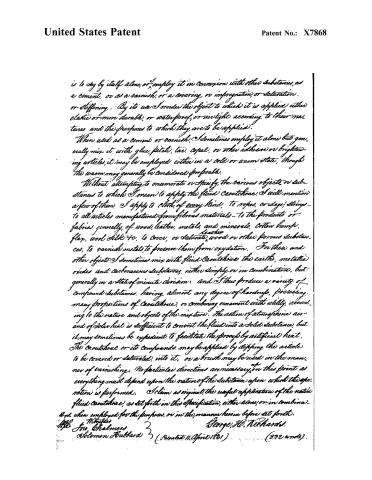
is to dry by itself alone, or employ it in connexion with other substances, as a cement, or as a varnish, or a covering, or impregnation, or saturation, or stiffening. By its use I render the object to which it is applied either elastic or more durable, or waterproof, or airtight according to their natures and the purposes to which they are to be applied.
When used as a cement or varnish, I sometimes employ it alone but generally mix it with glue, pitch, tar, copal, or other adhesive or brightening articles, it may be employed either in a cold or warm state, though the warm may generally be considered preferable.
Without attempting to enumerate or specify the various objects or substances to which I mean to apply the fluid Caoutchouc, I will mention a few of them. I apply to cloth of every kind, to ropes, cordage, strings — to all articles manufactured from fibrous materials — to the products or fabrics generally, of wood, leather, metals, and minerals, cotton hemp, flax, wool, silk &c, to cover, or saturate, wood or other porous substances, to varnish metals, to preserve them from oxidation. For these and other objects I sometimes mix with fluid Caoutchouc: the earths, metallic oxides and carbonaceous substances, either simply or in combination, but generally in a state of minute division, and I thus produce a variety of compound substances, having almost any degree of hardness, possessing many proportions of Caoutchouc, or combining ornament with utility, according to the nature and objects of the mixture. The action of atmospheric air and of solar heat is sufficient to convert the fluid into a solid substance, but it may sometimes be expedient to facilitate the process by artificial heat. The Caoutchouc or its compounds may be applied by dipping the article to be covered or saturated, into it, or a brush may be used in the manner of varnishing. No particular directions are necessary on this point as everything must depend upon the nature of the substance upon which the operation is performed. I claim as original, the useful application of the native fluid Caoutchouc, as set forth in this specification, either alone, or in combination, when employed for the purposes, or in the manner herein before set forth.
Witnesse
George H. Richards.
Solomon Hubbard
(Granted 11 April 1831) (322 words)
Page 6.
United States Patent
Patent No.: X7868
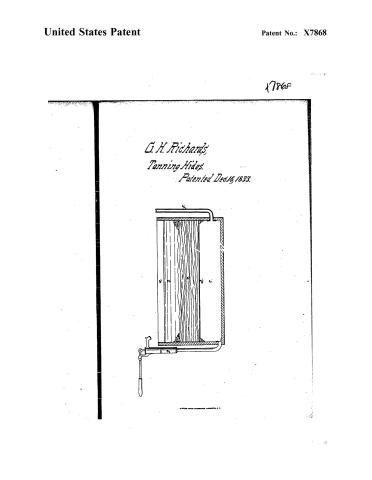
G. H. Richards,
Tanning Hides.
Patented Dec. 16, 1833.

Published accounts: journal notice
Notice in the monthly list of patents, with remarks
Journal of the Franklin Institute, new ser., vol. 13 (1834), p. 393 · View the page
20. For Tanning Skins, or Hides; George H. Richards, city of New York, December 16.
Remarks. This improvement in tanning is said to consist in applying the tanning liquor to the prepared skins, by exhausting the air from the vessel which contains them, so that the liquid may be made to ooze through them by atmospheric pressure. Different, but analogous, modes of effecting this, are described in the specification; and a claim is then made to "the plan of exhausting the air from skins and hides, VOL, XIII.-No. 6. -JUNE, 1834. 50 and thus opening their pores, and while in that state applying the tanning liquor to them; and by this means, and also by means of atmospheric pressure causing the liquor speedily and thoroughly to penetrate the hide, or skin, in such manner as rapidly and effectually to bring it into leather." The principle upon which the above process depends, has been long known, and extensively practiced. At p. 418, vol. x. there is an article upon this subject extracted from Babbage's Economy of Machinery and Manufactures, in which this procedure is explained. We could point to several other sources for similar information, and among them, to a patent obtained about two years since, by a citizen of New York, for a mode of exhausting vats by hydrostatic pressure, and upon which we made some animadversions.
About this record
- Patentee
- the Journal of the Franklin Institute, Journal
- Date
- the Name and Date index of patents, USPTO records, Jim Shaw's X-patent list
- Invention
- the Name and Date index of patents
- Listed in
- the Name and Date index of patents, USPTO records, Jim Shaw's X-patent list, the Journal of the Franklin Institute, Burke's List of Patents (1847)
- The patentee's full name comes from the Franklin Institute's journal.
- Burke's 1847 Patent Office list gives the same patent.