

Drawings and documents
National Archives restored drawings: drawing
Olney's Patent Drawing for an Anthracite Coal Burner

National Archives, Restored Patent Drawings (Record Group 241) · Full-size scan at the National Archives · Catalog record
Show the text on the drawing Hide (244 words)
Words on the drawing as machine-read by the National Archives; not checked. Useful mainly for searching.
11- Drawing of Olney's Anthracite Coal Bumer / 26. STOVES & FUP NACES / 1154] Heating Stoves. / Patented Dec.26 The 1833 / Drawing made / from this together writh / specification / CLASSIFICATION / References. / 7893 / ne1 Bottom plate / ISION. / 4 2 A plate forming part of the health / when down & acting as a blower / when turned up against the grate. / 3 Grate. / 4 Cast iron fire chamber / 5 Projection to acceive the fire buck or / living at the base of the fire chan / bev. / 6 Upper chamber through which the / fuel is put 4 to the back plate / of which is affixed the Collar / to receive the pipe / Cover of stove / 8 Water bessel & Cover / 9 & 10- Square Collars or bands to / hold together the upper Chambu, / the lower Collar(n°10) being attached / to the fire chamber by Screws passing / through it into ears on the inside of / the fine chamber / Hate of New York) / County of Albany / On this lighth day of June 1837 before / the subscribet a judge of Albany County Counts / personally appeared James N ohey is of Albany / made Salemn oath that he interested as / inventor & in a patent for an "Authraute Coal / Buenn issued to himself of dated 26 the / and the afregoing drawings, with :/ refer- / 1833 thereto, are as he verity believes, a true in / luces delineation of the invention, as described / the said letters patent. / Tuhmw thom where me Ia N. olney / this 8th June 1837 / Camly / Communied
USPTO scan
The patent as scanned by the USPTO
-
 Page 1
-
 Page 2
-
 Page 3
-
 Page 4


U.S. Patent and Trademark Office · Google Patents
Show the transcription Hide (770 words)
Machine transcription (LightOnOCR) of the pages as scanned by the USPTO, most of them the handwritten copies made when the records were restored after the 1836 fire. Not checked; it can misread handwriting, so compare it with the scan.
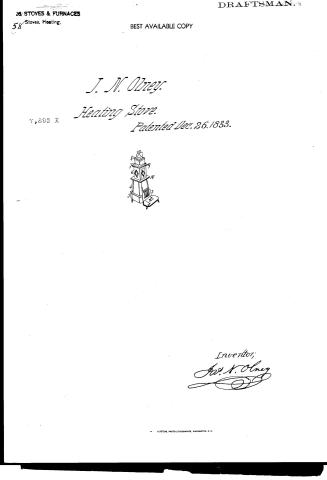
Page 1.
DRAFTSMAN.
26. STOVES & FURNACES
58 Stoves, Heating,
BEST AVAILABLE COPY
J. N. Olney.
Heating Stove.
Patented Dec. 26, 1833.

Inventor,
J. N. Olney
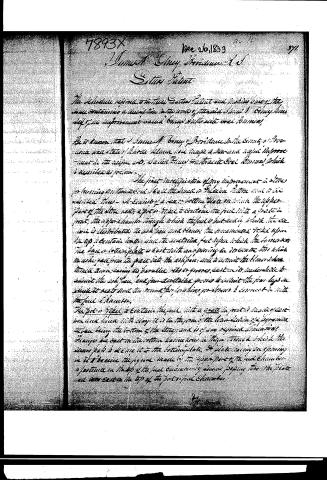
Page 2.
17893X
Dec 26, 1833
Samuel A. Chuy, Providence, R.I.
Letter Patent
The following refers to the Letter Patent and Patent of the same contains a description of the work of Samuel A. Chuy, his self of his improvement called "Chuy's Water Seal and Pump."
It is known that I Samuel A. Chuy of Providence in the County of Providence and State of Rhode Island, do make a new and useful improvement in the water seal, called Chuy's Water Seal and Pump, which is described as follows:
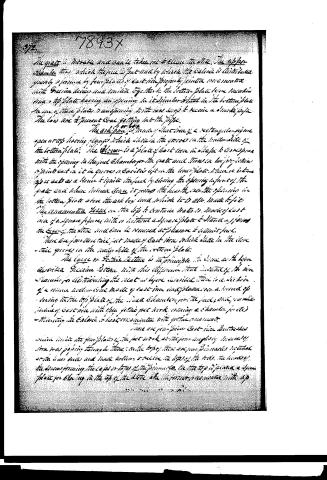
The first modification of my improvement is a stone or burning antimonite, at least the shape of a regular stone, and is divided thus - at every part of a lower bottom plate which the upper part of the stone rests upon, and it contains the fuel with a grate in part, the upper chamber through which the fuel is put and by which the air is distributed to the fuel and flame; the transverse plate upon the top of certain water, and the vertical fuel upon which the furnace is the base of the plate is cast with an opening in its centre, through which the fuel passes from the grate into the ash pan, and a conduit the flame where it meets the air, having its orifice, its or grooves, cast in its underside to admit the ash pan, and four dovetail grooves to admit the four legs in which it rests and the round perforations for steam I connect it with the fuel chamber.
The pot or boiler contains the fuel, with a grate in part, a manhole, cast iron and lined with clay; it is in the form of the lower section of a pyramid whose base is the bottom of the stone, and is of one regular dimension.
Hanging on cast in the stone having four or three through which the steam pipe is driven it to the bottom plate, a plate having an opening in it to receive the figure made by the upper part of the fuel chamber is fastened in the top of the fuel chamber by means passing into the plate and connected in the top of the pot or fuel chamber.
Dec 26, 1833
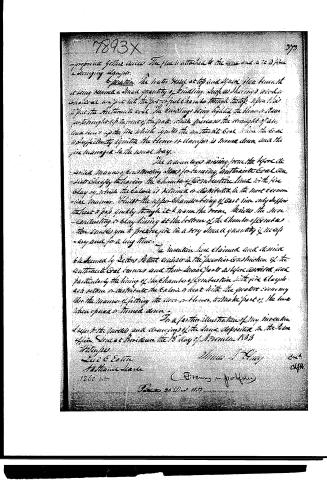
Page 4.
7893X
379.
—improve better air. The fire is attached to the one and is a fine swinging damper.
Operation. The water rises at top and when that level is being burned a small quantity of kindling, such as shavings or wood shavings, are put into the pot or fuel chamber through the top. When this is put the instrument cool. The kindling being lighted, the flame is then brought up in front of the grate, which increases the draught of air, and causes up the fire which ignites the anthracite coal. When the coal is sufficiently ignited, the door or chamber is turned down and the fire managed in the usual way.
The advantages arising from the before described manner of constructing stoves for burning anthracite coal can not chiefly be having the chamber of combustion lined with fire clay or, which the calor is retained or distributed in the most economical manner. Whilst the upper chamber being of cast iron only suffers the heat to pass quickly through it to warm the room. Besides the more economical or clay lining at the bottom of the chamber of combustion enables you to preserve fire in a very small quantity of coals any time for a long time.
The invention here claimed and described is claimed by Letters Patent issued in the previous construction of the anthracite coal burners and their improvements as before described, and particularly the lining of the chamber of combustion with fire clay so as to retain or distribute the calor or heat with the greatest economy, also the manner of fitting the door or chamber to make part of the heat when opened or turned down.
To a further illustration of my invention I refer to the models and drawings of the same deposited in the U.S. office, filed at Providence the 13 day of November 1833.
Witnesses
Luci C. Eaton
Hathorne, Mass.
Thomas J. King
1260 wts
(Drawing on portfolio)
Patent 30 Dec 1833
C. H. C. M.
Published accounts: journal notice
Notice in the monthly list of patents, with remarks
Journal of the Franklin Institute, new ser., vol. 13 (1834), p. 401 · View the page
42. For an Anthracite Coal Burner; James L. Alney, Providence, Providence county, Rhode Island, December 26.
Remarks. Although the patentee has taken much pains to describe his stove, and has furnished a very good drawing with written references; and has, moreover, informed us in what his claims consist, we are at a loss in selecting for our readers the points of novelty. It may be sometimes judicious, where there is little that is novel, to admit of some obscurity; as in that case the imagination is left free to act, and may come in to the aid of the inventor. The stove is to be of cast iron, and we are furnished with two views of it, one in the Grecian, and the other in the Gothic style of architecture. There is a top vessel for containing water, and on removing this, fuel may be supplied to the chamber of combustion, forming the base of a pyramidal, or conical, stove body, the lower part of which is lined with fire clay. The following is an abstract of the advantages offered by this stove, as set forth by the patentee. They consist "chiefly, in having the chamber of combustion lined with fire clay, by which the caloric is retained, or distributed in the most economical manner. Whilst the VOL. XIII. No. 6. - JUNE, 1834. 51 upper chamber being of cast iron only, suffers the heat to pass quickly through it to warm the room. Besides, the nonconducting, or clay, lining at the bottom of the chamber of combustion, enables you to preserve fire in a very small quantity, if necessary, and for a very long time." These are most undoubtedly real advantages, as has been fully proved ever since anthracite coal has been introduced as an article of general consumption; what these observations, therefore, may lack in originality, they must be allowed to make up in truth. The claims are to "the peculiar construction of the anthracite coal burners, and their several parts as before described; and particularly the lining of the chamber of combustion with fire clay, so as to retain or to distribute the caloric or heat with the greatest economy; also the manner of fitting the door, or blower, to make part of the hearth when turned down." The part italicised has been so distinguished by us.
About this record
- Patentee
- Jim Shaw's X-patent list
- Date
- the Name and Date index of patents, USPTO records, Jim Shaw's X-patent list
- Invention
- the Name and Date index of patents
- Listed in
- the Name and Date index of patents, USPTO records, Jim Shaw's X-patent list, the Journal of the Franklin Institute, Burke's List of Patents (1847)
- The Franklin Institute's journal spells the name differently.
- Burke's 1847 Patent Office list gives the same patent.