

Drawings and documents
National Archives restored drawings: drawing
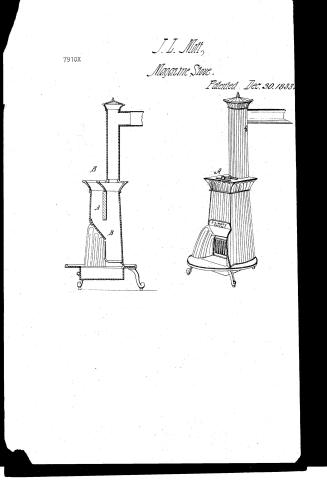
Jordan L. Mott's Patent Drawing for a Stove

National Archives, Restored Patent Drawings (Record Group 241) · Full-size scan at the National Archives · Catalog record
Show the text on the drawing Hide (43 words)
Words on the drawing as machine-read by the National Archives; not checked. Useful mainly for searching.
C.L. Fleischmann Civil Engineer. / oler / on of the the flaring pieces. flarine pieces. / 'NOISIAIT / EEST / + D / b 4 / STOVE / JORDAN L. MOTT's / [154] Magazine Stoves, / KG / INSTO
USPTO scan
The patent as scanned by the USPTO
-
 Page 1
-
 Page 2
-
 Page 3
-
 Page 4


U.S. Patent and Trademark Office · Google Patents
Show the transcription Hide (1,101 words)
Machine transcription (LightOnOCR) of the pages as scanned by the USPTO, most of them the handwritten copies made when the records were restored after the 1836 fire. Not checked; it can misread handwriting, so compare it with the scan.
Page 1.
7910X
J. L. Mott,
Magazine Stove.
Patented Dec. 30, 1833.

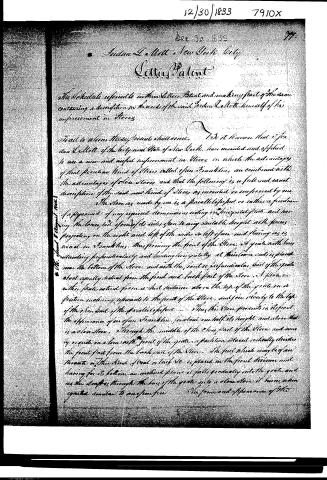
Page 2.
Dec 30, 1833
Indian L. Mott - New York City
Letter Patent
The Schedule referred to in this Letter Patent and making part of this same containing a description in words of the said Indian L. Mott himself of his improvement in Stores.
To all to whom these presents shall come.
Do it known that I, Indian L. Mott of the city and State of New York, have invented and applied to use a new and useful improvement in Stores in which the advantage of that peculiar kind of Stores called open Foundations, are combined with the advantages of close Stores, and that the following is a full and exact description of the said new kind of Stores as invented or improved by me.
The Store as made by me is a parallelopiped or rather a fraction of a parallelopiped of any required dimensions resting on a horizontal plane and having the lower half of one of its sides open to any suitable height with pieces projecting on the right and left of the side so left open and placing as is usual in Foundations, thus forming the front of the Store, a grate with bars standing perpendicularly and being horizontally at their lower ends is placed near the bottom of the Store, and with the front is perpendicular, bars of the grate about equally distant from the front and back part of the Store. A plate or rather plate, extend from a fixed distance above the top of the grate on a friction inclining upwards to the front of the Store, and join closely to the top of the other side of the parallelopiped. Thus the Store presents in its front the appearance of an open Foundation, for about one half its height and above that is a close Store. Through the middle of the close part of the Store and near its or quite on a line with front of the grate, a partition board vertically divides the front part from the back part of the Store. The fuel which may be of any material, in the kind of coal or turf &c is placed in the front division and having for its bottom an inclined plane it falls gradually into the grate and as the draft is through the bars of the grate into a close Store it burns when ignited similar to an open fire. The form and appearance of the
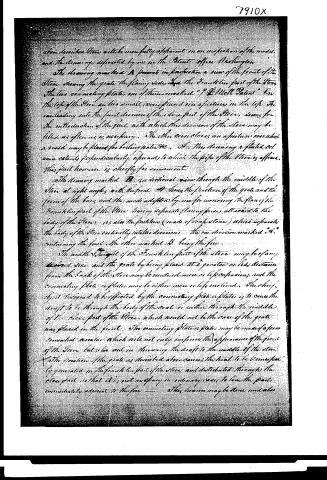
Page 3.
The above described Stove will be manifestly apparent on an inspection of the model and the drawings deposited by me in the Patent Office Washington.
The drawing marked A presents in perspective a view of the front of the Stove, showing the grate, the flaring sides, and the Franklin part of the Stove. The two connecting plates, one of them marked "I & Mott Patent" on the top of the Stove, are two small cross pieces placed one in front of the other leading into the front division of the stove part of the Stove, serving for the introduction of the fire, with which this division of the Stove may be filled as often as is necessary. The other cross piece, on a portion over which a vessel may be placed for boiling water, etc. As this drawing a flat iron with calms, perpendicularly upwards, to which the feet of the Stove is affixed. This foot however is chiefly for ornament.
The drawing marked B is an axial view through the middle of the Stove at right angles with the front. It shows the position of the grate and the form of the bars and the mode adopted by me for increasing the flame of the Franklin part of the Stove, having separate flaring pieces attached to the body of the Stove, as also the Franklin (made of soapstone) which separates the body of the Stove sectionally into two divisions. The one division marked "A" containing the fire, the other marked "B" being the fire.
The width and height of the Franklin part of the Stove may be of any desired size, and the grate by being placed at a greater or less distance from the back of the Stove may be rendered more or less expansive, and the connecting plate or plates may be either more or less inclined. The chief object designed to be effected by the connecting plate or plates is to cause the draft to be through the body of the stove or rather through the middle of the stove part of the Stove, which would not be the case if the grate was placed in the front. The connecting plate or plates may be made of a form somewhat circular which will not only improve the appearance of the front of the Stove but also aid in throwing the draft to the middle of the stove.
The position of the grate as described above causes the heat to be immediately generated in the front part of the Stove and distributed through the stove part so that it is not necessary in ordinary cases to have the parts immediately adjacent to the fire. This however may be done and also
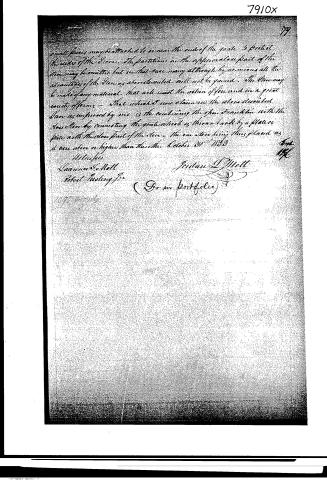
Page 4.
small pieces may be attached to or near the ends of the grate to protect the sides of the stove. The partitions in the upper or lower part of the stove may be omitted but in that case many although by no means all the advantages of the stove as above described will not be gained. The stove may be made of any material that will resist the action of fire and in a great variety of forms - that which I now claim in the above described stove as improved by me is the combining the open Franklin with the stove stove by connecting the grate which is thrown back by a plate or plate with the close part of the stove - the one stove being thus placed as it are above or higher than the other. October 31st 1833
Witness
Laurence S. Holt
Robert Austing Jr
Frederick D. Holt
(For my portfolio)
Published accounts: journal notice
Notice in the monthly list of patents, with remarks
Journal of the Franklin Institute, new ser., vol. 14 (1834), p. 24 · View the page
60. For an improvement in Stoves; Jordan L. Mott, city of New York, December 30.
Remarks. The claim made under this patent is to the "combining the open Franklin with the close stove, by connecting the grate, which is thrown back, by a plate, or plates, with the close part of the stove; the one stove being thus placed, as it were, above, or higher than the other." The lower portion of this stove is to be in the form of the open, or Franklin stove, and is to contain a grate for fuel; the plates forming the exterior of it are to be continued up to any convenient height, and this upper part constitutes the close stove. There may be a pipe, from the top plate to carry off the smoke; and it is proposed to divide the close part into two compartments, by a soap stone partition, descending from the top plate, to a considerable distance down; the anthracite may be put through an opening in the top plate over the front division, and it will then fall into the grate; the front plate being curved inwards, so as to conduct the coals over the upper bar; this constitutes the principal novelty, and is the foundation of the claim.
About this record
- Patentee
- DATAMP
- Date
- the Name and Date index of patents, DATAMP, USPTO records
- Invention
- DATAMP
- Listed in
- the Name and Date index of patents, DATAMP, USPTO records, Jim Shaw's X-patent list, the Journal of the Franklin Institute, Burke's List of Patents (1847)
- Burke's 1847 Patent Office list gives the same patent.