

Drawings and documents
National Archives restored drawings: drawing
Isaac Eaton's Patent Drawing for a Bedstead


National Archives, Restored Patent Drawings (Record Group 241) · Full-size scan at the National Archives · Catalog record
Show the text on the drawing Hide (260 words)
Words on the drawing as machine-read by the National Archives; not checked. Useful mainly for searching.
Sheet 1. ISAAC EATON'S / 5. BEDS. / BEDSTEAD. . / Corner Fastenings. / Patented / CLASSIMICATION / 7924-X 4-X / DIVISION. / h. / e. / b. / h. / m. / g. / Fig2 2. / d. / Revolving Rail. / NM2 / C. / b. / e: / a, The rail. b,h,the wooden gudgeons, , turned on the rail. c,c, common bedstead / screws, in the gudgeons. d, rag wheel. e, a square part, embraced by rag wheel. / See specification. / B.B.
Sheet 2. 5. BEDS. / [62] Mosquito Nets & Canopies / Div. / CLASSIFICATION / 7924 X / DIVISION. / Patented Dec.31, 1833. / I.Eaton, / Bedstead Fastening, / if / Claim; / What J claim as my invention and wish to secure by letters hatent, is the / before described improvement in the construction of bedsteads, by which / the sacking bottom can be strained with a single revolving rail / and the curtain frame sustained by the iron braces, / The curtain frame is sustained by four braces made of strong / wird, one end ofwhich is inserted into w small hole in the / top of each host, the other divides in such a manned / that one branch or brace reaches to the corner of the / curtain frame whilst the other extends the distance / of a foot from the corner, / The upper ends of the boacs must have shoulders i / with bolts k. extending therefrom on which the frame / rests secured by screw taps d. only proof heads on the botts / with slidesm, slipped on them so as to embrace the bolts / under the heads in the manner represented in the / drawing," / See Drawingi Beds: Cordings and Fastenings."
USPTO scan
The patent as scanned by the USPTO
-
 Page 1
-
 Page 2
-
 Page 3


U.S. Patent and Trademark Office · Google Patents
Show the transcription Hide (1,058 words)
Machine transcription (LightOnOCR) of the pages as scanned by the USPTO, most of them the handwritten copies made when the records were restored after the 1836 fire. Not checked; it can misread handwriting, so compare it with the scan.
Page 1.
7924X
I. Eaton,
Bedstead Fastening,
Patented Dec. 31, 1833.

Page 2.
7924X
Dec 31, 1833
Isaac Eaton, of Mount Gilad, Va.
Letter Patent.
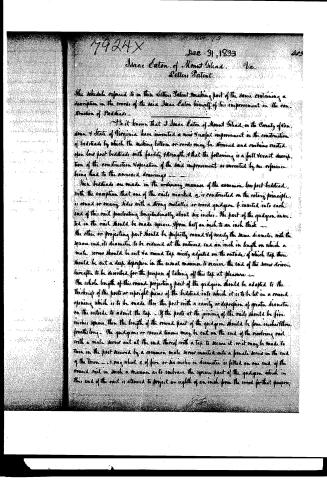
The schedule referred to in this Letter Patent making part of the same containing a description in the words of the said Isaac Eaton himself of his improvement in the construction of Bedsteads.
Be it known that I Isaac Eaton of Mount Gilad, in the County of Lou- down & State of Virginia have invented a new & useful improvement in the construction of bedsteads, by which the making bottom or cords may be strung and contains created open low post bedsteads with facility & strength & that the following is a full & exact description of the construction & operation of the said improvement as invented by me reference being had to the annexed drawings — —
These bedsteads are made in the ordinary manner of the common low post bedstead, with the exception that one of the rails marked a, is constructed on the rotary principle, is round or many sides with a strong metallic or wood quidgen b inserted into each end of this rail penetrating longitudinally about six inches — the part of the quidgen inserted in the rail should be made square from half an inch to an inch thick — the other or projecting part should be perfectly round & of nearly the same diameter with the square end, its diameter to be reduced at the outward end an inch in length on which a male screw should be cut & a round tap nicely adjusted on the outside of which tap there should be cut a deep depression in the usual manner to receive the end of the screw driver, hereafter to be described, for the purpose of taking off this tap at pleasure —
The whole length of this round projecting part of the quidgen should be adapted to the thickness of the posts or upright pieces of the bedstead into which it is to be let in a round opening which is to be made thru the post with a cavity or depression of greater diameter on the outside to admit the tap — If the posts at the joining of the rails should be five inches square, then the length of the round part of the quidgen should be four inches & three fourths long — The quidgen or round tenon may be cut on the end of the revolving rail with a male screw cut at the end thereof with a tap to secure it or it may be made to turn in the post secured by a common male screw inserted into a female screw in the end of the tenon — a rag wheel c of five or six inches in diameter is fitted on one end of the round rail in such a manner as to embrace the square part of the quidgen which in this end of the rail is allowed to project an eighth of an inch from the wood for that purpose;
Page 3.
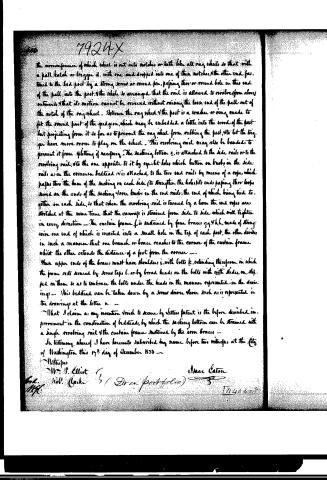
The circumference of which wheel is cut into notches or teeth like all ratchet wheels, so that with a pall, latch or tongue d, with one end dropped into one of these notches, the other end fastened to the bed post by a strong screw or round pin, passing through or round hole in this end of the pall into the post. The whole is arranged that the rail is allowed to revolve from along outward, that its motion cannot be reversed without raising the loose end of the pall out of the notch of the ratchet wheel. Between the ratchet wheel and the post is a washer or ring made to fit the round part of the quidigon, which may be embedded a little into the wood of the post but projecting from it so far as to prevent the ratchet wheel from rubbing the post, to let the trigger have more room to play on the wheel. This revolving rail may also be braced to prevent it from splitting if necessary. The locking bottom c, is attached to the side rails or to the revolving rail, to the one opposite to it by equal holes which button on knobs in the side rails a, in the common bedstead. It is attached to the two end rails by means of a rope which passes through the hem of the locking on each side (to strengthen the holes) its ends passing through loops secured on the ends of the locking or on knobs in the end rails; the end of which being tied together on each side, so that when the revolving rail is turned by a lever the end ropes are stretched at the same time that the canvas is strained from side to side which will tighten in every direction. The curtain frame f is sustained by four braces g, g, h, h, made of strong iron, one end of which is inserted into a small hole in the top of each post, the other divides in such a manner that one branch or brace reaches to the corner of the curtain frame whilst the other extends the distance of a foot from the corner.
Their upper ends of the braces must have shoulders i, with bolts k, extending therefrom in which the frame rests secured by screw taps l, or by broad heads on the bolts with with slides, m, slipped on them so as to embrace the bolts under the heads in the manner represented in the drawings. This bedstead can be taken down by a screw driven lever such as is represented in the drawings at the letter n.
What I claim as my invention which to secure by Letters patent is the before described improvement in the construction of bedsteads, by which the locking bottom can be strained with a single revolving rail and the curtain frame sustained by the iron braces.
In testimony whereof I have hereunto subscribed my name before two witnesses at the City of Washington this 19th day of December 1833.
Witnesses
Wm. S. Elliot
Isaac Eaton
Published accounts: journal notice
Notice in the monthly list of patents, with remarks
Journal of the Franklin Institute, new ser., vol. 14 (1834), p. 30 · View the page
We do not see any think in the "general form," or in the " particular mode of producing and applying the heat," by which to distinguish this stove from some, and indeed from many, others. 73. For an improvement in the construction of Bedsteads; Isaac Eaton, Mount Gilead, Loudon county, Virginia, December 31.
Remarks. The object of this invention is to tighten the sacking bottom with facility, and to convert a low into a high post bedstead, for the hanging of curtains. The description, as given, appears somewhat formidable, but the result does not correspond thereto. The sacking is to be tightened by making one of the side rails revolve, applying a rag wheel and pall at the ends to keep it in its place. The posts are to be lengthened by inserting two stout wires in the top of each of them, one of which is to pass straight up to the tester, and the other to reach it in an oblique direction, so as to form a brace. The claim is to the "constructing of bedsteads, by which the sacking bottom can be strained with a single revolving rail; and the curtain frame sustained by the iron braces."
About this record
- Patentee
- the Journal of the Franklin Institute, Journal
- Date
- the Name and Date index of patents, USPTO records, Jim Shaw's X-patent list
- Invention
- the Name and Date index of patents
- Listed in
- the Name and Date index of patents, USPTO records, Jim Shaw's X-patent list, the Journal of the Franklin Institute, Burke's List of Patents (1847)
- The patentee's full name comes from the Franklin Institute's journal.
- Burke's 1847 Patent Office list gives the same patent.