

Drawings and documents
National Archives restored drawings: drawing
Eliphalet Nott's Patent Drawing for a Stove

National Archives, Restored Patent Drawings (Record Group 241) · Full-size scan at the National Archives · Catalog record
Show the text on the drawing Hide (676 words)
Words on the drawing as machine-read by the National Archives; not checked. Useful mainly for searching.
RNACES / Oal / itoves. / 166 STOVES & FURNACES. / Cooking / ELIPHALET.NOTT" / Síove, / TION / For prerending ihe wasłe ofheal. / 7948 X / Patented Jan. 947854. / DIVISION. / Lig.1 / Thig / ENCES. / REFER / is / Alig 5 / 90 / Cet / * .r. I" hollow plinth S. store pyre that for holding meat / q.1. Elevation of a cylindrical Cookstove. a ask drawer. / in / oven. / be / Bon / oven doors Damper handle dd Rettles C valve for open- / in / Fiy 6 Lection of slove ur which towords the outer hollow / 1- / and shulling alternate outlets from chamber of combust / engular is contracted the base so / SJ / as to close around the intiner pressure / Hig 2 vertical section of eng a uspub b. grate c chamber / a chamber b.b. flue for flame C.C howy outal floors / carribustion de bruck front of interior flue ee brick side walls / reverberating flame. d, section of presm con / tracted lowards the base. e outer door to chamber / of chamber of combustion pitition me flue for kettles 5h alter / nate outtes for flame from chamber of bombustion to kittle flue & / of combustion shut . I outer door to com / from kettle flue to store pupe according as the valves qn are al / bustion open finner door to chambe of com / terriately opend & closed being open when 71 is shill and g / bustion J.g. section of floor of over h oven. / when it is open. ці, brust of inverted truncaled come for heat- / Lig / 2.2 ceiling of own, R.K. kettle flue ll aperture / mg oven bottom by reflaction kk final fiorizontal flat or oven bottom / Fig.8 / for hettles m nature handle for opening and / and Hrutting a alternately. pagages oferflame / и oven mm second hovizontal flat or cren ceiling h valve for / Fig / from channber of constiustion, n.n hollow flinth. / оротинд and shulling atternate outtels from chambers of com- / 00 under cover of kettle flue p.pe upper cover of hettle / Fig 7 section of as store with an over on / flue- betwen which covers are intermediate space left / are side of a chaminer of consebustion / value in pupe for орешид and shutting alemately the / wunning acrofs the same in which the / divided passage into the same / escape of heat is preserved, by a bud lin / my at the back end of the chamberof / Dig $ Plan of plate mm oz second honzoutal flat- a.gale / combustion. and also on the tide opposite / b outlet to boiler flue, shut by value d cutlet to boiler flue / side of the oven - a chamber of combustion / open drabe for onexony and shutting be alternately / b.6flue for flame C.C. floors by which fame is / reverberated d brist living ab back er dat / Fig Ther cover of kettle flue a a a.a apportures for kettle's / be ver of chamber of combustion c enlet to smoke-pipe closed / chamber of cornbustion C. door to chambering / d intet to smike pupe open / combustion f. partition in kettle flue, on one / Sig A. / Kig.S, / Lide of which The flame passes to Lettler a d / Fug Section of a slove in which two concentric hollow F / on the other to smoke pipe g.j. Lettle dal / are plate / angular pisims both vesting on the health are / h. cover of bettle flue. 2 smoke pipe / employed bottom of central depression in hearth / plate for Loiling t cavity of coal's for boiling C'. outer / marge of hearth plate a chamber of combustion flue / Fig f. cover or top plate of Eig.7 / for flame et horizontal floors reverberating flame g section of / a,a,a apartures for kettles. bouth t / interior apgular hollow prism h. door to cham ber of / Amot pipe / combustion 2,2 selion of eselemor angular presm k.k. / even C. door to over and outer cloor to chanber of oom- / buslion m.m. ceiling of oven and floor of kettle flue. / n.n. kettle flue Q, cover of Reller flue p.p apetures for / kittle q er handle for operung and shutting at / ernate pagaages from chamber of combustion.=*
USPTO scan
The patent as scanned by the USPTO
-
 Page 1
-
 Page 2
-
 Page 3
-
 Page 4
-
 Page 5
-
 Page 6
-
 Page 7


U.S. Patent and Trademark Office · Google Patents
Show the transcription Hide (1,696 words)
Machine transcription (LightOnOCR) of the pages as scanned by the USPTO, most of them the handwritten copies made when the records were restored after the 1836 fire. Not checked; it can misread handwriting, so compare it with the scan.
Page 1.
7948X
E. Nott,
Cook Stove.
Patented Jan. 2, 1834.
Fig. 1.
Fig. 2.
Fig. 3.
Fig. 4.
Fig. 5.
Fig. 6.
Fig. 7.
Fig. 8.
Page 2.
7948x June 9, 1834 501
Eliphalet Stone
Letters Patent.
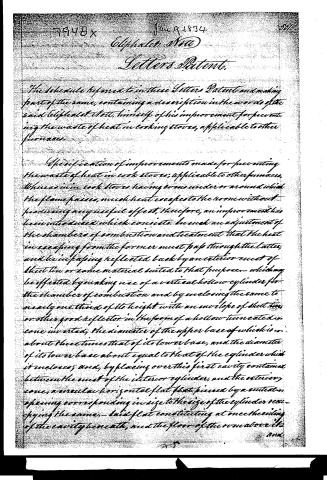
The schedule before to in these Letters Patent and making part of the same, containing a description in the words of the said Eliphalet Stone, himself, of his improvement for preventing the waste of heat in cooking stoves, applicable to other furnaces.
Specification of improvements made for preventing the waste of heat in cook stoves; applicable to other furnaces. Whereas in cook stoves having ovens under or around which the flame passes, much heat escapes to the room without producing any useful effect, therefore, an improvement has been introduced which consists in such an adjustment of the chambers of combustion and treatment that the heat in escaping from the former must pass through the latter, and be in passing reflected back by an exterior coat of sheet tin or some material suited to that purpose, which may be effected by making use of a vertical hollow cylinder for the chamber of combustion and by enclosing the same to nearly one third of its height with an envelope of sheet tin, or other good reflector in the form of a hollow truncated cone inverted, the diameter of the upper base of which is about three times that of its lower base, and the diameter of its lower base about equal to that of the cylinder which it encloses; and, by placing over this first cavity contained between the coat of the interior cylinder, and the exterior cone, a circular horizontal flat plate pierced by a vertical opening corresponding in size to the size of the cylinder receiving the same, said flat constituting at once the ceiling of the cavity beneath, and the floor of the cone above it, and
Page 3.
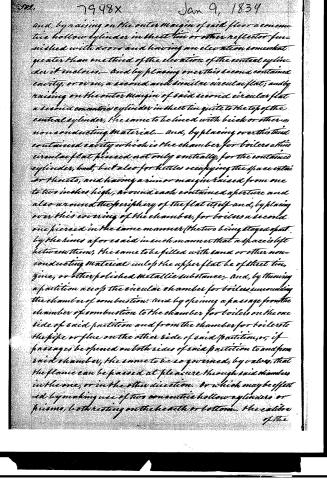
and, by raising on the outer margin of said floor a concentric hollow cylinder in sheet tin or other reflector finished with doors and having an elevation somewhat greater than one third of the elevation of the central cylinder it encloses, and by placing over this second contained cavity, or oven, a second and similar circular flat; and by raising on the outer margin of said second circular flat a second concentric cylinder in sheet tin quite to the top of the central cylinder, the same to be lined with brick or other non-conducting material, and, by placing over this third contained cavity which is the chamber for boilers a third circular flat pierced not only centrally, for the contained cylinders, but, but also for kettles occupying the space exterior thereto, and having a rim or margin raised from one to two inches high, around each contained aperture and also around the periphery of the flat itself and, by placing over this covering of the chamber, for boilers a second one pierced in the same manner (the two being stayed apart by the rims aforesaid in such manner that a space is left between them, the same to be filled with sand or other non-conducting material unless the upper flat be of sheet tin, zinc, or other polished metallic substance; and, by throwing a partition across the circular chamber for boilers surrounding the chamber of combustion: and by opening a passage from the chamber of combustion to the chamber for boilers on the one side of said partition and from the chamber for boilers to the pipe or flue on the other side of said partition, or, if passages be opened on both sides of said partition to and from said chamber, the same to be so governed, by valves, that the flame can be passed at pleasure through said chamber in the one, or in the other direction. Or which may be effected by making use of two concentric hollow cylinders or prisms, both resting on the hearth or bottom. The calibre of the
Page 4.
7948X Jan 9, 1834
of the interior one constituting the chamber of combustion and flue for flame to pass off by, either direct, or by convection; as preferred; the rest of the exterior one, constituting the rest of the oven, and the space between the two, the oven itself; the requisite apertures for ingress and egress being provided in each, and both being surrounded by a horizontal flue or chamber for containing boilers in giddles &c. It is to be understood that a second exterior lamina may, if necessary, be added; and the space between the two filled with sand or left vacant as preferred—and it is, also, to be understood that the exterior prism when prisms are employed, may, if desired, be so constructed, towards its lower extremity as to close around the interior prism, or which may be more or less perfectly effected, by adjusting in like manner, especially if wood be the fuel in use, separate ovens on the sides of a chamber of combustion; or, even a single oven on a single side; provision being made in such case for the ingress of fuel, laterally at one end, and the egress of flame, vertically, at the other; the same to be passed horizontally over the ceiling of said chamber, to the end at which the fuel enters, and thence upwards; into the chamber for boilers which rests thereon, and provision being also made for preventing the escape of heat, from the side on which there is no oven, by the interposition of a brick wall, along the same; or by any other manner of adjustment preferred; Provided, only, an oven, heated by radiation and reflection, and the outer crust of which is a sheet tin reflector, or a reflector of any other material, be so combined with a chamber of combustion, in a cook stove, as to form an integral part thereof.—For further information, reference must be had to the drawings and explanations connected herewith.
Page 5.
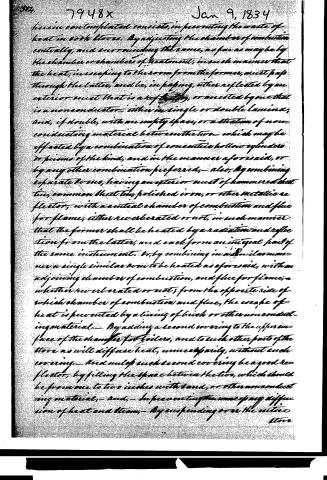
herein contemplated consists, in preventing the waste of heat in cook stoves. By adjusting the chamber of combustion centrally, and surrounding the same, as far as may be by the chamber or chambers of treatment, in such manner that the heat, in escaping to the room from the former, must pass through the latter, and be, in passing, either reflected by an exterior sheet that is a reflector, or arrested by one that is a nonconductor—either in single or double lamina; and, if double, with an empty space, or a stratum of non-conducting material between the two—which may be effected by a combination of concentric hollow cylinders or prisms of the kind, and in the manner aforesaid, or by any other combination preferred,—also, by combining separate boilers, having an exterior sheet of hammered sheet iron, common sheet iron, polished iron, or other metallic reflector, with a central chamber of combustion and flue for flame, either reverberated or not, in such manner that the former shall be heated by a radiation and reflection from the latter, and each form an integral part of the same instrument. Or, by combining in a similar manner a single similar boiler to be heated as aforesaid, with an adjoining chamber of combustion, and flue for flame, in whether reverberated or not; from the opposite side of which chamber of combustion and flue, the escape of heat is prevented by a lining of brick or other nonconducting material.—By adding a second covering to the upper surface of the chamber for boilers, and to such other parts of the stove as will diffuse heat, unnecessarily, without such covering.—And unless such second covering be a good reflector, by filling the space between the two, which should be from one to two inches with sand, or other nonconducting material,—and,—in preventing the same escape of diffusion of heat and steam,—By suspending over the entire stove
Page 6.
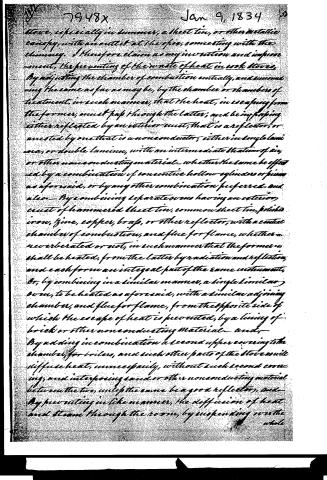
store, especially in summer, a sheet tin, or other metallic canopy, without an outlet at the open, connecting with the chimney. I therefore claim as my invention and improvement, the preventing of the waste of heat in cook stoves, by adjusting the chamber of combustion centrally, and surrounding the same as far as may be, by the chamber or chambers of treatment, in such manner, that the heat, in escaping from the former, must pass through the latter; and being so passing either reflected by an exterior wall, that is a reflector, or arrested by one that is a nonconductor; either in single laminæ, or double laminæ, with an intermediate stratum of air, or other nonconducting material, whether the same be effected by a combination of concentric hollow cylinders or pipes as aforesaid, or by any other combination preferred, and also—By combining separate ovens having an exterior crust of hammered sheet tin, common sheet tin, polished iron, zinc, copper, brass, or other reflector, with a central chamber of combustion, and flue for flame, whether reverberated or not, in such manner that the former shall be heated, from the latter by radiation and reflection, and each form an integral part of the same instrument, or, by combining in a similar manner, a single similar oven, to be heated as aforesaid, with a similar adjoining chamber, and flue for flame, from the opposite side of which the escape of heat is prevented, by a lining of brick or other nonconducting material—and—By adding in combination a second upper covering to the chamber, for boilers, and such other parts of the stove will diffuse heat, unecearily, without such second covering, and interposing sand or other nonconducting material between the two, unless the same be a good reflector, and—By preventing in like manner, the diffusion of heat and steam through the room, by suspending in the whole
Page 7.
7948X Jan. 9, 1834
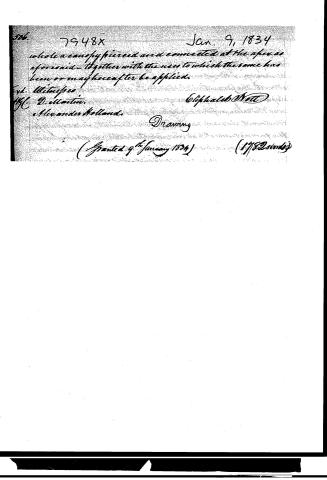
whole a canopy pierced and connected at the apex as aforesaid - together with the uses to which the same has been or may hereafter be applied.
Eliphalet Nott
Alexander Holland
Drawing
(Granted 9th January 1834) (1782 Sunday)
Published accounts: journal notice
Notice in the monthly list of patents
Journal of the Franklin Institute, new ser., vol. 14 (1834), p. 112 · View the page
7. For Preventing the waste of Heat in Cook Stoves; applicable to other purposes; Eliphalet Nott, Schenectady, New York, January 9.
Published accounts: journal notice
Notice in the monthly list of patents
Journal of the Franklin Institute, new ser., vol. 14 (1834), p. 133 · View the page
Description of an improvement for preventing the waste of heat in Cook Stoves; applicable to other furnaces; for which a patent was granted to ELIPHALET NOTT, of Schenectady, New York, January 9th, 1834.
DATAMP: illustration
Illustrations from DATAMP
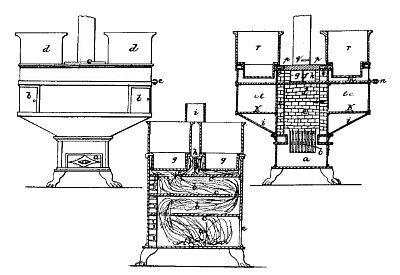

DATAMP (Directory of American Tool and Machinery Patents), via the Internet Archive · Archived DATAMP page
About this record
- Patentee
- DATAMP
- Date
- the Name and Date index of patents, DATAMP, USPTO records
- Invention
- DATAMP
- Listed in
- the Name and Date index of patents, DATAMP, USPTO records, Jim Shaw's X-patent list, the Journal of the Franklin Institute, Burke's List of Patents (1847)
- Burke's 1847 Patent Office list gives the same patent.