

Drawings and documents
USPTO scan
The patent as scanned by the USPTO
-
 Page 1
-
 Page 2
-
 Page 3


U.S. Patent and Trademark Office · Google Patents
Show the transcription Hide (500 words)
Machine transcription (LightOnOCR) of the pages as scanned by the USPTO, most of them the handwritten copies made when the records were restored after the 1836 fire. Not checked; it can misread handwriting, so compare it with the scan.
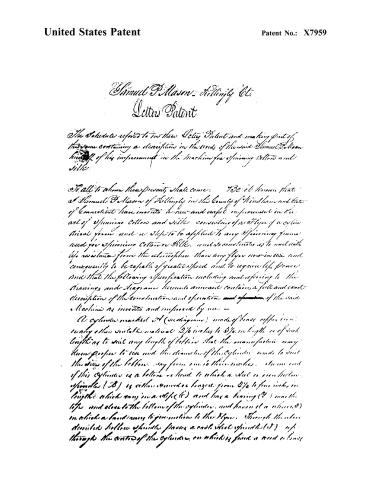
Page 2.
United States Patent
Patent No.: X7959
Samuel P. Mason, Killingly, Ct.
Letter Patent
The Schedule refers to the above Letter Patent and making part of the same containing a description in the words of the said Samuel P. Mason himself of his improvement in the Machine for spinning Cotton and Silk.
To all to whom these presents shall come: We do know that Samuel P. Mason of Killingly in the County of Windham and State of Connecticut have invented a new and useful improvement in the art of spinning Cotton and Silk consisting of a Flyer of a certain kind form and a Shaft to be applied to any Spinning frame used for spinning Cotton or Silk, and is constructed as to need with less resistance from the atmosphere than any flyer now in use and consequently to be capable of greater speed and to require less power and that the following specification including and referring to the Drawings and Diagrams hereto annexed contains a full and exact description of the construction and operation of the said Machine as invented and improved by me —
A cylinder marked A (see diagram) made of brass or any other suitable material 2½ inches to 3½ inches in length or of such length as to suit any length of bobbins that the manufacturer may deem proper to use and the diameter of the cylinder made to suit the size of the bobbins, say from one to three inches. One end of this cylinder is a hollow or band to which a shaft or iron hollow spindle (B) is either screwed or hinged from 2½ to four inches in length which runs in a shaft (C) and has a bearing (D) near the top and close to the bottom of the cylinder, and having at a distance in which a band serves to give motion to the Flyer. Through the above described hollow spindle passes a cast steel spindle (E) up through the center of the cylinder on which is fixed a rod or bar
Page 3.
United States Patent
Patent No.: X7959
button (B), which supports the bobbin (B). The cast steel spindle last mentioned has a transverse motion roller up and down which regulates the filling or laying of the yarn on the bobbin. At the top of the cylinder which stands perpendicular, either small hooks are attached or small metal studs in the end, for the purpose of giving twist to and guiding the thread on the bobbin. The above mentioned spindle machine is not differing essentially from many spindle machines now in use and claimed as a part of the invention.
In witness whereof I have hereunto subscribed my name this 16th day of December A.D. 1839
Owen Parish 3 Witnesses
Thomas Banks 3 Witnesses
Samuel D. Mason
4156 12/39
Published accounts: journal notice
Notice in the monthly list of patents, with remarks
Journal of the Franklin Institute, new ser., vol. 14 (1834), p. 114 · View the page
15. For a Cylindrical Flyer, and a Step for Spinning Machines; Samuel P. Mason, Killingly, Windham county, Connecticut, January 17.
Remarks. The flyer here patented consists of a cylindrical ferule, or barrel, of metal, sufficiently long and wide to admit the spool upon which the spun material is to be wound. The upper end of this cylinder is open, and has pins, or notches, on its edge, to guide the thread; the lower end of it is closed, and has affixed to it, by soldering or otherwise, a hollow steel or iron spindle, which receives a whirl, and allows the main spindle, that supports the bobbin, to traverse up and down within it. The hollow spindle has, of course, a suitable step and collar, to support it as it revolves, with its cylindrical flyer. The advantage proposed by the adoption of this spindle, is the getting rid of the resistance of the atmosphere, and the consequent accelerated motion which may be given to it. The only part considered new is the flyer, as described. As regards the getting rid of the resistance of the atmosphere, we see but little difference between this and the can spinner patented by John Thorp, November 20th, 1828, (vol. iv. p. 65.) In the foregoing patent, the can is inverted, and is operated upon in a different, and perhaps in a better way, than in Thorp's machine, but still, in the point alluded to, they appear to be similar.
About this record
- Patentee
- DATAMP
- Date
- the Name and Date index of patents, DATAMP, USPTO records
- Invention
- DATAMP
- Listed in
- the Name and Date index of patents, DATAMP, USPTO records, Jim Shaw's X-patent list, the Journal of the Franklin Institute, Burke's List of Patents (1847)
- Burke's 1847 Patent Office list gives the same patent.