

Drawings and documents
National Archives restored drawings: drawing
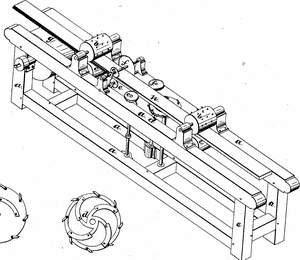
John D. Beers' Patent Drawing for a Machine for Tonguing, Grooving, and Planing Boards

National Archives, Restored Patent Drawings (Record Group 241) · Full-size scan at the National Archives · Catalog record
Show the text on the drawing Hide (132 words)
Words on the drawing as machine-read by the National Archives; not checked. Useful mainly for searching.
Ling treatching / 144 WOOD-WORKING MACHINES. / Plan Matching. / CLASSI TCATION / 7961- X / DIV ISION. / John / Meachine for longueing, grooving splancing boards. / Patented Jan 18th 1834 1834 / References / a.a a.ge Frame / b.b. Vertical wheels with points which catches hold of the board / to paps it in its proper position through the machine / c.c d ditts ditto without points for the board to reston / Circular and saw If shawing irons for reducing a. thicknefs, / smoothing the of plank boards, se. / f. / e.e.e. of Circular saws for forming the tongue / ditts ditto / Drum / the groove / Board. / Patent Office / del Made under the direction of the Commy / Patents in comformity with act. Mari / nd Sushorth / Commipions of Paty
USPTO scan
The patent as scanned by the USPTO
-
 Page 1
-
 Page 2
-
 Page 3


U.S. Patent and Trademark Office · Google Patents
Show the transcription Hide (881 words)
Machine transcription (LightOnOCR) of the pages as scanned by the USPTO, most of them the handwritten copies made when the records were restored after the 1836 fire. Not checked; it can misread handwriting, so compare it with the scan.
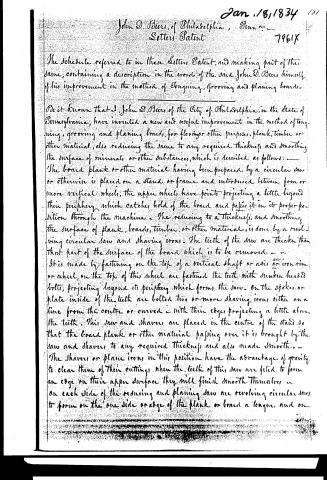
Page 1.
7961X J. D. Beers,
Planing and Matching Machine.
Patented Jan. 18, 1834.

A.M. PHOTO-LITHO. CO. N.Y. (OSBORNE'S PROCESS)
Page 2.
Jan. 18, 1834 181
John D. Beers, of Philadelphia, Penna.
Letters Patent 7961X
The Schedule referred to in these Letters Patent, and making part of the same, containing a description in the words of the said John D. Beers himself, of his improvement in the method of tonguing, grooving and planing boards.
Be it known that I, John D. Beers, of the City of Philadelphia, in the State of Pennsylvania, have invented a new and useful improvement in the method of tonguing, grooving and planing boards, for flooring or other purposes, plank, timber or other material, also reducing the same to any required thickness, and smoothing the surface of minerals or other substances, which is described as follows:
The board, plank or other material having been prepared by a circular saw or otherwise is placed on a stand or frame and introduced between four or more vertical wheels, the upper wheels have points projecting a little beyond their periphery which catches hold of the board and passes it in its proper position through the machine. The reducing to a thickness, and smoothing the surface of plank, boards, timber, or other material, is done by a revolving circular saw and shaving irons. The teeth of the saw are thicker than that part of the surface of the board which is to be removed.
It is made by fastening on the top of a vertical shaft or axis an iron rim or wheel, on the top of this wheel are fastened the teeth with sunken headed bolts, projecting beyond its periphery which forms the saw. On the spokes or plate inside of the teeth are bolted two or more shaving irons either on a line from the centre or curved with their edges projecting a little above the teeth. This saw and shavers are placed in the centre of the stand so that the board, plank or other material passing over it is brought by the saw and shavers to any required thickness and also made smooth.
The shavers or plane irons in this position have the advantage of gravity to clear them of their cuttings, when the teeth of this saw are filed to form an edge on their upper surface they will finish themselves.
On each side of the reducing and planing saw are revolving circular saws to form on the one side or edge of the plank or board a tongue, and on
Page 3.
the other side or edge a groove the whole length if required. To form the tongue are placed on a vertical shaft three circular saws bolted together. The central saw is the thickness of the tongue intended to be made and double the width of the tongue. Less in diameter than the upper and lower saws. The upper and lower saws cut the depth in the side or edge of the board or plank that is required for the width of the tongue while the central saw finishes the edge of the tongue.
Two circular saws are also fastened on horizontal shafts or axis, one above the board, the other below it and set the width of the tongue from the edge of the plank or board and to cut into the carf made by the tonguing saws on the vertical shaft which finishes the tongue. On the other side or edge of the board are one, two, three or more circular saws on vertical shafts and are set three fourths their thickness above each other and are placed to cut in the edge of the board a groove the required depth and width. These saws as well as all the others are not set in the teeth when the work is required very smooth. On a horizontal shaft before or behind the grooving saws is placed a circular saw of any required thickness to trim the shoulder for the tongue to fit against.
To illustrate my invention further I refer to the drawings of the same, deposited in the patent office. What I the said John D. Beers claim as my invention is 1st: The improvement and application of circular saws for tonguing grooving and trimming boards for flooring or other purposes. Plank timber or other material, also their application to finish smooth and the mode of application as herein described. 2nd: The application of circular saws for reducing to a thickness and planing boards, for flooring and other purposes, plank, timber or other material and smoothing the surface of minerals or other substances also the application of planing or shaving iron in the mode and for the purposes herein described. 3rd: The application of wheels with points projecting beyond their periphery to move the board plank or other material in its proper position through the machine.
Witnesses,
Robert Perry
John B. Perry
John D. Beers
(Patented January 18, 1874)
Drawing
Published accounts: journal notice
Notice in the monthly list of patents, with remarks
Journal of the Franklin Institute, new ser., vol. 14 (1834), p. 116 · View the page
19. For a Machine for Tonguing, Grooving, and Planing Boards, for flooring, and other purposes; John D. Bears, city of Philadelphia, January 18.
Remarks. The planing, tonguing, and grooving, effected by this machine is, almost exclusively, done by circular saws; in most instances, the application of these is sufficiently plain, although the specification is not very clearly drawn up, and the drawing not well executed. The planing is to be effected by a circular saw, having teeth on its rim, their edges being in the plane of the wheel, like the teeth upon a crown wheel. These teeth, when sharp, will, it is said, render the face of a board quite smooth; but, in addition to them, knives, or cutters, are attached to the arms of the wheel, like those sometimes used in straw cutting machines, the edges of these knives being either straight or curved, and projecting a little beyond the teeth which are on the periphery. The board to be planed is passed between rollers, two of which have projecting teeth, or pins, to take hold of it, and cause it to advance. The planing wheel operates upon the under side of the board, so that the shavings fall down as fast as they are taken off. The grooving and tonguing, is to be effected entirely by circular saws, some of which work vertically, and others horizontally, according to the purpose which they are intended to answer. The grooving may be effected by three circular saws, following each other, each of them rather more than one-third of the width of the groove in thickness, so that they may overlap each other, and cut the groove clean. The patentee claims "the application of circular saws for tongueing, grooving, and trimming boards. The application of circular saws for reducing to a thickness, and planing boards for flooring and other purposes, also the application of planing, or shaving irons, in the mode, and for the purposes herein described. The application of wheels with points projecting beyond their peripheries, to move the board, or plank, through the machine." At p. 120 of the last volume, there is described a machine for planing, tonguing, and grooving, patented on the 28th of August, 1833, in which the jointing, tonguing, and grooving, are all proposed to be effected in precisely the same way with that now claimed. On examining the remarks made upon that patent, it will be seen that we did not then deem the plan to be essentially new; in the other parts we think there is sufficient novelty.
DATAMP: illustration
Illustrations from DATAMP

DATAMP (Directory of American Tool and Machinery Patents), via the Internet Archive · Archived DATAMP page
About this record
- Patentee
- DATAMP
- Date
- the Name and Date index of patents, DATAMP, USPTO records
- Invention
- DATAMP
- Listed in
- the Name and Date index of patents, DATAMP, USPTO records, Jim Shaw's X-patent list, the Journal of the Franklin Institute, Burke's List of Patents (1847)
- The Franklin Institute's journal spells the name differently.
- Burke's 1847 Patent Office list gives the same patent.