

Drawings and documents
USPTO scan
The patent as scanned by the USPTO
-
 Page 1
-
 Page 2
-
 Page 3
-
 Page 4


U.S. Patent and Trademark Office · Google Patents
Show the transcription Hide (883 words)
Machine transcription (LightOnOCR) of the pages as scanned by the USPTO, most of them the handwritten copies made when the records were restored after the 1836 fire. Not checked; it can misread handwriting, so compare it with the scan.
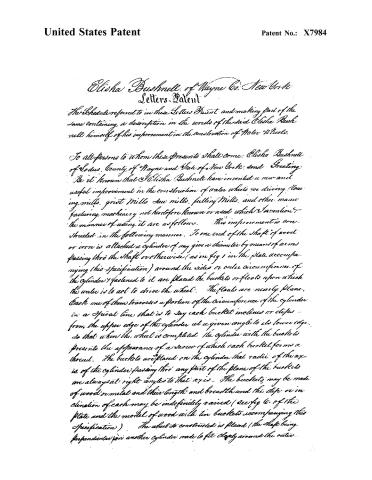
Page 2.
United States Patent
Patent No.: X7984
Elisha Bushnell, of Wayne Co. New York
Letters Patent
The Schedule referred to in these Letters Patent and making part of the same containing a description in the words of the said Elisha Bushnell himself of his improvement in the construction of Water Wheels.
To all persons to whom these presents shall come: Elisha Bushnell of Lodus, County of Wayne and State of New York, send Greeting:
Be it known that I Elisha Bushnell have invented a new and useful improvement in the construction of water wheels for driving sawing mills, grist mills, saw mills, fulling Mills, and other manufacturing machinery not heretofore known or used which I have not the manner of using it are as follows. This improvement is constructed in the following manner. To one end of the shaft of wood or iron is attached a cylinder of any given diameter by means of arms passing thro’ the shaft overthruwise (as in fig 1 in the plate accompanying this specification) around the sides or outer circumference of the cylinder fastened to it are placed the buckets or floats upon which the water is to act to drive the wheel. The floats are nearly plane. Each one of them traverses a portion of the circumference of the cylinder in a spiral line that is to say each bucket inclines or dips from the upper edge of the cylinder at a given angle to its lower edge so that when the wheel is completed the cylinder with the buckets presents the appearance of a screw of which each bucket forms a thread. The buckets are placed on the cylinder that radii of the axis of the cylinder passing thro’ any part of the plane of the buckets are always at right angles to that axis. The buckets may be made of wood or metal and their length and breadth and the dip or inclination of each may be indefinitely varied (see fig 6. of the plate and the model of wood with tin buckets accompanying this specification). The wheel so constructed is placed (the shaft being perpendicular) on another cylinder made to fit closely around the outer...
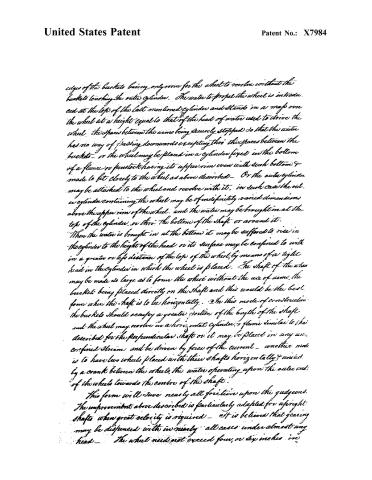
Page 3.
United States Patent
Patent No.: X7984
edges of the buckets having only room for the wheel to revolve without the buckets touching the outer cylinder. The water to propel the wheel is introduced at the top of the last mentioned cylinder and stands in a mass over the wheel at a height equal to that of the head of water used to drive the wheel, the spaces between the arms being securely stopped so that the water has no way of passing downwards excepting through the spaces between the buckets— or the wheel may be placed in a cylinder fixed in the bottom of a flume or penstock having its upper rim even with such bottom & made to fit closely to the wheel as above described— Or the outer cylinder may be attached to the wheel and revolve with it, in such case the outer cylinder containing the wheel may be of indefinitely varied dimensions above the upper rim of the wheel, and the water may be brought in at the top of the cylinder, or through the bottom of the shaft or around it.
When the water is brought in at the bottom it may be suffered to rise in the cylinder to the height of the head, or its surface may be confined to with in a greater or less distance of the top of the wheel, by means of a tight head in the cylinder in which the wheel is placed. The shaft of the wheel may be made so large as to form the wheel without the use of arms, the buckets being placed directly on the shaft and this would be the best form when the shaft is to be horizontally. In this mode of construction the buckets should occupy a greater portion of the length of the shaft and the wheel may revolve in a horizontal cylinder, or flume similar to that described for the perpendicular shaft or it may be placed in any unconfined stream and be driven by force of the current— another mode is to have two wheels placed with their shafts horizontally & united by a crank between the wheels, the water operating upon the outer ends of the wheels towards the centre of the shaft.
This form will save nearly all friction upon the guidecons. The improvement above described is particularly adapted for upright shafts when great velocity is required— It is believed that gearing may be dispensed with in nearly all cases under almost any head— The wheel need not exceed four, or six inches in
Page 4.
United States Patent
Patent No.: X7984
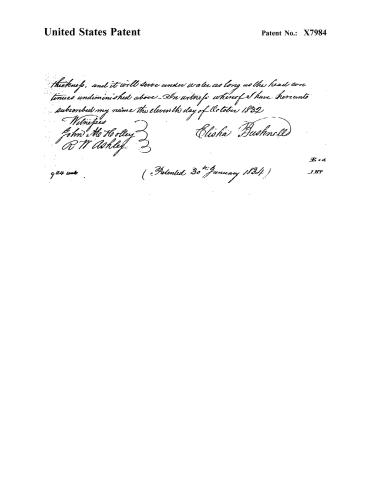
thicknes, and it will serve under water as long as the head con-
tinues undiminished above. In witness whereof I have hereunto
subscribed my name the eleventh day of October 1832
Witnesses
John McHooley
R W Ashley
Elisha Bushnell
( Patented 30th January 1834 )
Ex: a
JHT
924 wks
Published accounts: journal notice
Notice in the monthly list of patents, with remarks
Journal of the Franklin Institute, new ser., vol. 14 (1834), p. 128 · View the page
44. For a Water Wheel; Elisha Bushnell, Sodus, Wayne county, New York; an alien who has resided two years in the United States, January 30.
Remarks. This wheel is to be placed at the bottom of a flume, through which rises a vertical shaft to drive the machinery. The wheel may be from four to six feet in diameter, and from four to six inches in thickness; the buckets are placed spirally round its circumference, appearing like the segment of a many threaded screw, the water entering at top, and escaping at bottom. The cylinder which forms the penstock is to surround the buckets so closely as just to allow them to revolve, or it may be attached to and revolve with them. There is no claim made, and no room for one, as water wheels upon this principle have not the slightest claim to novelty; and, as regards their utility, they may be considered as upon a par with the tub wheel.
About this record
- Patentee
- DATAMP
- Date
- the Name and Date index of patents, DATAMP, USPTO records
- Invention
- DATAMP
- Listed in
- the Name and Date index of patents, DATAMP, USPTO records, Jim Shaw's X-patent list, the Journal of the Franklin Institute, Burke's List of Patents (1847)
- Burke's 1847 Patent Office list gives the same patent.