

Drawings and documents
USPTO scan
The patent as scanned by the USPTO
-
 Page 1
-
 Page 2
-
 Page 3
-
 Page 4
-
 Page 5


U.S. Patent and Trademark Office · Google Patents
Show the transcription Hide (1,124 words)
Machine transcription (LightOnOCR) of the pages as scanned by the USPTO, most of them the handwritten copies made when the records were restored after the 1836 fire. Not checked; it can misread handwriting, so compare it with the scan.
Page 2.
U.S. Patent Feb. 5, 1834 X7997
HUG 1847.505 FF
1830's
The United States of America
TO ALL TO WHOM THESE LETTERS PATENT SHALL COME:
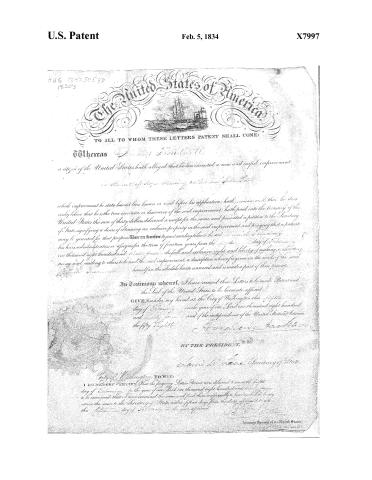
Whereas Daniel Franklin, a citizen of the United States, hath alleged that he has invented a new and useful improvement in the art of Vapour Heating called an Iron Stove, which improvement he states has not been known or used before his application; hath, under oath, that he does truly believe that he is the true inventor or discoverer of the said improvement, hath paid into the Treasury of the United States the sum of thirty dollars, delivered a receipt for the same, and presented a petition to the Secretary of State, signifying a desire of obtaining an exclusive property in the said improvement, and praying that a patent may be granted for that purpose. These are therefore to grant, according to law, to the said Daniel Franklin, his heirs, administrators or assigns, for the term of fourteen years, from the 1st day of February, one thousand eight hundred and thirty-four, the full and exclusive right and liberty of making, constructing, using, and vending to others to be used, the said improvement, a description whereof is given in the words of the said inventor in the schedule hereto annexed, and is made a part of these presents.
In Testimony whereof, I have caused these Letters to be made Patent, and the Seal of the United States to be hereunto affixed.
GIVEN under my hand, at the City of Washington, this 1st day of February, in the year of our Lord one thousand eight hundred and thirty-four, and of the Independence of the United States, two hundred and fifty-eight.
[Signature]
BY THE PRESIDENT,
[Signature]
City of Washington, TO WIT:
I DO HEREBY CERTIFY, That the foregoing Letters Patent were delivered to me on the 1st day of February, in the year of our Lord one thousand eight hundred and thirty-four, to be examined; that I have examined the same, and find them in form and law, and I do hereby return the same to the Secretary of State, within fifteen days from the date of this certificate, to wit, this 1st day of February, in the year aforesaid.
[Signature]
Attest: [Signature]
Page 3.
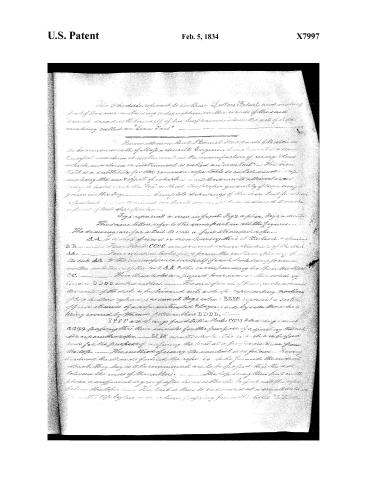
The Schedules referred to in these Letters Patent, and making part of this same containing a description in the words of the said Daniel, and himself of his improvement in the act of rope making called an "Iron Disk."
I, Thomas Daniel, of Boston, in the Commonwealth of Massachusetts, Engineer, do hereby declare that I have invented a useful machine or instrument in the manufacture of cordage, lines, which machine or instrument is called an "Iron Disk." This Iron Disk is a substitute for the common rope-folks so called, and is used for achieving the end object of which it is well known to all persons, being to hold or catch the rope so that the proper quantity of lines may be given out thereby.
Complete drawings of the Iron Disk for which patent is now claimed are hereto annexed, and a description of the same is part of this specification.
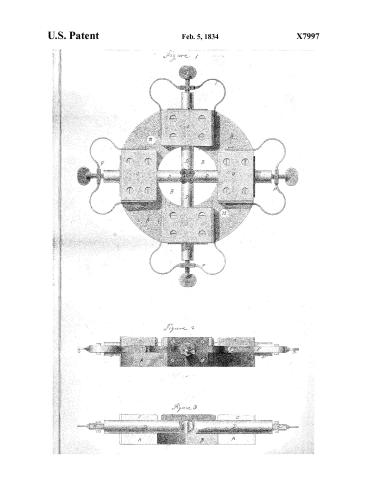
Fig. 1 represents a view in front. Fig. 2 a plan. Fig. 3 a section.
The same letters refer to the same parts in all the figures.
The drawings are for the purpose of making a general understanding of the same.
A.A. is a disk of wood or iron having three or four holes or openings.
B.B. Four blocks CCCC are arranged around the disk of the disk A.A.
These additional blocks are placed from the center or opening of the disk A.A. to the circumference one half of each hole being formed in the disk A.A. and the corresponding half in the blocks C.C.
These holes are placed four around the disk or kind of DDDD called a rubber.
The inner face of these rubber is the center of the disk is fashioned into another representing fractions of a circle, as shown at Fig. 1.
FF represents a section of iron strands of rope contained in laying, and by which the rope is being covered by the ends of the rubber DDDD.
FFFF are the rings fixed to the blocks CCCC, having a cross GGGG passing through their annulars for the purpose of adjusting them in a proper manner.
FF represents the iron disk A.A. which is a disk and is placed ends for the purpose of confining the rope at a proper distance from the stop.
The method of using the invention is as follows: Having the desired the strands of which the rope is to be formed, the ends of which they say to be commenced are to be placed into the disk between the ends of the rubber.
The rope being thus laid, a sufficient degree of after tension is then to be put into the rope below the stop.
The tool is then to be moved at a certain rate so as to the rope by two ends, while passing from the holes CCCC.
Page 4.
U.S. Patent
Feb. 5, 1834
X7997
Drawing of an iron tail used in laying ropes
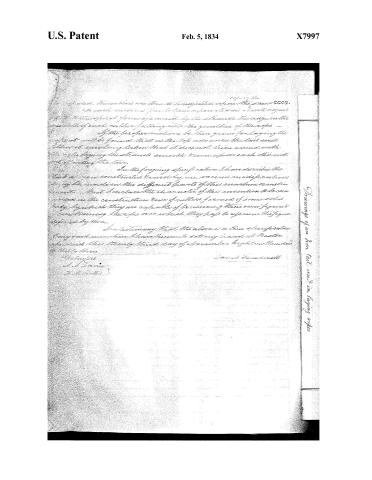
The numbers are then to be adjusted when the scene is ready rubber if you have not found a tail adjust to the original forms as named by the strands. The edges on the outside of each rubber falling into the question of the rope.
If the proportions between given for laying the rope it will be found that as the top and as the tail will follow a certain fashion that it does not turn round and then while laying the strands smooth between each other without affecting the rope.
In the foregoing specification I have described the tail as now constructed used by me, various modifications may be made in the different parts of this machine or its construction. But I declare the character of this invention to be confined to the construction used of rubbers formed of some solid body by which they are capable of preserving their own figure and retaining their use over which they profess to perform the figure defined by them.
I do testify that the above is a true specification of my said invention. I have the means to set my hand at Boston this twenty-third day of November Eighteen Hundred and Thirty-three.
Witnesses
J. J. Davis
J. H. Miller
Daniel S. Searlewell
Page 5.
U.S. Patent
Feb. 5, 1834
X7997
Figure 1
Figure 2
Figure 3
Published accounts: journal notice
Notice in the monthly list of patents, with remarks
Journal of the Franklin Institute, new ser., vol. 14 (1834), p. 174 · View the page
6. For a new Machine to be used in Rope Making, and which is denominated an " Iron Tail;" Daniel Treadwell, Boston, Massachusetts, February 5.
Remarks. In the business of rope making, what are called rope tails are used for the purpose of holding back the "top," so that the proper quantity of turn may be given to the lay. In the instrument before us, the strands to be laid are pressed upon by iron bolts, which move in suitable slides upon a flat disk, so that their ends are directed towards the centre of the disk, through which the strands are to pass. The bolts have grooves, or hollows, on their ends, to embrace the strands with sufficient force, which force is regulated by screws, fixed upon bow springs, and bearing against the outer ends of the bolts. The patentee observes, that "various modifications may be made in the different parts of the machine, or instrument; but declares the character of this invention to be comprised in the construction and use of rubbers formed of some solid body, by which they are capable of preserving their own figure, and of constraining the rope over which they pass, to assume the figure defined by them."
DATAMP: illustration
Illustrations from DATAMP
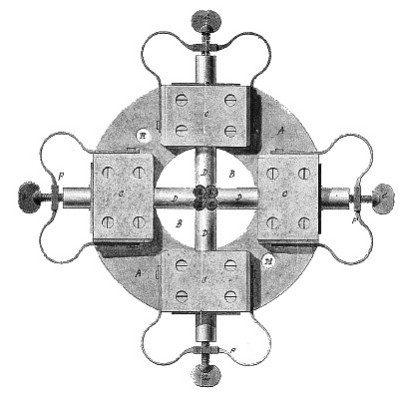
DATAMP (Directory of American Tool and Machinery Patents), via the Internet Archive · Archived DATAMP page
About this record
- Patentee
- DATAMP
- Date
- the Name and Date index of patents, DATAMP, USPTO records
- Invention
- DATAMP
- Listed in
- the Name and Date index of patents, DATAMP, USPTO records, Jim Shaw's X-patent list, the Journal of the Franklin Institute, Burke's List of Patents (1847)
- Burke's 1847 Patent Office list gives the same patent.