

Drawings and documents
National Archives restored drawings: drawing
George Reynold's Patent Drawing for a Feather-dressing Machine

National Archives, Restored Patent Drawings (Record Group 241) · Full-size scan at the National Archives · Catalog record
Show the text on the drawing Hide (117 words)
Words on the drawing as machine-read by the National Archives; not checked. Useful mainly for searching.
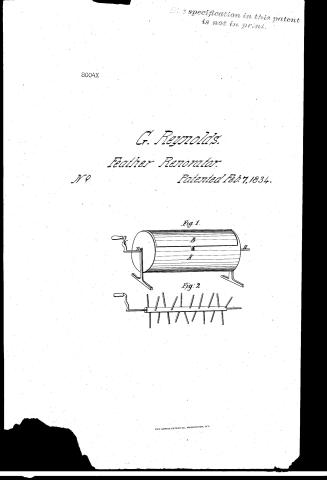
Feather Renovators / 34. DRIERS. / Vagn products / Sta How V / Cylinder-Internal, / Sta. Horizontal. / classijication / 8004-X DIVISION. / GEORGE REYNOLDS / Feather - dressing Mch® / Patented the 7 February 1834 / Reissued 17th Oct- 1835. / Tig 1. / DATE / hig2. / oi / 00 / References. Fig1 Represents the Machine entire placed upon stanchions, for filling & emptying / The Cylinder or barrel, into which the feathers are put for dressing / B The Door which opens to recieve and discharge the feathers / c The Crank for turning the Machine / DDThe Gudgeons on which it turns. / Fig2 Represents the Shaft passing through the centre of the Cylinder into rohich the / h.L Fleischmana all / dressing pins are inserted
USPTO scan
The patent as scanned by the USPTO
-
 Page 1
-
 Page 2
-
 Page 3


U.S. Patent and Trademark Office · Google Patents
Show the transcription Hide (840 words)
Machine transcription (LightOnOCR) of the pages as scanned by the USPTO, most of them the handwritten copies made when the records were restored after the 1836 fire. Not checked; it can misread handwriting, so compare it with the scan.
Page 1.
The specification in this patent is not in print.
8004X
G. Reynolds.
Feather Renovator.
No. Patented Feb. 7, 1834.
Fig. 1.
Fig. 2.
THE NORRIS PETERS CO., WASHINGTON, D.C.
Page 2.
July 1834
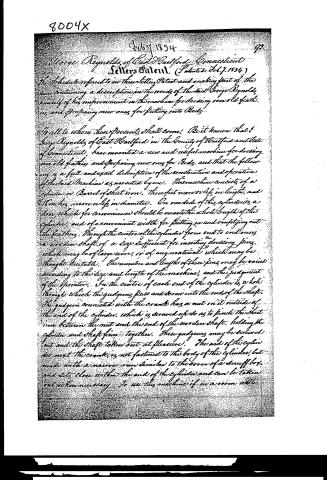
George Reynolds of East Hartford, Connecticut
Letters Patent. (Patented Feb. 7, 1834)
The Schedule referred to in the Letters Patent and making part of the
Same containing a description in the words of the said George Reynolds
himself of his improvement on the machine for dressing worn old feathers
and for preparing new ones for putting into Beds.
To all to whom these presents shall come: Be it known that I
George Reynolds of East Hartford in the County of Hartford and State
of Connecticut, have invented a new and useful machine for dressing
worn old feathers and for preparing new ones for Beds, and that the following
is a full and exact description of the construction and operation
of the said Machine as invented by me. This machine consists of a
cylinder or Barrel of sheet iron, Three feet more or less in length, and
18 inches more or less in diameter. On one side of this cylinder is a
door, which for convenience should be near the whole length of the
cylinder, and of a convenient width for putting in and emptying out
the feathers. Through the centre of the cylinder from end to end runs
a wooden shaft of a size sufficient for inserting dressing pins,
which may be of large size, or of any material which may be
thought suitable. The number and lengths of these pins may be varied
according to the size and length of the machine, and the judgment
of the operator. In the centre of each end of the cylinder is a hole
through which the gudgeons pass and screw into the ends of the shaft.
The gudgeon connected with the crank has a nut on it outside of
the end of the cylinder, which is screwed up so as to pinch the sheet
iron between the nut and the end of the wooden shaft, holding the
cylinder and shaft firm together. These gudgeons may be screwed
out and the shaft taken out at pleasure. The end of the cylinder
next the crank is not fastened to the body of the cylinder, but
made with a narrow rim similar to the edge of a snuff box,
and sets close within the end of the cylinder and can be taken
out when necessary. To use this machine if in a room with
Page 3.
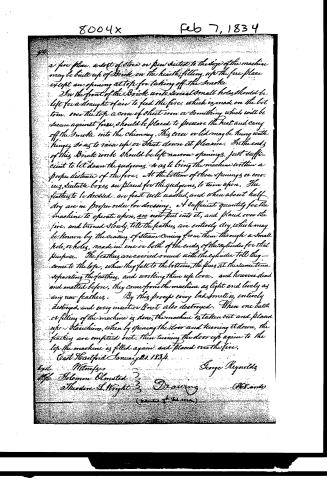
a fire place. a sort of stove or pan suited to the size of the machine may be built up of brick on the hearth filling up the fire place except an opening at top for taking off the smoke.
In the front of the Brick work several small holes should be left for a draught of air to feed the fire, which is made on the bottom. over the top a cover of sheet iron or something which will be secure against fire, should be placed to preserve the heat and carry off the smoke into the chimney. This cover or lid may be hung with hinges so as to raise up or shut down at pleasure. In the ends of this Brick work should be left narrow openings, just sufficient to let down the quidgeons, so as to bring the machine within a proper distance of the fire. At the bottom of these openings or openings, suitable boxes are placed for the quidgeons to turn upon. The feathers to be dressed, are first well washed, and when about half dry are in proper order for dressing. A sufficient quantity for the machine to operate upon, are now put into it, and placed over the fire, and turned slowly, till the feathers are entirely dry, which may be known by the ceasing of steam coming from them through a small hole or holes, made in one or both of the ends of the cylinder for that purpose. The feathers are carried round with the cylinder till they come to the top, when they fall to the bottom, the pins at the same time separating the feathers, and working them up loose, and however dead and matted before, they come from the machine as light and lively as any new feathers. By this process every bad smell is entirely destroyed, and every insect or lint also destroyed. When one batch or filling of the machine is done, the machine is taken out and placed upon a stand, when by opening the door and turning it down, the feathers are emptied out, then turning the door up again to the top the machine is filled again, and placed over the fire.
Cast Hartford January 21, 1834.
by Mtnesizes
Wm Solomon Olmsted
Theodore L. Wright
George Reynolds
Drawing (Pls. and)
Published accounts: journal notice
Notice in the monthly list of patents, with remarks
Journal of the Franklin Institute, new ser., vol. 14 (1834), p. 176 · View the page
13. For a Machine for Dressing Feathers; George Reynolds, East Hartford, Hartford county, Connecticut, February 7.
Remarks. This machine has, exteriorly, very much the appearance of a large cylindrical coffee roaster. A cylinder of sheet iron, which may be three feet long, and eighteen inches in diameter, has a shaft through its centre, which revolves freely within it, and from which projects a number of pins that may be formed of wire, and of such length as nearly to touch the cylinder. The shaft is of wood, but iron gudgeons from its ends pass through the heads of the cylinder, and one of them receives a crank by which it is turned, the shaft lying horizontally. A door, extending the whole length of the cylinder, opens on one side of it, to admit and discharge the feathers. This machine is to be placed where a fire, the heat of which can be properly regulated, may be placed under it. The feathers to be dressed are first washed quite clean, and suffered to become half dry; they are then placed in the machine, and exposed to the action of a moderate heat, whilst the machine is made to revolve; in this situation they are to be allowAmerican Patents for February, with Remarks. ed to become perfectly dry, which will be known by the ceasing of the issue of steam through small openings left in the heads for that purpose. It is said that however dead and matted the feathers may have been, they will, by this process, be rendered quite lively; and, whether old or new, they will be equally light, and deprived of every bad smell.
About this record
- Patentee
- DATAMP
- Date
- the Name and Date index of patents, DATAMP, USPTO records
- Invention
- DATAMP
- Listed in
- the Name and Date index of patents, DATAMP, USPTO records, Jim Shaw's X-patent list, the Journal of the Franklin Institute, Burke's List of Patents (1847)
- Burke's 1847 Patent Office list gives the same patent.