

Drawings and documents
National Archives restored drawings: drawing
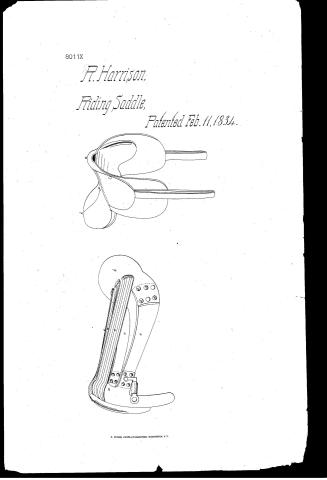
Richard Harrison's Patent Drawing for a Spring Riding Saddle

National Archives, Restored Patent Drawings (Record Group 241) · Full-size scan at the National Archives · Catalog record
Show the text on the drawing Hide (96 words)
Words on the drawing as machine-read by the National Archives; not checked. Useful mainly for searching.
/2 / 54. harness / [72] Riding Saddles. / CLASSIFICATION / 8011- X / Richard Harrison / DIVISION. / Spring Riding Saddles / Vol.18. pg 595 / Patented Tebitt 1834. / 160000 / 0000 / oip / a the head. b. the cantle C. C. bars made of whole bone ddd He. rivets which confine / the bars to the head & cantle. e.e.e. strips of webbing. of the covering. / Patent office 31 august. 1841. / made under the direction of the Comm forever / ch. L. Heischmann del: / of Patents in Con formity with aar of d. march 1837. / Hungh Sunooth / of Patents.
USPTO scan
The patent as scanned by the USPTO
-
 Page 1
-
 Page 2
-
 Page 3


U.S. Patent and Trademark Office · Google Patents
Show the transcription Hide (851 words)
Machine transcription (LightOnOCR) of the pages as scanned by the USPTO, most of them the handwritten copies made when the records were restored after the 1836 fire. Not checked; it can misread handwriting, so compare it with the scan.
Page 1.
8011X
R. Harrison,
Riding Saddle,
Patented Feb. 11, 1834.
Page 2.
2/11/1834 8011X
Feb. 11, 1834
Richard Harrison, an alien, New York
Letters Patent
The schedule referred to in these Letters Patent and making part of the same containing a description in the words of the said Richard Harrison himself of his improvement in manufacturing Spring Riding Saddles.
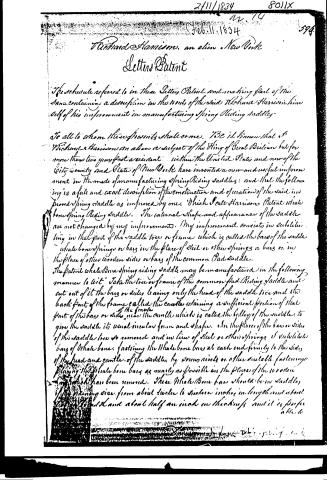
To all to whom these presents shall come. To be it known that I, Richard Harrison, an alien a subject of the King of Great Britain but for more than two years past a resident within the United States and now of the City, County and State of New York have invented a new and useful improvement in the mode of manufacturing Spring Riding Saddles; and that the following is a full and exact description of the construction and operation of the said improved Spring Riding Saddle as improved by me. Which I call Harrison’s Patent Whale Bone Spring Riding Saddle. The external shape and appearance of the saddle are not changed by my improvement. My improvement consists in substituting in that part of the saddle tree or frame which is called the bars of the saddle whale bone springs or bars in the place of steel or other springs or bars or in the place of other wooden sides or bars of the common Pad Saddle.
The patent whale bone spring riding saddle may be manufactured in the following manner to wit: Take the tree or frame of the common Pad Riding Saddle and cut out of it the bars or sides leaving only the head of the saddle tree and the back part of the frame called the cantle retaining a sufficient portion of that part of the bars or sides near the cantle which is called the belly of the saddle, to give the saddle its usual circular form and shape. In the places of the bars or sides of the saddle tree so removed and in lieu of steel or other springs I substitute bars of whale bone fastening the whale bone bars at each end firmly to the sides of the head and cantle of the saddle by screws rivets or other suitable fastenings placing the whale bone bars as nearly as possible in the places of the wooden bars which have been removed. These whale bone bars should be in saddles of the ordinary size from about twelve to sixteen inches in length and about two and a half and about half an inch in thickness and it is preferable to
Page 3.
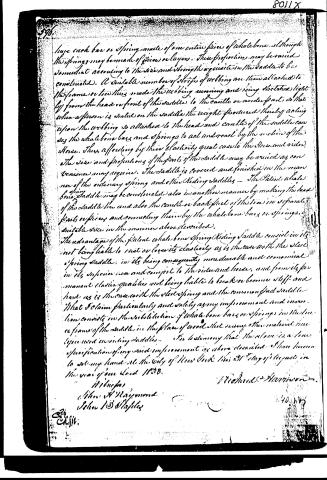
have each bar or spring made of one entire piece of whalebone, although the springs may be made of pieces or layers. These proportions may be varied somewhat according to the size and strength requisite in the saddle to be constructed. A suitable number of strips of webbing are then attached to the frame or tree thus made the webbing running and being stretched tightly from the head or front of the saddle to the cantle or under part so that when a person is seated on the saddle the weight produced thereby acting upon the webbing so attached to the head and cantle of the saddle causes the whalebone bars and springs to act and react by the motion of the Horse. Thus affording by their elasticity great ease to the Horse and rider. The sizes and proportions of the parts of the saddle may be varied as convenience may require. The saddle is covered and finished in the manner of the ordinary spring and other riding saddles. The Patent whalebone spring saddle may be constructed also in another manner by making the head of the saddle tree and also the cantle or back front of the tree in separate parts or pieces and connecting them by the whalebone bars or springs, of suitable size in the manner above described.
The advantage of the Patent whalebone spring riding saddle consists in its not being liable to rust or lose its elasticity as is the case with the steel spring saddle; in its being consequently more durable and economical in its superior ease and comfort to the rider and horse, and from its permanent elastic qualities not being liable to break or become stiff and hard as is the case with the steel spring and the common pad saddle.
What I claim particularly and solely as my improvement and innovation consists in the substitution of whalebone bars or springs in the tree or frame of the saddle in the place of wood, steel, or any other material now typically used in riding saddles. In testimony that the above is a true specification of my said improvement as above described I have hereunto set my hand at the City of New York this 21st day of August in the year of our Lord 1838.
Witnesses
John H. Raymond
John B. Staples
Richard Harrison
Published accounts: journal notice
Notice in the monthly list of patents, with remarks
Journal of the Franklin Institute, new ser., vol. 14 (1834), p. 181 · View the page
24. For an improvement in Spring Riding Saddles; Richard Harrison, an alien who has resided two years in the United States; city of New York, February 11.
Remarks. The improvement here patented consists in the substitution of whalebone springs or bars, for steel or other springs which have been used in that part of the saddle tree, denominated the bars. The proposed mode of employing the whalebone, is to cut out the bars of the common saddle tree, leaving only the head and cantle, and such portions of the bars near the cantle, as may be necessary to American Patents for February, with Remarks. give to the saddle its usual shape when finished, and then to place bars of whalebone instead of steel, or others, securing it in the situation occupied by that part of the tree which has been removed. The pieces of whalebone should be about sixteen inches long, two in width, and half an inch thick; and after fixing them, the saddle is to be finished by stretching webbing in a proper manner, as is done in other spring saddles, and applying the ordinary stuffing and covering. The claim made is to "the substitution of whalebone bars or springs, in the tree, or frame, of the saddle, in the place of wood, steel, or any other material heretofore used in riding saddles."
About this record
- Patentee
- DATAMP
- Date
- the Name and Date index of patents, DATAMP, USPTO records
- Invention
- DATAMP
- Listed in
- the Name and Date index of patents, DATAMP, USPTO records, Jim Shaw's X-patent list, the Journal of the Franklin Institute, Burke's List of Patents (1847)
- Burke's 1847 Patent Office list gives the same patent.