

Drawings and documents
USPTO scan
The patent as scanned by the USPTO
-
 Page 1
-
 Page 2
-
 Page 3


U.S. Patent and Trademark Office · Google Patents
Show the transcription Hide (654 words)
Machine transcription (LightOnOCR) of the pages as scanned by the USPTO, most of them the handwritten copies made when the records were restored after the 1836 fire. Not checked; it can misread handwriting, so compare it with the scan.
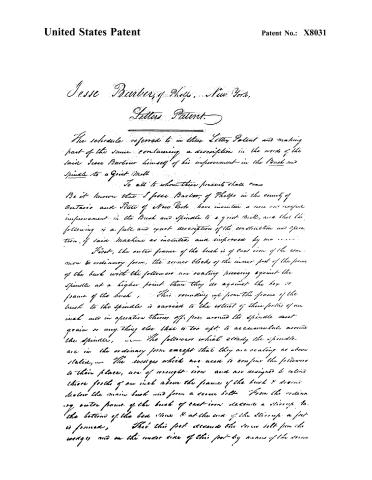
Page 2.
United States Patent
Patent No.: X8031
Jesse Barber, of Phelps, New York,
Letters Patent.
The schedule referred to in these Letters Patent and making part of the same containing a description in the words of the said Jesse Barber himself of his improvement in the Bush and Spindle to a Grist Mill.
To all to whom these presents shall come
Be it known that I Jesse Barber, of Phelps in the county of Ontario and State of New York have invented a new and useful improvement in the Bush and Spindle to a grist mill, and that the following is a full and exact description of the construction and operation of said machine as invented and improved by me.
First, the outer frame of the bush is of cast iron of the common or ordinary form, the corner blocks of the inner part of the frame of the bush with the followers are sealing pressing against the spindle at a higher point than they do against the box or frame of the bush. This rounding up from the frame of the bush to the spindle is carried to the extent of three fourths of an inch and in operation throws off, from around the spindle dust, grain or anything else that is too apt to accumulate around the spindle. The followers which steady the spindle are in the ordinary form except that they are sealing as above stated. The wedges which are used to confine the followers to their place, are of wrought iron and are designed to extend three fourths of an inch above the frame of the bush & down below the main bush and form a screw belt. From the ordinary outer frame of the bush of cast iron ascends a slip-up to the bottom of the box stone & at the end of the slip-up a foot is formed. This foot ascends the screw belt from the wedges and on the under side of this foot by means of the screw
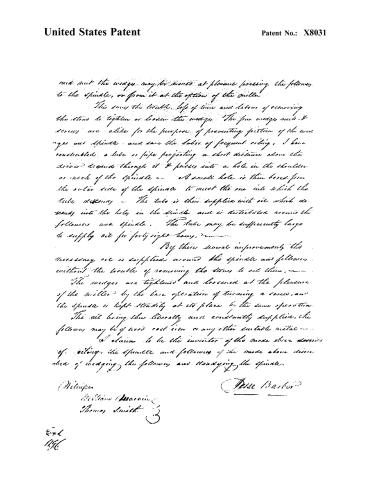
Page 3.
United States Patent
Patent No.: X8031
and not the wedges may be moved at pleasure pressing the followers to the spindle, or from it at the option of the miller.
This saves the trouble, loss of time and labour of removing the stone to tighten or loosen the wedges. The four wedges, nuts, & screws are alike for the purpose of preventing friction of the wedges and spindle, and save the labor of frequent oiling. I have constructed a tube or pipe projecting a short distance above the stone and descends through it & passes into a hole in the shoulder or neck of the spindle — A small hole is then bored from the outer side of the spindle to meet the one into which the tube descends — The tube is then supplied with oil which descends into the hole in the spindle and is distributed around the followers and spindle. The tube may be sufficiently large to supply oil for forty-eight hours.
By these several improvements the necessary oil is supplied around the spindle and followers without the trouble of removing the stones to oil them.
The wedges are tightened and loosened at the pleasure of the miller by the base operation of turning a screw, and the spindle is kept steadily at its place by the same operation.
The oil being thus liberally and constantly supplied, the followers may be of wood cast iron or any other suitable metal.
I claim to be the inventor of the mode above described of oiling the spindle and followers of the mode above described of wedging the followers and steadying the spindle.
Witnesses
William Morrison
Thomas Smith
Dessé Barber
3
End
1856
Published accounts: journal notice
Notice in the monthly list of patents, with remarks
Journal of the Franklin Institute, new ser., vol. 14 (1834), p. 191 · View the page
43. For a Bush and Spindle to a Grist Mill; Jesse Barber, Phelps, Ontario county, New York, February 28.
Remarks. The improvements here claimed consist in a mode of oiling the spindle and followers, without the trouble of removing the stone; and of tightening or loosening the followers around the spindle, at pleasure, by the mere turning of a screw or screws. For the purpose of oiling, a tube, or pipe, projecting a short distance above the driver, descends through it, and passes into a hole in the shoulder, or neck of the spindle. A small hole is then bored from the outer side of the spindle, to meet the one into which the tube descends. Oil supplied to the tube is thus distributed around the spindle and followers, and enough may be contained in the tube to last for forty-eight hours. The followers, which steady the spindle, are in the ordinary form; the wedges which are used to confine them in their places are made of wrought iron; they are lengthened out below, so as to form a screw bolt, and from the outer frame of the bush, of cast iron, a stirrup descends to the bottom of the bed stone, through a foot in which screw bolts, which are attached to the wedges, pass down, and by means of a nut on the lower end of each of these bolts, the wedges may be tightened or loosened at pleasure.
About this record
- Patentee
- DATAMP
- Date
- the Name and Date index of patents, DATAMP, USPTO records
- Invention
- DATAMP
- Listed in
- the Name and Date index of patents, DATAMP, USPTO records, Jim Shaw's X-patent list, the Journal of the Franklin Institute, Burke's List of Patents (1847)
- The Name and Date index lists this patent twice.
- Burke's 1847 Patent Office list gives the same patent.