

Drawings and documents
National Archives restored drawings: drawing
Nathaniel Foster and William Van Wick's Patent Drawing for a Method of Constructing Cisterns

National Archives, Restored Patent Drawings (Record Group 241) · Full-size scan at the National Archives · Catalog record
Show the text on the drawing Hide (118 words)
Words on the drawing as machine-read by the National Archives; not checked. Useful mainly for searching.
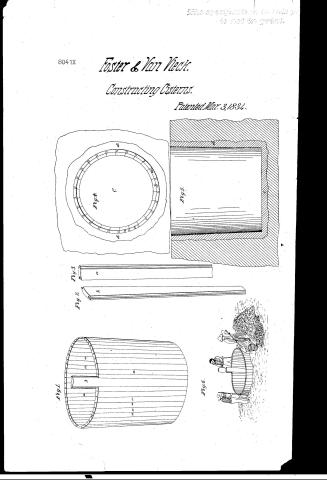
12. MASONRY. / [51] Cisterns. / 300 / 8041-X / Nathaniel Foster & William Van Heck / DIVISION. / Constructing listerns de. de. / Tigh. / Vol. 18. pg. 491. / Patented Mar.3.1804. / Sig.2. Jys / Siz.i. / B. / Tig.6. / b. / ligs. / Patent affice Deen- / made under the direction after Commissioner / Puferences. a.a.a.a.a Ne. staves. b. Key stave / of Patents in conformity with act of Maren 1837 / C. bottom of bisternsyd d sides of hydraulic cement. / Jig 1. the pattern curve. Fig the Keystave Fig. the stave / n Liumorth / Jig. 4. Topoiewof the cistern & curve. Sig. 5 section / of such a cistern. Jig. 6 illustration of the manner / Aom missioner of Patents. / making such cesterns. / Mewihmann fiest.
USPTO scan
The patent as scanned by the USPTO
-
 Page 1
-
 Page 2
-
 Page 3


U.S. Patent and Trademark Office · Google Patents
Show the transcription Hide (688 words)
Machine transcription (LightOnOCR) of the pages as scanned by the USPTO, most of them the handwritten copies made when the records were restored after the 1836 fire. Not checked; it can misread handwriting, so compare it with the scan.
Page 1.
8041X
Foster & Van Vleck.
Constructing Cisterns.
Patented Mar. 3, 1834.

Page 2.
3/3/1834 8041x
Mar. 3, 1834 491
Nathaniel Foster & William Van Vleck
Selling Patent
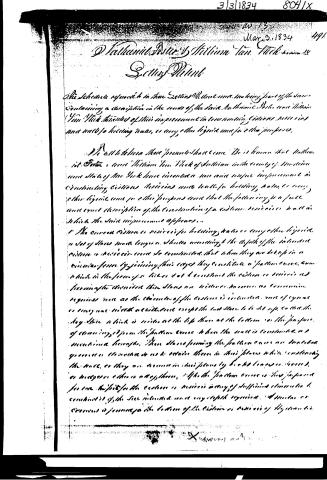
The Schedule referred to in the Letters Patent, and making part of the same, containing a description in the words of the said Nathaniel Foster and William Van Vleck, trustees of their improvement in constructing cisterns, reservoirs and vats for holding water, or any other liquid and for other purposes.
We, Nathaniel Foster and William Van Vleck of Sullivan in the county of Madison and State of New York have invented a new and useful improvement in constructing cisterns, reservoirs and vats for holding water, or any other liquid and for other purposes and that the following is a full and exact description of the construction of a cistern, reservoir or vat in which the said improvement appears...
1. The covered cistern or reservoir for holding water or any other liquid, a set of slats made longer or shorter according to the depth of the intended cistern or reservoir must be constructed that when they are set up in a circular form by joining their edges they constitute a pattern cover, around which in the form of a tube it is to constitute the cistern or reservoir as hereinafter described. These slats are without a seam or connection around as the diameter of the cistern is intended, and of course so many as will be with such except the last slat to be set up, so that the top slat which is wider at the top than at the bottom, so the purpose of expanding it from the pattern cover when the wall is constructed as mentioned hereafter. These slats forming the pattern cover are marked generally the number to us to relate them in their places while constructing the wall, so they are secured in their places by hooks longer or shorter, or longer or shorter at top, there. If the pattern cover is thus prepared for use the slats for the cistern or reservoir are of sufficient dimensions to constitute it of the size intended and very depth required. A number of corners is formed at the bottom of the cistern or reservoir of the same.
X
Page 3.
3/3/1834 8041X
472
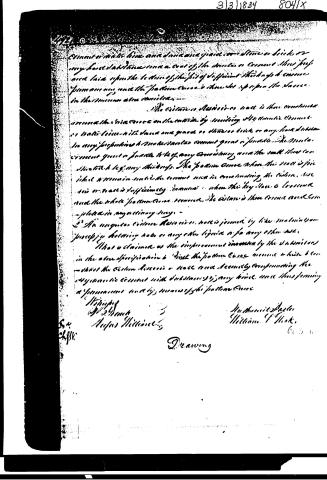
cement or make lime and sand and place on stone or brick or any hard substance and a coat of the mortar or cement then prep one laid upon the bottom of the pit of sufficient thickness to ensure firmness, and the bottom course is then to be upon the stone in the manner above described.
The bottom course is to be so laid as to be constructed around the inside of the pit by mixing the mortar cement or stone lime with sand and placed on stone or brick or any hard substance in any proportion to make mortar cement great or small. The mortar cement great or small to be of any consistency and the wall then constructed to be any thickness. The bottom course when the wall is finished to remain until the cement has in constructing the sides, the soil or wall is sufficiently firmness when the key stone is inserted and the whole bottom course removed. The bottom is then cement and completed in any ordinary way.
2. The upper course bottom course is formed by like materials properly holding water or any other liquid or for any other use.
That is claimed as the improvement invented by the subscriber in the above specification is that the bottom course remains while to be that the bottom course or wall once securely conforming the hydraulic cement with substances of any kind, once thus forming a permanent and by means of the bottom course.
Witness
J. H. Smith
Nurse Millard
Witnesses
William F. Black
Drawing
Published accounts: journal notice
Notice in the monthly list of patents, with remarks
Journal of the Franklin Institute, new ser., vol. 14 (1834), p. 232 · View the page
2. For constructing Cisterns for holding Water, &c.; Nathaniel Fortin and William Van Vleck, Sullivan, Madison county, New York, March 1.
Remarks. What is called a pattern curve, which is like a tub without a bottom, is to be formed of the size of the intended reservoir; an excavation large enough to receive this pattern curve, and to allow of a due thickness for the intended wall, is then made, and the bottom of it covered with gravel, stones, &c. mixed with hydraulic lime. Upon this the curve is placed, and the space between it and the earth, is filled with like materials, and when dry, the staves, &c. which formed the curve, are to be removed. The claim is to, "first, the pattern curve, around which to construct the cistern, reservoir, or wall; and secondly, compounding the hydraulic cement with substances of any kind, and thus forming a permanent wall by means of the pattern curve." We refer to the patent of G. Tibbetts, for our notice of a very similar contrivance, so similar, that so far as principles are concerned, we should denominate them identical. Patentees, however, are rarely aware that alterations in form or proportions, which still leave a thing essentially the same in its mode of action, are not protected by the patent law, such alterations being mere colourable pretexts, which, were they not resisted, would destroy its whole intention.
About this record
- Patentee
- DATAMP
- Date
- the Name and Date index of patents, DATAMP, USPTO records
- Invention
- DATAMP
- Listed in
- the Name and Date index of patents, DATAMP, USPTO records, Jim Shaw's X-patent list, the Journal of the Franklin Institute, Burke's List of Patents (1847)
- The Franklin Institute's journal gives a different date.
- Burke's 1847 Patent Office list gives the same patent.