

Drawings and documents
National Archives restored drawings: drawing
B. Hinckley's Patent Drawing for a Grain Mill

National Archives, Restored Patent Drawings (Record Group 241) · Full-size scan at the National Archives · Catalog record
Show the text on the drawing Hide (102 words)
Words on the drawing as machine-read by the National Archives; not checked. Useful mainly for searching.
$250 / 83. MILLS. / Grinding Mills. / Cylinder and Concave. / B. Hinkley / 1834 B / Vol.19.7. 473, / CLASSI ISATION / 8061-4 / Cylinders boueave / Grain Mill. / Patented 10th March 1834, / DIVISION. / Fift, / Fight. / Fifes. / Fir,2, / THAN / skisted / cr / FO / TA / References, / Fid.1. Perspective view. / Fif.2. initial section, / Fife3. steel cylinder. / Fife. wrought iron plate, / A, A, frame, Bhopper cylinder, / Di iron fitate, Enadjusting screws, / F. pinion on cylinder shaft. G. driving whed / II meal trought / Patent Office ben.y.1541 / Made under the duection of the Commifrioner fatul / inconformity with act of bougreft I. March 1935 / Commissioner of
USPTO scan
The patent as scanned by the USPTO
-
 Page 1
-
 Page 2
-
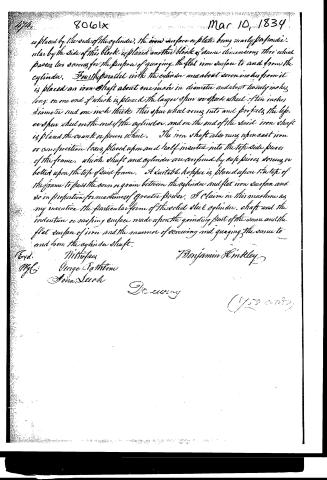 Page 3


U.S. Patent and Trademark Office · Google Patents
Show the transcription Hide (781 words)
Machine transcription (LightOnOCR) of the pages as scanned by the USPTO, most of them the handwritten copies made when the records were restored after the 1836 fire. Not checked; it can misread handwriting, so compare it with the scan.
Page 1.
8061X
B. HINKLEY.
Grain Mill.
Patented Mar. 10, 1834.
No Printed Specification Available

THE NORRIS PETERS CO., PHOTO-LITHO., WASHINGTON, D. C.
Page 2.
8001 X Mar. 10, 1834 479
Benjamin Hinkley of Fayette, Kennebec Co: Maine
Letters Patent.
The above refers to notice and Letters Patent and making part of the issue, containing a description in the words of the said Benjamin Hinkley himself of his improvement in the Mill for cracking or grinding corn and other grain by hand or otherwise known.
To all to whom these presents shall come:
We do know that Benjamin Hinkley of the Town of Fayette in the County of Kennebec and State of Maine, have invented a new and useful improvement in a mill for cracking or grinding corn or other grain by hand or otherwise known and that the following is a full and exact description of the construction and operation of the said machine as invented or improved by me. The size for hand power is as follows. First. A frame made of plank one and a half inch thick. The two ends fifteen inches wide and thirty two inches high. The side pieces of said frame is at the bottom about thirty six inches long, at the top about thirty inches long of suitable width to give strength to the frame. Second. A cylinder made of German or Cast Steel, two and half inches in diameter and the grinding part about two and a half inches long. The surface of which is cut or indented in form of a rasp or grate. The two ends of said cylinder or shaft are one inch in diameter and one and a half inch long turned perfectly true, to run in the boxes and said cylinder or shaft extends at each end about one and half inch further which last inch and half at each end is turned down to three quarters of an inch in diameter, making the whole cylinder or shaft of solid steel about eighteen or nineteen inches long. This cylinder is placed upon or across the frame running upon cast iron or construction Boxes, which boxes are placed upon and half inserted into the top side pieces of the frame. One end of said cylinder shaft projecting beyond the frame is for a balance or fly wheel. The other end is formed for a cog wheel, which cog wheel is about five inches in diameter and one inch thick and made of cast iron. Third. The grinding part of said cylinder or rollers have flat surface a plate of wrought iron about one and quarter inch wide and about a quarter inch thick and some length as the grinding part of the cylinder. This plate of iron is secured or bolted to a block of wood about thirteen inches long, three inches wide and one inch thick which
Page 3.
Mar 10, 1834
is placed by the side of the cylinder, the iron surface or plate being nearly perpendicular by the side of this block is placed another block of same dimensions there which passes two screws for the purpose of guaging the flat iron surface to and from the cylinder. Truly parallel with the cylinder and about seven inches from it is placed an iron shaft about one inch in diameter and about twenty inches long on one end of which is placed the larger spur or gear wheel, fifteen inches diameter and one inch thick. This spur wheel runs into and projects the lever or spur wheel on the end of the cylinder, and on the end of the said iron shaft is placed the counter or power wheel. The iron shaft also runs upon cast iron or composition boxes placed upon and half inserted into the top side pieces of the frame, which shaft and cylinder are confined by said pieces, screws or bolted upon the top of said frame. A suitable hopper is placed upon the top of the frame to pass the corn or grain between the cylinder and flat iron surface and so in proportion for readiness of greater power. I claim in this machine as my invention the particular form of the solid steel cylinder, shaft and the indenture or rasping surface made upon the grinding point of the same and the flat surface of iron and the manner of screwing and guaging the same to and from the cylinder shaft.
Benjamin Hinkley
Exd. Witnesses
George Eastburn
Anna Leech
Dec 2000 (Y22 010)
Published accounts: journal notice
Notice in the monthly list of patents, with remarks
Journal of the Franklin Institute, new ser., vol. 14 (1834), p. 238 · View the page
24. For a Mill for Cracking or Grinding Corn or other Grain; Benjamin Hinkley, Fayette, Kennebeck county, Maine, March 10.
Remarks. The corn to be broken is put into a hopper having a longitudinal slot in the bottom of it, against which revolves a steel roller, about two and a half inches in diameter, and twelve inches long; the face of this roller is cut like a rasp or grater. A flat plate of wrought iron stands along the cylinder, their distance apart being adjusted by screws; and between these the grain descends when the roller is turned. To give the proper motion there is a cog wheel, pinion, and fly wheel, fixed in the usual manner. The claim is to "the particular form of the solid steel cylinder shaft, and the indented, or rasping, surface made upon the grinding part of the same; and the flat surface of iron, and the manner of screwing and guaging the same to and from the cylinder." The similarity between this machine and that of Webber Furbish, noticed vol. 13, p. 403, will be apparent to any one.
About this record
- Patentee
- DATAMP
- Date
- the Name and Date index of patents, DATAMP, USPTO records
- Invention
- DATAMP
- Listed in
- the Name and Date index of patents, DATAMP, USPTO records, Jim Shaw's X-patent list, the Journal of the Franklin Institute, Burke's List of Patents (1847)
- Burke's 1847 Patent Office list gives the same patent.