

Drawings and documents
National Archives restored drawings: drawing
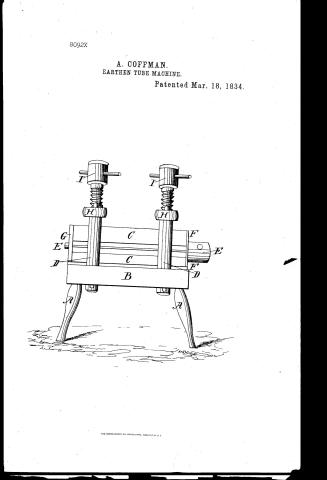
A. Coffman's Patent Drawing for an Earthen Tube Machine

National Archives, Restored Patent Drawings (Record Group 241) · Full-size scan at the National Archives · Catalog record
Show the text on the drawing Hide (78 words)
Words on the drawing as machine-read by the National Archives; not checked. Useful mainly for searching.
-25. CLAY & POTTERY, / DIV. 15 / Tile Machines / 11 / CLASSIFICATION / 8092-X / DIVISION. / Earthen Lube machine / Patented 18th Max 1834 / in / I' / E! / A The four legs or posts / I Bearings forther Zarge / B The Bench / endofthe staff, / c The hollow blocks or moulds / G Bearingsfor little end ofthe staff / D The four uprights / It The Crofs pieces / "In / I The Staff / I The Screws.
USPTO scan
The patent as scanned by the USPTO
-
 Page 1
-
 Page 2
-
 Page 3


U.S. Patent and Trademark Office · Google Patents
Show the transcription Hide (739 words)
Machine transcription (LightOnOCR) of the pages as scanned by the USPTO, most of them the handwritten copies made when the records were restored after the 1836 fire. Not checked; it can misread handwriting, so compare it with the scan.
Page 1.
8092X
A. COFFMAN.
EARTHEN TUBE MACHINE.
Patented Mar. 18, 1834.

THE NORRIS PETERS CO. PHOTO-LITHO. WASHINGTON, D.C.
Page 2.
80928 Mar. 18, 1834 309
Andrew Coffman of New Market Virginia
Letters Patent
The Schedule referred to in these Letters Patent and making part of the same containing a description in the words of the said Andrew Coffman himself of his improvement in the machine for making stone or earthen pipes for the conveyance of water, &c.
To all to whom these presents shall come: Be it known that I Andrew Coffman of New Market in the County of Shenandoah & State of Virginia, have invented a new method of making clay or stone tubes or pipes for the conveyance of water &c by means of a press and mould and that the following is a full and exact description of the construction and operation of the same. The press consists of a bench of thick Plank 3½ feet long and 17 or 18 inches wide, supported on four posts or legs of any convenient height. About 9 inches from each end are two mortices in which are framed two uprights, the tenons to extend through the bench to admit being secured by keys or pins. Said uprights to be about 6 inches wide 2½ inches thick & extend above the bench about twelve inches to a cross piece through which is a 2½ inch wooden screw worked by a lever at the upper end of said screw. The mould consists of two oblong blocks about 3 feet long, 6 inches wide & 5 thick. One side is worked to a semi cylindrical hollow of about 3 inches diameter to within 2 inches of one end where the diameter is half an inch less. Which moulds a round tenon on the end of the tube. The corners of the hollow blocks are chamfered to an angle of 45° making the edge between the angle & hollow nearly sharp (to admit the superfluous clay being pressed out) on each side of the hollow blocks about 6 inches from each end are iron dowels with corresponding holes in the other block to receive the end of said pins to keep the hollow blocks to their proper place as to form a perfect cylindrical hollow to be covered with that copper or other suitable metal. On each end of said blocks are bearings to support the ends of a staff turned of metal or some firm ground wood such as cedar apple cherry &c said staff is three feet
Page 3.
8092X
Mar. 18, 1834
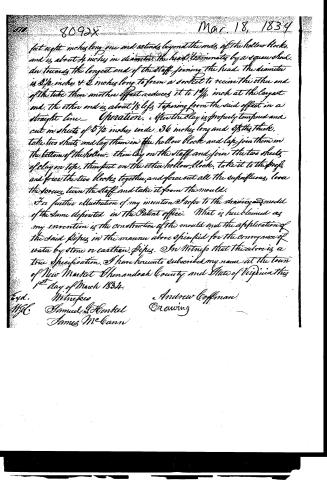
fat eight inches long one end extends beyond the ends of the hollow blocks, and is about 4 inches in diameter. The head terminates by a square shoulder towards the longest end of the staff joining the head. The diameter is 2½ inches & 2 inches long to form a socket to receive the other end of the tube. Then another offset reduces it to 1¾ inch at the largest end. The other end is about 18 lbs. tapering from the said offset in a straight line.
Operation. After the clay is properly tempered and cut in sheets of 5½ inches wide, 36 inches long and 5/8ths thick, take two sheets and lay them in the hollow block and lay join them on the bottom of the hollow. Then lay on the staff and join the two sheets of clay on top. Then put on the other hollow block. Take it to the press and force the two blocks together, and force out all the superfluous, loose the screw, turn the staff and take it from the mould.
For a further illustration of my invention I refer to the drawing & model of the same deposited in the Patent office. What is here claimed as my invention is the construction of the mould and the application of the said pipes in the manner above specified for the conveyance of water by stone or earthen pipes. In Witness that the above is a true specification, I have hereunto subscribed my name at the town of New Market Shenandoah County and State of Virginia this 1st day of March 1834.
Andrew Coffman
Witnesse
Samuel G. Henkel
James McCann
Drawing
Published accounts: journal notice
Notice in the monthly list of patents, with remarks
Journal of the Franklin Institute, new ser., vol. 14 (1834), p. 248 · View the page
56. For making Earthen Pipes for the Conveyance of Water; Andrew Coffman, New Market, Shenandoah county, Virginia, March 18.
Remarks. A mould is to be made in two pieces, and a core to form the tube. The thing has been done hundreds of times in similar and better ways; it is in vain, therefore, that the patentee claims "the construction of the moulds, and the application of the said pipes."
About this record
- Patentee
- DATAMP
- Date
- the Name and Date index of patents, DATAMP, USPTO records
- Invention
- DATAMP
- Listed in
- the Name and Date index of patents, DATAMP, USPTO records, Jim Shaw's X-patent list, the Journal of the Franklin Institute, Burke's List of Patents (1847)
- Burke's 1847 Patent Office list gives the same patent.