

Drawings and documents
USPTO scan
The patent as scanned by the USPTO
-
 Page 1
-
 Page 2
-
 Page 3
-
 Page 4
-
 Page 5


U.S. Patent and Trademark Office · Google Patents
Show the transcription Hide (1,061 words)
Machine transcription (LightOnOCR) of the pages as scanned by the USPTO, most of them the handwritten copies made when the records were restored after the 1836 fire. Not checked; it can misread handwriting, so compare it with the scan.
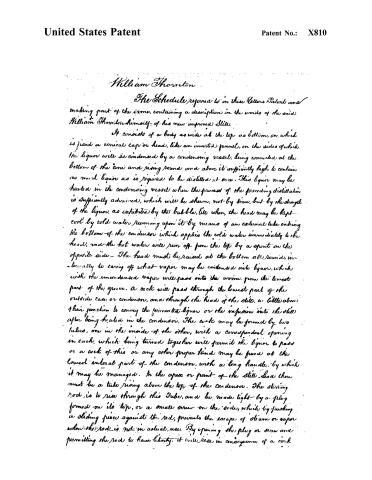
Page 2.
United States Patent
Patent No.: X810
William Thornton
The Schedule referred to in these Letters Patent and making part of the same, containing a description in the words of the said William Thornton himself, of his new improved Still.
It consists of a body as wide at the top as bottom, on which is fixed a conical cap or head, like an inverted funnel, on the sides of which the liquor will be condensed by a condensing vessel, being connected at the bottom of the cone and rising round and above it sufficiently high to contain as much liquor as is required to be distilled at once. This liquor may be heated in the condensing vessel when the process of the preceding distillation is sufficiently advanced, which will be shown, not by time, but by the strength of the liquor, as exhibited by the bubble, till when, the head may be kept cool by cold water running upon it by means of an external tube entering the bottom of the condenser which applies the cold water immediately to the head, and the hot water will run off from the top by a spout on the opposite side. The head must be raised at the bottom all round, internally to carry off what vapor may be condensed into liquor, which with the uncondensed vapor will pass into the warm, from the lowest part of the groove. A cock will pass through the lowest part of the outside case or condenser, and through the head of the still, a little above their junction to convey the fermented liquor or the infusion into the still after being heated in the condenser. The cock may be formed by two tubes, one in the inside of the other, with a corresponding opening in each, which being turned together will permit the liquor to pass or a cock of this or any other proper kind may be fixed at the lowest internal part of the condenser, with a long handle, by which it may be managed. In the apex or point of the still head there must be a tube rising above the top of the condenser. The stirring rod is to rise through this tube, and be made tight by a plug formed on its top, or a small screw on the sides, which, by pushing a sliding piece against the rod, prevents the escape of steam or vapor when the rod is not in actual use. By opening the plug or screw and permitting the rod to have liberty, it will rise in consequence of a cork
Page 3.
United States Patent
Patent No.: X810
on other float being placed near the bottom of this shank or rod, and thereby indicate at all times, when wanted, the height of the boiling liquor by which the fire may be completely regulated, as well as the charge. The stirring rod is to stir the liquor at the bottom of the still, by cross pieces formed like a rake or otherwise. The head of the still, may be raised by a weight and multiplied pulleys, and kept so near a balance as to be easily moved whether full or empty. The still will have a worm and tub in the usual way, and a lock at the bottom of the still to empty it as usual, also a lock to empty the condenser of water externally. The body of the still may be of metal, or of wood and metal, the head of metal or wood, and the condenser of metal or of wood bound with hoops.
When the still is to be charged with grain &c. it may be done by throwing the head up, and when the still is not wanted, the head being up, the body will serve for a boiler to prepare food for battle, heating water for Brewing, washing &c. boiling byder (which however I cannot recommend at any time in copper vessels on account of the acid of the byder, making portable soup, maple sugar, making the extracts of Barley, (or any vegetable matter) for tanning, dying, and many other purposes. During the distillation, if the liquor is not to be charged with the grain &c. in it, the head of the still being luted in with Rye, or any other paste, and paper, linen, or any other suitable substance, need not be moved for a day or two together, as the whole process is perfectly manageable without. Instead of putting the materials whether of grain or fruit into the still, they may be put into a screw or lever press, and after pressing out all the liquor to be distilled, wash the remainder in water in which more grain or fruit may be set. This would take away the necessity of stirring, and the liquor would not be so subject to burning. It is best to supply the condenser by a reservoir, which may be perfectly regulated by a lock. By a still of this kind I have distilled spirit of wine, and from the trials I have made I consider it as the most manageable, the quickest—
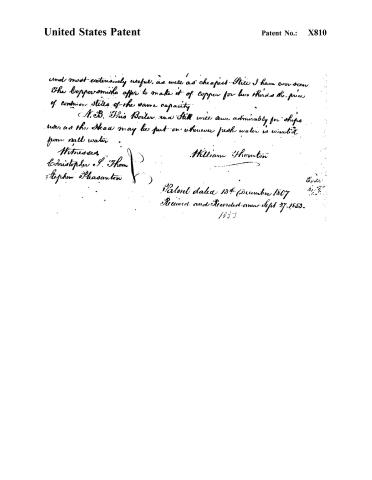
Page 4.
United States Patent
Patent No.: X810
and most extensively useful, as well as cheapest—Still I have ever seen. The Coppersmiths offer to make it of copper for two thirds the price of common stiles of the same capacity.
(N.B. This Boiler and Still will serve admirably for ships use, as the Head may be put on whenever fresh water is wanted from salt water)
Witnesses
Christopher J. Thom
Stephen Pleasanton
William Thornton
Patent dated 13th December 1807
Received and Recorded anew Sept 27, 1853.
1853
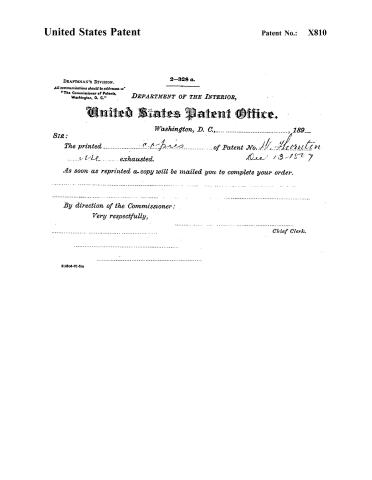
Page 5.
United States Patent
Patent No.: X810
DRAFTSMAN'S DIVISION.
All communications should be addressed to
"The Commissioner of Patents,
Washington, D. C."
2-328 a.
DEPARTMENT OF THE INTERIOR,
United States Patent Office.
Washington, D. C., 189_
SIR:
The printed copies of Patent No. W. Herutin
Dec 13-1867
will be exhausted.
As soon as reprinted a copy will be mailed you to complete your order.
By direction of the Commissioner:
Very respectfully,
Chief Clerk.
3148bd-97-5m
About this record
- Patentee
- Jim Shaw's X-patent list
- Date
- the Name and Date index of patents, USPTO records, Jim Shaw's X-patent list
- Invention
- the Name and Date index of patents
- Listed in
- the Name and Date index of patents, USPTO records, Jim Shaw's X-patent list, S. A. Elliot's printed list of patents, Burke's List of Patents (1847)
- S. A. Elliot's printed list of patents gives the same name and date.
- Burke's 1847 Patent Office list gives the same patent.
- Residence from Burke's 1847 Patent Office list; the standard lists give none.