

Drawings and documents
National Archives restored drawings: drawing
Silvanus Leonard's Patent Drawing for a Thrashing Machine

National Archives, Restored Patent Drawings (Record Group 241) · Full-size scan at the National Archives · Catalog record
Show the text on the drawing Hide (60 words)
Words on the drawing as machine-read by the National Archives; not checked. Useful mainly for searching.
Entered. / 130. THRASHING. / $2- / [159] ThrashingMach's / CLASSIFICATION / Cyl / Milvanis Leonard's of / 8111-4 / DIVISION / Leashing Machine. / Patented 27 March: 1834. / References / wheel. / Pullies / c. / Beater / bed / slide / h. / Feeding / Patent Office Han / Made undri the derection of the Comminer / Patents in con informity with act 3 Manh / MLSunorth
USPTO scan
The patent as scanned by the USPTO
-
 Page 1
-
 Page 2
-
 Page 3
-
 Page 4
-
 Page 5
-
 Page 6
-
 Page 7
-
 Page 8
-
 Page 9


U.S. Patent and Trademark Office · Google Patents
Show the transcription Hide (2,620 words)
Machine transcription (LightOnOCR) of the pages as scanned by the USPTO, most of them the handwritten copies made when the records were restored after the 1836 fire. Not checked; it can misread handwriting, so compare it with the scan.
Page 1.
130. THRASHING.
[139] Thrashing Mach.
CLASSIFICATION
8/11/5 +
DIVISION.
BEST AVAILABLE COPY
O/P
Page 2.
3/27/1834 8111X
Mar 27 1834
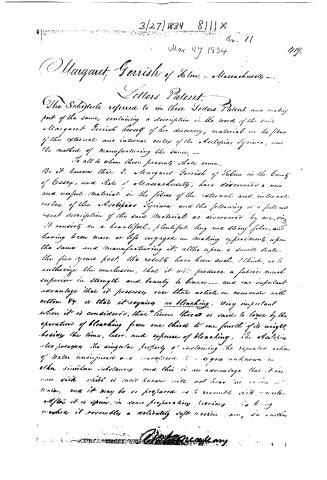
Margaret Gerrish of Salem, Massachusetts
Letters Patent.
The Schedule referred to in these Letters Patent, and making part of the same, containing a description in the words of the said Margaret Gerrish herself of her discovery, material in the fibres of the external and internal cortex of the Aculepias Syriaca, and the method of manufacturing the same.
To all to whom these presents shall come,
Be it known that I, Margaret Gerrish of Salem in the County of Essex, and State of Massachusetts, have discovered a new and useful material in the fibres of the external and internal cortex of the Aculepias Syriaca, and the following is a full and exact description of the said material as discovered by me, viz:
It consists in a beautiful, plentiful, long and strong fibre, and having been more or less engaged in making experiments upon the same and manufacturing it, altho upon a small scale, the five years past, the results have been such, I think, as to authorize the conclusion, that it will produce a fabric much superior in strength and beauty to linen, and one important advantage that it possesses over that article in common with cotton viz. is that it requires no bleaching. Very important when it is considered, that linen thread is said to lose by the operation of bleaching from one third to one fourth of its weight, besides the time, labor, and expense of bleaching, the Aculepias also possesses the singular property of sustaining the repeated action of water uninjured and unaltered to a degree unknown in other similar substances, and this is an advantage that it has over silk which is well known will not bear its weight of water, and it may be so prepared as to resemble silk in some respects, and it may be so prepared as to resemble silk in others.
Margaret Gerrish
Page 3.
421
3/27/1834 8111N
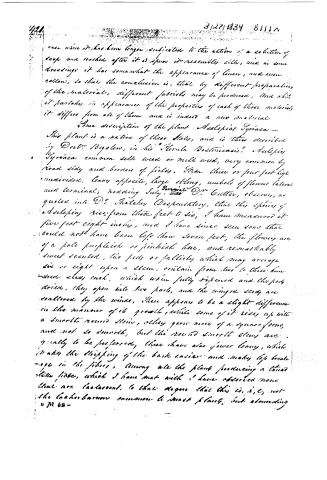
case where it has been longer subjected to the action of a solution of soap and soaks after it is spun it resembles silk, and in some dressings it has somewhat the appearance of linen, and even cotton, so that the conclusion is, that by different preparations of the materials, different fabrics may be produced, and while it partakes in appearance of the properties of each of those materials it differs from all of them and is indeed a new material.
Some description of the plant Isatis Syriaca —
This plant is a native of these States, and is thus described by Dr. Wyatow, in his "Formula Bostoniensis." Isatis Syriaca common silk weed or mulk weed, very common by road side and borders of fields. From three or four feet high, undivided. Leaves opposite, large, oblong, umbels of flowers lateral and terminal; nodding July. Dr. Gutter, observes, as quoted into Dr. Thatcher's Descriptive, that this species of Isatis rises from three feet to six, I have measured it five feet eight inches, and I have since seen some that could not have been less than seven feet, the flowers are of a pale purplish or pinkish hue, and remarkably sweet scented, the pods or follicles which may average six or eight upon a stem, contain from two to three hundred seeds each, which when fully ripened and the pods dried, they open into two parts, and the winged seeds are scattered by the wind. There appears to be a slight difference in the manner of its growth, while some of it rises up with a smooth round stem, others grow more of a square form, and not so smooth, but the round smooth stems are usually to be preferred, these have also fewer leaves, which make the stripping of the bark easier and make the breakage in the fibers. Among all the plants producing a thread-like fiber, which I have met with I have observed none that are lacquered, to that degree that this is, i.e., not the lacquer barnow common to most plants, but abundant
"p 62-
Page 4.
3/27/1834 8111x 7/21.
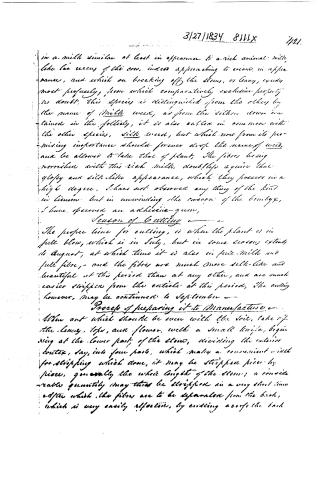
in a milk similar at least in appearance to a rich animal milk, like the uccy of the cow, indeed approaching to cream, in appearance, and which on breaking off the stem, or leaf, exudes most profusely, from which comparatively exclusive property no doubt this species is distinguished from the others by the name of Milk weed, as from the yellow down contained in the follicle, it is also called in common with the other species, Milk weed, but which now from its promising importance should forever drop the name of weed, and be allowed to take that of plant, the fibres being nourished with this rich milk, doubtless acquire that glossy and silk-like appearance, which they possess in a high degree. I have not observed any thing of the kind in linen, but in unwinding the cocoon of the bombyx, I have observed an adhesive gum.
Season of Cutting
The proper time for cutting, is when the plant is in full blow, which is in July, but in some seasons extends to August, at which time it is also in full milk and full fibre, — and the fibres are much more silk-like and beautiful at this period than at any other, and are much easier stripped from the outside at this period, the cutting however, may be continued to September —
Process of preparing it to Manufacture
When cut which should be even with the soil, take off the leaves, tops, and flowers, with a small knife, beginning at the lower part of the stem, dividing the exterior cortex, say, into four parts, which makes a convenient width for stripping which done, it may be stripped piece by piece, generally the whole length of the stem; a considerable quantity may thus be stripped in a very short time after which the fibres are to be separated from the bark, which is very easily effected, by cutting across the bark
Page 5.
3/27/1834 8111x
122.
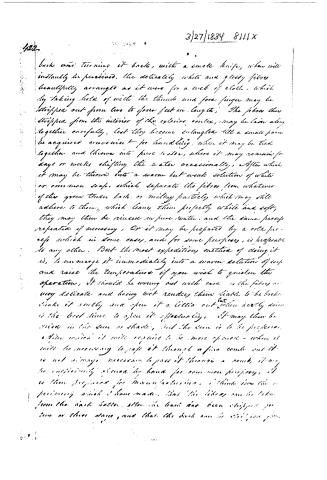
bark and turning it back, with a small knife, when will instantly be perceived, the delicately white and glossy fibres beautifully arranged as it were for a web of cloth, which by taking hold of with the thumb and fore finger may be stripped out from time to time feet in length; The fibres thus stripped from the interior of the exterior cortex, may be laid along together carefully, lest they become entangled till a small parcel be acquired convenient for handling, when it may be tied together and thrown into pure water, where it may remain for days or weeks shifting the water occasionally. After which it may be thrown into a warm but weak solution of white or common soap, which separates the fibres from whatever of the green tannin bark or milky particles which may still adhere to them, which leaves them perfectly white and soft, they may then be rinsed in pure water, and the same process repeated if necessary. Or it may be prepared by a cold process which in some cases, and for some purposes, is preferable to any other. But the most expeditious method of doing it is, to immerse it immediately into a warm solution of soap and raise the temperature if you wish to quicken the operation. It should be wrung out with care, as the fibres are very delicate and being wet renders them liable to be broken. Shake it wellly and open it a little out, but when partly dried is the best time to open it effectually. It may then be dried in the sun or shade, but the sun is to be preferred. If the dried it will require to be more opened - when it will be necessary to pass it through a fine comb and it is not always necessary to pass it through a comb, it may be sufficiently opened by hand for common purposes. It is then prepared for manufacturing. I think from the experience which I have made, that the fibres can be taken from the bark better after the bark has been stripped for two or three days, and that the bark can be stripped from
Page 6.
3/27/1834 8/11x
626
123.
The skin equally well after the lapse of several days or more, which may sometimes be found convenient. The process of preparation being extremely simple, as has been shown, so much so, that it comes within the means of the humblest peasant. No apparatus being necessary but a small knife, a tub or run of water.
The shorter fibres, which remain in the comb, after combing may be again subjected to the action of a hot or boiling solution of soap, until the fibres be sufficiently broken up for carding, which when done makes a very light, delicate and almost transparent batting, which can be manufactured into a wadding particularly suitable for silk dress, and which may be coloured to correspond to any required shade.
Spinning
After having been thus dressed it is fit for spinning, which is done upon the common linen wheel, with a slight alteration in the present construction of a part of that machine termed the distaff. In spinning this material there is much less to injure the eyes and lungs, than in cotton or flax.
Colouring
This material when manufactured into a thread, as above described, washed or boiled in a solution of soap, rinsed in fair water and slightly alummed is duly prepared to receive the colouring you may choose to give it. Its attraction for coloring matters appears to be as strong and equal as that of silk, indeed it attracts the coloring particles more equally than that material. If we may judge from the account of those acquainted with the business, and decidedly more than that of cotton or linen, which I should suppose a highly important object: "we are told that cotton and linen do not take black, blue with reddest soap," and that when intended to be dyed, they must be subjected to the operation of scouring, alumming, and galling, and that the preparation of silk with alum, is necessary in all cases" which the
+ Nicholson Diet. Mr. Oving -
Page 7.
3/27/1834 8111x
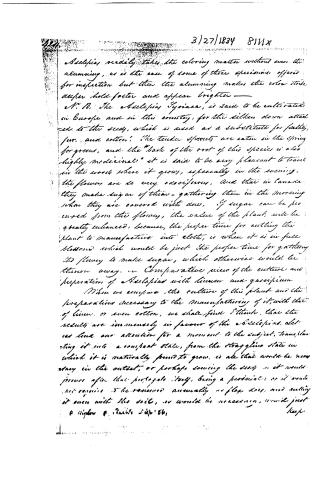
Sclepin readily takes the coloring matter without even the alumning, as is the case of some of those specimens offered for inspection but then the alumning makes the color strike deeper hold faster and appear brighter —
N.B. The Sclepin Syriaca, is said to be cultivated in Europe and in this country, for the silk down attached to the seed, which is used as a substitute for flax, fur, and cotton. The tender sprouts are eaten in the spring for greens, and the bark of the root of this species is also highly medicinal it is said to be very pleasant to travel in the woods where it grows, especially in the evening, the flowers are so very odorous, and that in Canada they make sugar of them, gathering them in the morning when they are covered with dew. If sugar can be procured from the flowers, the value of the plant will be greatly enhanced, because, the proper time for cutting the plant to manufacture into cloth, is when it is in full blossom which would be just the proper time for gathering the flowers to make sugar, which otherwise would be thrown away. — Comparative piece of the culture and preparation of Sclepin with linen and gossypium
When we compare the culture of this plant and the preparation necessary to the manufacturing of it, with that of linen, or even cotton, we shall find I think, that the results are immensely in favour of the Sclepin, let us look and attention for a moment to the subject, transforming it into a compact state, from the straggling state in which it is naturally found to grow, is all that would be necessary in the outset, or perhaps saving the seed in it would prove after that prototype itself, being a perennial or it would not require to be sown annually or flax does, and sowing it once with the seed, as would be necessary, would just
Highlow & Kachis 24th '56,
keep
Page 8.
3/27/1834 8111X 423
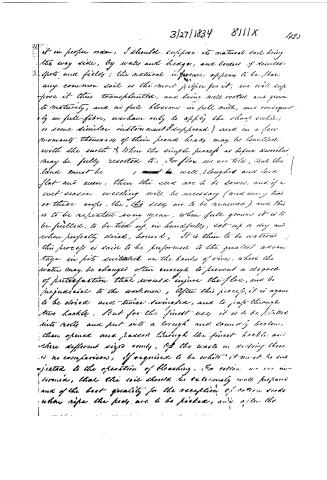
it in proper order, I should suppose its natural soil being the way side, by walls and hedges, and borders of gardens, yards and fields; the natural inference appears to be, that any common soil is the most proper for it, we will suppose it thus transplanted, and being well rooted and grown to maturity, and in full blossom in full milk, and consequently in full fibre, we have only to apply the sharp sickle, (or some similar instrument supposed) and in a few moments thousands of their proud heads may be levelled with the earth. When the simple process as before described may be fully resorted to. For flax we are told, that the land must be well ploughed and laid flat and even, then the seed are to be sown, and if a wet season weeding will be necessary (and every two or three crops, the, the seed are to be renewed) and this is to be repeated every year, when full grown it is to be pulled, to be tied up in handfuls, set up to dry and when perfectly dried, hewed, It is then to be watered this process is said to be performed to the greatest advantage in pits situated on the banks of rivers, where the water may be changed often enough to prevent a degree of putrefaction that would injure the flax, and be prejudicial to the workmen, After this process, it is again to be dried and twice swirled, and to pass through two hackles, But for the finest use it is to be pulled into rolls and put into a trough and coarsey baskets, then opened and passed through the finest hackle and then different sizes only. Of the waste in working these is no comparison, if required to be white it must be subjected to the operation of bleaching. For cotton we are informed, that the soil should be extremely well prepared and of the best quality for the reception of cotton seeds when ripe the pods are to be picked, and after the
Page 9.
3/27/1839 8111N
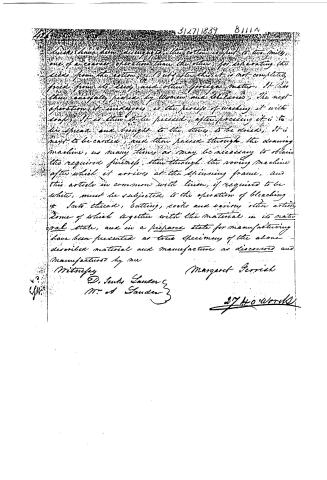
lunch have been described. The cotton is put to two mills, one of a coarse operation than the other, for separating the seed from the cotton. But after this it is not completely freed from its seed and other foreign matter. It is then carefully picked by women and children. The next operation it undergoes is the process of washing it with soap. It is then to be pressed, after pressing it is to be spread and brought to the stove to be dried. It is next to be carded, and then passed through the drawing machine, as many times as may be necessary to obtain the required fineness, then through the roving machine after which it arrives at the spinning frame, and this article in common with linen, if required to be white, must be subjected to the operation of bleaching.
* Into thread, batting, socks and various other articles some of which together with the material in its natural state, and in a prepared state for manufacturing have been presented as true specimens of the above described material and manufacture as discovered and manufactured by me
Margaret Gerrish
Witness
D. Sinks Sander
Mr. A. Sander
27 H. O. Works
Published accounts: journal notice
Notice in the monthly list of patents, with remarks
Journal of the Franklin Institute, new ser., vol. 14 (1834), p. 255 · View the page
76. For a New Fibrous Material to be used in Manufactures; Margaret Gerrish, Salem, Essex county, Massachusetts, March 27.
Remarks. The new material designated as the subject of this patent, is obtained from the cortex of the asclepias syriaca, known under the common name of silk weed, or milk weed, and Syrian swallow wort, a native of the United States. The description of it in Dr. Bigelow's "Florula Bostoniensis," and in other works, is alluded to in the specification. The mode of obtaining the fibres, recommended by the patentee, is to take the stems, divide the bark longitudinally into four parts, and strip it off, which may be effected with much facility. On making a partial transverse section and bending the bark, the glossy, silk-like fibres, make their appearance, and may be drawn out in lengths of from two to three feet. After the necessary preparation, these fibres may be spun, coloured, and used as other fibrous materials. The specification contains a good deal of matter which may be considered as altogether extraneous in such an instrument, as it has nothing to do with the security of the patent; we therefore, pass this part over, having stated the object of the patent, which is simply to secure the right to the introduction of the substance designated as a new material for the manufacture of thread, cloth, and other similar fabrics.
About this record
- Patentee
- DATAMP
- Date
- the Name and Date index of patents, DATAMP, USPTO records
- Invention
- DATAMP
- Listed in
- the Name and Date index of patents, DATAMP, USPTO records, Jim Shaw's X-patent list, the Journal of the Franklin Institute, Burke's List of Patents (1847)
- The National Archives' catalog gives the name differently.
- Burke's 1847 Patent Office list gives the same patent.