

Drawings and documents
National Archives restored drawings: drawing
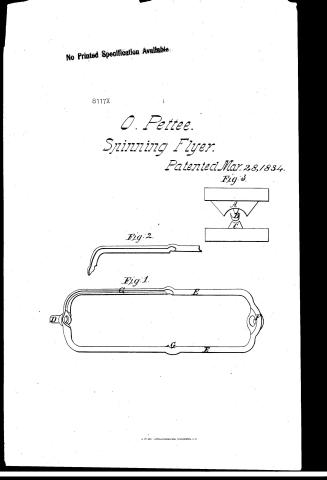
Otis Pettee's Patent Drawing for Double Speeder Fliers

National Archives, Restored Patent Drawings (Record Group 241) · Full-size scan at the National Archives · Catalog record
Show the text on the drawing Hide (100 words)
Words on the drawing as machine-read by the National Archives; not checked. Useful mainly for searching.
118. SPINNING, / Fliers. / pl / SERIVICATION / 8117-4 8119 x / DIVISION. / O TIS PETTEE'S / Patented 28 Mar 1834. / Double Speeder Fliers / Refferences. / Fight Perspective viewof the fher comple te X made in one piece.D is the nose, EE the arms the bottom / GG the tubes. / tig3 Vertical section of the dies by which the grooms are elosed A,the uperdie. B, the tube d'the nether die / to Figl. The groove when first cast being only partially tubes closed resembling the pod of an anger. / Fiz3 / Fig 2 / Fiz1
USPTO scan
The patent as scanned by the USPTO
-
 Page 1
-
 Page 2
-
 Page 3


U.S. Patent and Trademark Office · Google Patents
Show the transcription Hide (828 words)
Machine transcription (LightOnOCR) of the pages as scanned by the USPTO, most of them the handwritten copies made when the records were restored after the 1836 fire. Not checked; it can misread handwriting, so compare it with the scan.
Page 1.
No Printed Specification Available.
8117X
O. Pettee.
Spinning Flyer.
Patented Mar. 28, 1834.
Fig. 3.
Fig. 2.
Fig. 1.
H. PETERS, PHOTO-LITHOGRAPHER, WASHINGTON, D. C.
Page 2.
Mar 28, 1834 389
Otis Peltier, Newton, Massachusetts 8117X
Letter Patent
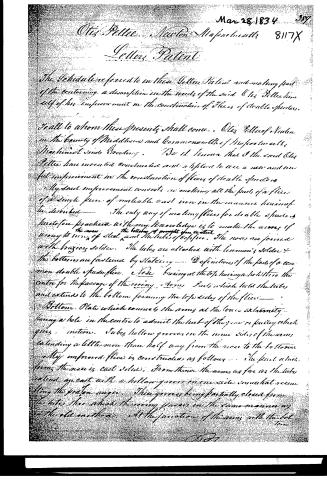
The Schedule referred to in these Letters Patent and making part of the containing a description in the words of the said Otis Peltier himself of his improvement in the construction of flees of double species.
To all to whom these presents shall come... Otis Peltier of Newton in the county of Middlesex and Commonwealth of Massachusetts Machinist and Engineer. Be it known that I the said Otis Peltier have invented constructed and applied to use a new and useful improvement in the construction of flees of double species.
My said improvement consists in making all the parts of a flees of a single piece of malleable cast iron in the manner hereinbefore described.
The only way of making flees for double species heretofore practiced with any knowledge is to make the arms of the arms of the sleeves of wrought iron instead of steel and the tubes of steel. The arms are joined with braziers solder. The tubes are attached with common solder & the bottoms are fastened by staking.
Definitions of the parts of a common double species flees.
Rise having at the top having a hole to the centre for the passage of the spring.
Arms Parts which hold the tubes and extends to the bottom forming the top sides of the flees.
Bottom Plate which connects the arms at the lower extremity having a hole in the centre to admit the hub of the gear or pulley which gives motion.
Tubes hollow grooves on the inner sides of the arms extending a little more than half way from the nose to the bottom.
My improved flees is constructed as follows. The part which forms the nose is cast solid. From thence the arms as far as the tubes extend are cast with a hollow groove on one side somewhat resembling the portion upper. These grooves being partially closed from the tubes those which the spring passes in the same manner as in the old method. At the junction of the arms with the bottom.
Page 3.
8117X
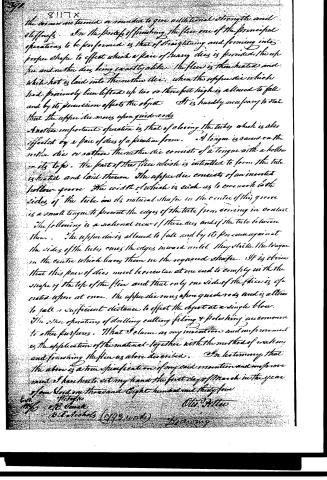
The manner is termed a rounded to give additional strength and stiffness. Also the process of finishing the flue one of the principal operations to be performed is that of straightening and forming into proper shape to effect which a pair of heavy dies is provided, the upper and neither dies being exactly alike. The flue is then heated and while hot is laid into the neither die. When the upper die which had previously been lifted up two or three feet high is allowed to fall and by its pressure affects the object. It is hardly necessary to state that the upper die moves upon guide rods.
Another important operation is that of closing the tube which is also effected by a pair of dies of a peculiar form. A tongue is raised on the neither dies or rather the neither die consists of a tongue with a hollow on its top. The part of the flue which is intended to form the tube is heated and laid thereon. The upper die consists of an inverted hollow groove the width of which is such as to correspond to the sides of the tube in its natural shape in the centre of this groove is a small tongue to prevent the edges of the tube from coming in contact.
The following is a sectional view of these dies and of the tube between them. The upper die is allowed to fall and by its pressure against the sides of the tube closes the edges inward until they strike the tongue in the centre which leaves them in the required shape. It is obvious that this pair of dies must be circular at one end to comply with the shape of the top of the flue and that only one side of the flue is operated upon at once. The upper die runs upon guide rods and is allowed to fall a sufficient distance to effect the object at a single blow.
The other operations of drilling cutting filing & polishing are common to other purposes. What I claim as my invention and improvement is the application of the material together with the method of making and finishing the flue as above described. In testimony that the above is a true specification of my said invention and improvement I have hereunto set my hand the first day of March in the year of our Lord one thousand eight hundred and thirty-four.
604
1836
W. H. D.
W. H. D. (1836 work)
W. H. D.
Published accounts: journal notice
Notice in the monthly list of patents, with remarks
Journal of the Franklin Institute, new ser., vol. 14 (1834), p. 257 · View the page
80. For an improvement in the Fliers of Double Speeders; Otis Pettee, Newton, Middlesex county, Massachusetts, March 28.
Remarks. The fliers of double speeders are usually made of several pieces of metal, the arms of wrought iron, the nose of steel, the bottoms of wrought iron, or steel, and the tubes of copper; the improvement consists in making the flier in one entire piece of malleable cast iron, in the manner described. The part which is to form the groove is, when delivered from the mould, open like the pod of an augur, and requires to be closed. The flier is formed into proper shape, and straightened by a pair of heavy dies fixed in a drop press, and the tubes are formed by dies made for the purpose, which close the open pod, so as to leave the required groove. The process is described with sufficient clearness, and the plan appears to be one which offers no small saving in the formation of the article patented.
About this record
- Patentee
- DATAMP
- Date
- the Name and Date index of patents, DATAMP, USPTO records
- Invention
- DATAMP
- Listed in
- the Name and Date index of patents, DATAMP, USPTO records, Jim Shaw's X-patent list, the Journal of the Franklin Institute, Burke's List of Patents (1847)
- Burke's 1847 Patent Office list gives the same patent.