

Drawings and documents
National Archives restored drawings: drawing
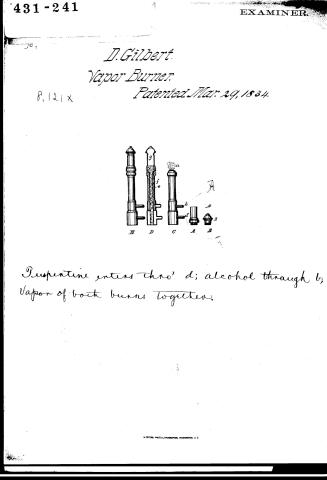
David Gilbert's Patent Drawing for a Vapour Lamp

National Archives, Restored Patent Drawings (Record Group 241) · Full-size scan at the National Archives · Catalog record
Show the text on the drawing Hide (45 words)
Words on the drawing as machine-read by the National Archives; not checked. Useful mainly for searching.
Vaper Burner Heal conclucting / CLASSIFICATION / 8121 X / DIVISION. / $1- / 67. LAMPS & GASFITTINGS. / [90] Vapor Burners. / # 8/2/x / a. / Div.10 / OlA / b. / E. / Dame Gilberts bapour back / Patented montg 1834 / Drawings / Explanations / and Outh / 60
USPTO scan
The patent as scanned by the USPTO
-
 Page 1
-
 Page 2
-
 Page 3
-
 Page 4


U.S. Patent and Trademark Office · Google Patents
Show the transcription Hide (943 words)
Machine transcription (LightOnOCR) of the pages as scanned by the USPTO, most of them the handwritten copies made when the records were restored after the 1836 fire. Not checked; it can misread handwriting, so compare it with the scan.
Page 1.
431-241
EXAMINER.
D. Gilbert.
Vapor Burner.
Patented Mar. 29, 1834
8,121x

Turpentine enters thro' d; alcohol through b; Vapors of both burns together.
K. PETERS, PHOTO-LITHOGRAPHER, WASHINGTON, D. C.
Page 2.
Mar. 29, 1834 8121X 79.
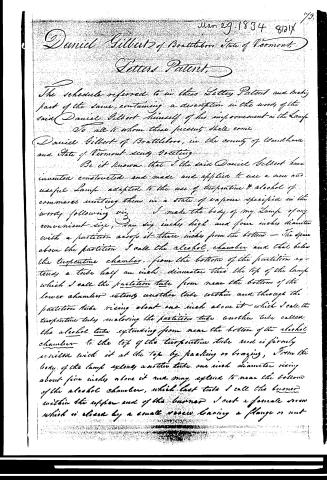
Daniel Gilbert of Brattleboro State of Vermont,
Letters Patent,
The schedule referred to in these Letters Patent and being part of the same, containing a description in the words of the said Daniel Gilbert himself of his improvement in the Lamp.
To all to whom these presents shall come.
Daniel Gilbert of Brattleboro, in the county of Windham and State of Vermont, Greeting.
Be it known that I the said Daniel Gilbert have invented, constructed, and made and applied to use a new and useful Lamp adapted to the use of turpentine & alcohol of commerce uniting them in a state of vapour specified in the words following viz: I make the body of my Lamp of any convenient size, say six inches high and four inches diameter with a partition across it three inches from the bottom — The space above the partition I call the alcohol chamber and that below the turpentine chamber. From the bottom of the partition extends a tube half an inch diameter to the top of the lamp which I call the partition tube. From near the bottom of the lower chamber extends another tube within and through the partition tube rising about one inch above it which I call the turpentine tube enclosing the partition tube. Another tube called the alcohol tube extending from near the bottom of the alcohol chamber to the top of the turpentine tube and is firmly united with it at the top by packing or brazing. From the body of the lamp extends another tube one inch diameter rising about five inches above it and may extend to near the bottom of the alcohol chamber, which last tube I call the burner within the upper end of the burner I cut a female screw which is closed by a small screw having a flange or nut.
Page 3.
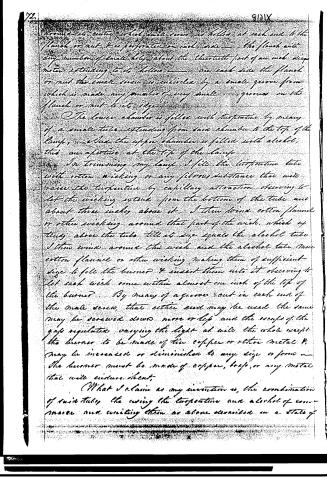
round its outer which ends in a hollow at each end to the flanch or nut. It is perforated on each side—the flanch with any number of small holes about the thirtieth part of an inch diameter extending to its hollow—on each side the flanch or nut the small orifice is inclosed by a small groove from which is made any number of very small grooves on the flanch or nut to its edge.
The lower chamber is filled with turpentine by means of a small tube extending from said chamber to the top of the lamp; and the upper chamber is filled with alcohol, this an aperture at the top of the lamp.
In trimming my lamp I fill the turpentine tube with cotton wicking or any fibrous substance that will raise the turpentine by capillary attraction, observing to let the wicking extend from the bottom of the tube and about three inches above it. I then wind cotton flannel or other wicking around that part of the wick, which extends above the tube till its size equals the alcohol tube. I then wind around this wick and the alcohol tube more cotton flannel or other wicking making them of sufficient size to fill the burner & insert them into it observing to let each wick come within almost one inch of the top of the burner. By means of a groove cut in each end of the male screw, that either end may be used the same may be screwed down more or less and the wicks of the gas regulated varying the light at will. The whole except the burner to be made of tin, copper or other metal & may be increased or diminished to any size or form. The burner must be made of copper, brass, or any metal that will endure heat.
What I claim as my invention is, the combination of said tubes, the using the turpentine and alcohol of course and uniting them as above described in a state of
Page 4.
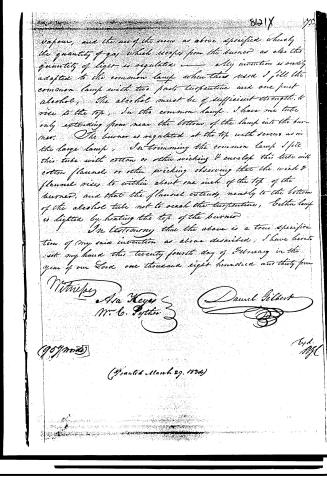
vapour, and the use of the screw as above specified whereby the quantity of gas which escapes from the burner as also the quantity of light is regulated. My invention is readily adapted to the common lamp when thus used. I fill the common lamp with two parts turpentine and one part alcohol. The alcohol must be of sufficient strength to rise to the top. In the common lamp I have one tube only extending from near the bottom of the lamp into the burner. The burner is regulated at the top with screws as in the large lamp. In trimming the common lamp I fill this tube with cotton or other wicking & envelop this tube with cotton flannel or other packing observing that the wick & flannel rises to within about one inch of the top of the burner, and that the flannel extends nearly to the bottom of the alcohol tube not to reach the turpentine. Either lamp is lighted by heating the top of the burner.
In testifying that the above is a true specification of my said invention as above described, I have hereunto set my hand this twenty fourth day of February in the year of our Lord one thousand eight hundred and thirty four.
Witnesses:
Asa Keyes
M. C. Pyther
Daniel Gilbert
(907 made)
(Printed March 29, 1834)
Published accounts: journal notice
Notice in the monthly list of patents, with remarks
Journal of the Franklin Institute, new ser., vol. 14 (1834), p. 258 · View the page
83. For a Lamp for Burning Alcohol and Spirits of Turpentine; Daniel Gilbert, Brattleboro', Windham county, Vermont, March 29.
Remarks. In this lamp the alcohol and turpentine are to be separately converted into vapour, and to be ignited as they combine. A metal lamp is to be divided into two compartments by a horizontal partition, which may be at about one-third of its height from the bottom. The lower chamber is to be filled with spirits of turpentine through a tube leading into it, and extending above the top of the lamp; a similar tube enters the upper chamber, for the purpose of filling it with alcohol. The burner, in the centre of the lamp, and extending to the height of some inches from the top, consists in part of two concentric tubes, with a space between them; the inner of these tubes extends down into the turpentine chamber, and is furnished with a wick, reaching nearly to its top, in order to raise the spirit by capillary attraction; the larger tube descends into the alcohol chamber, whence that also rises by means of cotton or other fibrous material occupying the space between the two tubes, this cotton also terminating at the same distance below the top, as the turpentine wick. A brass cap screws into the upper end of the burner, and has lateral perforations in it, through which the vapour escapes, and at which it is to be ignited; by raising or lowering the cap, the apertures may be enlarged, or lessened. To adapt the common lamp to the purpose, two parts of turpentine, and one of alcohol, are to be put into it, the alcohol being of such strength as to float upon the surface. The tube is to be provided with its cap, and managed, generally, as in the former instance. We do not believe that this lamp will be approved, as there are no means of regulating the proportionate quantities of the spirits which are to enter into combustion, and there will frequently be a strong smell of oil of turpentine. The plan of Mr. Jennings, in which the two fluids are perfectly combined, is, we think, altogether to be preferred on several accounts, but they are both dangerous.
About this record
- Patentee
- DATAMP
- Date
- the Name and Date index of patents, DATAMP, USPTO records
- Invention
- DATAMP
- Listed in
- the Name and Date index of patents, DATAMP, USPTO records, Jim Shaw's X-patent list, the Journal of the Franklin Institute, Burke's List of Patents (1847)
- Burke's 1847 Patent Office list gives the same patent.