

Drawings and documents
National Archives restored drawings: drawing
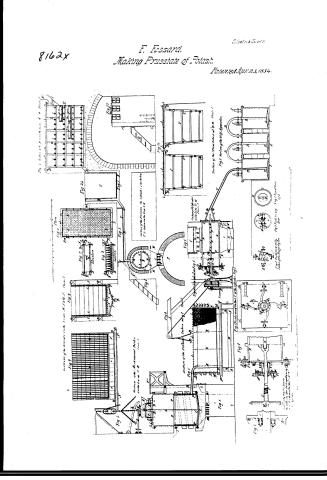
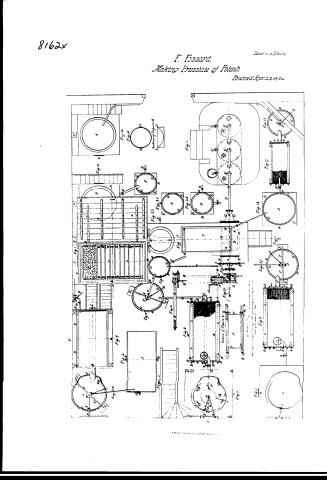
Felix Fossard's Patent Drawing for an Apparatus for Manufacturing the Prussiates of Potash and Soda


National Archives, Restored Patent Drawings (Record Group 241) · Full-size scan at the National Archives · Catalog record
Show the text on the drawing Hide (197 words)
Words on the drawing as machine-read by the National Archives; not checked. Useful mainly for searching.
Sheet 1. №2 / Apparatus for Manufacturing IDC Prissintes / ICATION / Potash and Soda / 8162-4 / Fig.15. Serion of the Store on the Line и Plate.,1. / VISION / Scale / E181 / S- / sections of the Drainer onthe mes / III. / II / IL / BL / rip.D. / oz / 12/2 / ST / 5'10.2. / FIO.23. / 0.4 / to / #16.22 / Fib.5 / F19 / Section efthe Mechanical Boiler / ontine Line C.B. / section of Ihe Purnace the Cyttriler & the Boilers / pig I. / 7:7 7. taken onthe Lane 0 Q / IS / 12 / e ection of the Filterer TOKEN at q.l. Plate.2. / rip.5. / Section of the Cylinder / FIOUTES dependent F10.2 / mthe Line c.a. / or / Plate / Section of Hre Stove taken at V.X / rig.1. section of the Welf-Apparatus / Fig.1. Krowl view ef the Door.T. of llic cylinder. pyal. / Pig.7. / =: / or / FIP /. Front view of the / FIG. / From view of / pig.1. Front / Collar of the Stuffard Box / Section of the Wherl Scren / the Collars, Door, the Lenglhening, / Cylunder / Scute
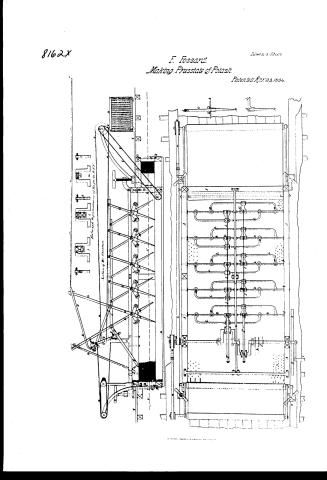
Sheet 2. N°3 / 8162- / Machine for Hashing Hool. / section of the Elevation / Horizontal ViewomeMachine
Sheet 3. $26 / N°1 / FELIX FOSSARD / CLASSIFICATION / PATENTED23APRILIS3A. / 8162-X / APPARATUS FOR MANUFACTURING the PRUSSIATES / DIVISION. / POTASH & SODA / OR / Co / AI / Fif.L / Fig 27
USPTO scan
The patent as scanned by the USPTO
-
 Page 1
-
 Page 2
-
 Page 3
-
 Page 4
-
 Page 5
-
 Page 6
-
 Page 7
-
 Page 8
-
 Page 9
-
 Page 10
-
 Page 11
-
 Page 12
-
 Page 13
-
 Page 14
-
 Page 15
-
 Page 16
-
 Page 17
-
 Page 18
-
 Page 19
-
 Page 20
-
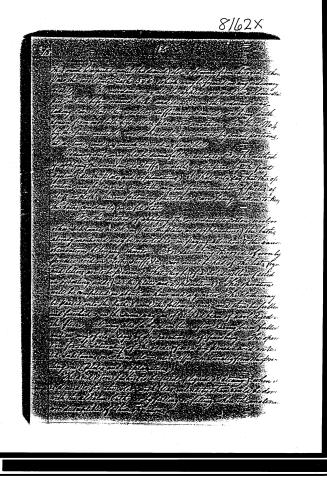 Page 21
-
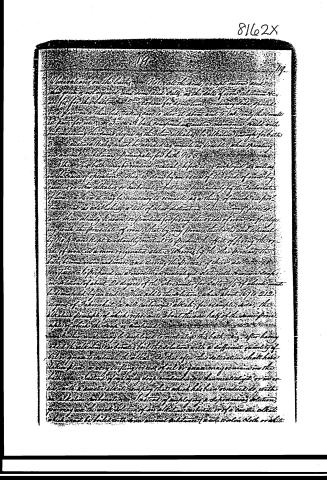 Page 22
-
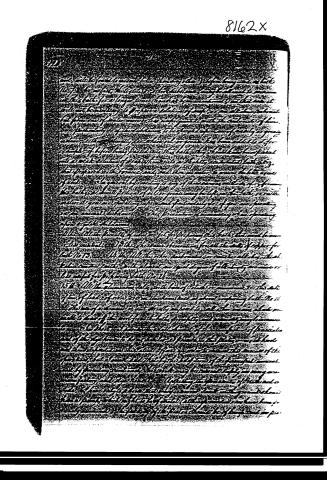 Page 23
-
 Page 24
-
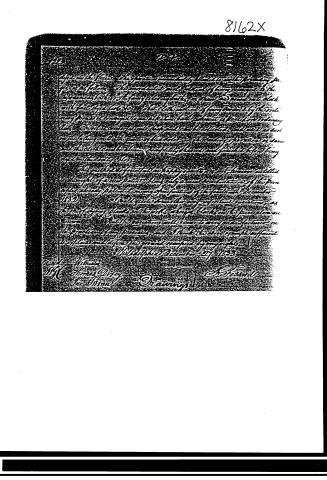 Page 25


U.S. Patent and Trademark Office · Google Patents
Show the transcription Hide (7,836 words)
Machine transcription (LightOnOCR) of the pages as scanned by the USPTO, most of them the handwritten copies made when the records were restored after the 1836 fire. Not checked; it can misread handwriting, so compare it with the scan.
Page 1.
8162x
F. Fossari.
Making Prussiate of Potash.
Patented Apr. 23, 1834.
Page 2.
8162X
F. Fossard.
Making Prussiate of Potash.
Patented April 23, 1834.
Page 3.
8162x
F. Fossard.
Making Prussiate of Potash.
Patented Apr. 23, 1834.
Sheet 3 of 3 Sheets.
Page 4.
4/23/1834 8162X
April 23, 1834 101
Felix Howard
Letters Patent
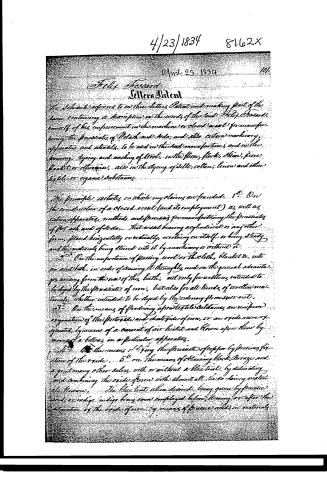
The Schedule referred to in their Letters Patent and making part of the same, containing a description in the words of the said Felix Howard, himself of his improvement in the machine or closed vessel for manufacturing the products of Potash and Soda; and also certain machinery, apparatus and utensils, to be used in the said manufacture, and in the scouring, dyeing and washing of wool, in the fleece, flock, skin, piece, blanket, or otherwise, also in the dyeing of silk, cotton, linen and other textile or organic substances.
The principle articles on which my claims are founded: 1st. On the construction of a closed vessel (and its employment) as well as certain apparatus, methods, and processes for manufacturing the products of potash and of soda. That vessel having a cylindrical or any other form, placed horizontally or vertically, resting on itself or being steady, and the materials being stirred into it by machinery or without it.
2nd. On the importance of passing wool or the cloth, blanket &c. into an acid bath, in order of scouring it thoroughly, and on the general advantages resulting from the use of this bath, not only for woollens intended to be dyed by the products of iron, but also for all kinds of woollen materials, whether intended to be dyed by the ordinary processes or not.
3rd. On the means of producing upon textile substances an uniform oxidation of the ferric oxide and deutoxide of iron, or an oxide more or less ignited, by means of a current of air heated and blown upon them by means of a bellows, in a particular apparatus.
4th. On the means of fixing the ferric oxide of copper by previous fixation of the oxide. 5th. On the means of obtaining black, bronze and a great many other colors, with or without a blue tint, by reducing and combining the oxide of iron with almost all the coloring materials known. The blue tint when desired being given by ferric oxide or indigo indigo being used employed before, during, or after the oxidation of the oxide of iron, by means of ferric oxide or materials.
Page 5.
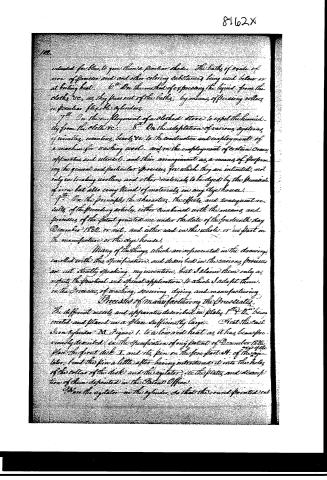
intended for blue to give them a peculiar shade. The baths of oxide of iron of ferric acid and other coloring substances, being used below or at boiling heat. 6th On the method of expressing the liquid from the cloths, &c., as they pass out of the baths, by means of pressing rollers or peculiar flexible cylinders.
7th On the employment of a clothed stone to expel the humidity from the cloths &c. 8th On the adaptation of various systems of rivets, eccentric, &c., to the construction and employment of a machine for washing wool, and on the employment of certain cross apparatus and utensils, and their arrangement as a means of performing the general and particular processes for which they are intended, not only in treating wools and other materials to be dyed by the process of iron, but also every kind of materials in any dye house.
9th On the principles, the characters, the effects, and consequent results of the preceding articles, either combined with the means and processes of the patent granted me under the date of the fourteenth day December 1832, or not, and either used in the whole or in part in the manufacture or the dye house.
Many of the things, which are represented in the drawings, carried with this specification, and described in the various processes are not, strictly speaking, my invention, but I claim them only as respects the practical and special application to which I adapt them, in the processes of washing, scouring, dying and manufacturing.
Processes of manufacturing the Provisories.
The different vessels and apparatus described in plates 1st & 2nd being erected and placed in a place sufficiently large. Heat the cast iron cylinder M. Figure 1. to a low red heat as it has been previously described in the specification of my patent of December 1832. Place the front disk I and its pin on the front part of the agitator. Insert the pin a little after having introduced it into the holes of the collar of the disk, and the agitator, to the plates and description of them deposited in the Patent Office.
Place the agitator on the cylinder so that the round pointed rod
Page 6.
8162X
109
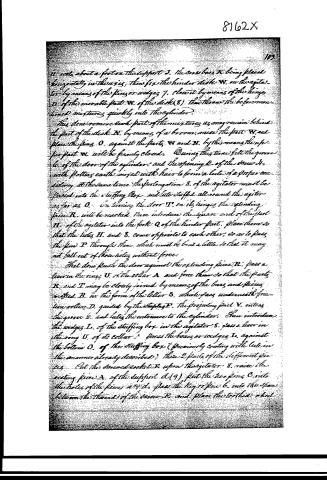
It eats about a foot on the support J. The cross bars K being placed horizontally in the axis, then fix the hinder disk N on the agitator by means of the pins or wedges J, close it by means of the hinge D of the movable part W of the disk (8), then throw the before mentioned mixtures quickly into the cylinder.
This done remove each part of the mixtures as may remain behind the part of the disk N by means of a broom, raise the part W and place the piece O against the parts W and N. By this means the upper part W will be firmly closed. During this time let the groove C of the door of the cylinder and the opening R of the door A with flatter earth mixed with hair to form a lute of a proper consistency. At the same time the prolongation S of the agitator must be fixed into the stuffing box and let stuff all round the agitator as far as O. In closing the door T on its hinges the extending piece R will be reached. There introduce the square end of the part H of the agitator into the fork Q of the hinder part. Place them so that the holes H and S come opposite to each other, so as to pass the pin P through them, which must be bent a little so that it may not fall out of these holes without force.
That done push the door against the extending piece R, fasten a loop in the ring U of the collar A and force them so that the parts R and T may be closely joined by means of the bars and pieces marked B in the form of the letter S, which pass underneath friction rollers D guided by the staples F. The projecting part V enters the groove L and lets the entrance to the cylinder. Then introduce the wedges I, of the stuffing box in the agitator S. Pass a loop in the ring U of its collar S. Force the bars or wedges I, against the bottom O of the stuffing box (previously crating with lute in the manner already described). There 2 parts of the different pieces. Put the screwed socket E upon the agitator S, raise the seating piece X of the support d (9), put the two pieces C into the holes of the pieces a and d, pass the key or pin b into the space between the threads of the screw E and place the toothed wheel
Page 7.
8162X
114
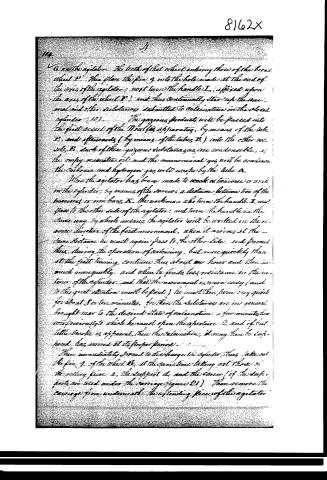
6. on the agitator. The teeth of that wheel entering those of the brass wheel F. Then place the pin g into the hole made at the end of the axis of the agitator, next turn the handle I, (fixed upon the axis of the wheel F) and thus continually stir up the animal and other substances submitted to calcination in the closed cylinder (10). The gaseous products will be passed into the first vessel of the Woulff's apparatus, by means of the tube E, and afterwards (by means of the tubes B) into the other vessel B. Such of these gaseous substances as are condensable, i.e. the amphyxymate oil, and the ammoniacal gas, will be condensed. The carbonic and hydrogen gas will escape by the tube A.
When the agitator has been made to work as to arrive at work in the cylinder, by means of the screw: a distance between two of the traverses or iron bars K, the workman who turns the handle I, must pass to the other side of the agitator, and turn the handle in the same way, in which means the agitator will be worked in the reverse direction of the first movement, when it arrives at the same distance he must again pass to the other side, and proceed thus, during the operation of calcining, but more quickly than at the first turning, continue thus about one hour and then in much more quickly, and when he finds less resistance in the interior of the cylinder, and that the movement is more easy (and to this great attention must be paid) he must then turn very quick for about 8 or ten minutes, for then the substances are in general brought near to the desired state of calcination: a few minutes less or more only, which he must open the aperture D, and if but little smoke is apparent, then the calcination, it may then be supposed, has arrived at its proper point.
Then immediately proceed to discharge the cylinder, thus, take out the pin g, of the wheel G, at the same time letting out those of the rolling piece a, the support d, and the screw (if the supports are used under the carriage figure 21). Then remove the carriage from underneath the extending piece of the agitator.
Page 8.
8162X
A of the top by means the edge X
take off the door B, insert the collar, unfasten the collar A of
the door and open it half way. Take out the pin P, which unites
the two parts of the agitator, open the door entirely and by means
of hooked pieces of iron (which need be passed into the handles
5 of the disk) have the agitator of the cylinder quickly and let
the calcined matter fall into the conical moulds B of the crane
figure 2 (11) placed under the extension of the cylinder D. In
withdrawing the agitator from the cylinder it must be held by the
hooks B of the crane figure 3. The agitator being withdrawn
from the cylinder the little calcined matter which remains
adhering to it, must be removed by means of a brush formed
of small wires, and with a wiper remove such of the calcined
matter from the cylinder as was not withdrawn by the front disk
1 of the agitator. Take the surcharge from under the extension
of the cylinder and immediately recharge the cylinder as in
the first instance. A mixture of the described materials
should always be had in readiness for that purpose. The cal-
cined matter being cooled (12) transport to the moistening vessel
figure 4, and when moistened as described in the specification
of my Patent of December 1862, put it into the funnel A of
the feeder of the steam vessel figure 5.
Change the boiler to about three feet of its height, and then admit water (or afterwards the weak solution in the reservoir) raised
by the pump Figure 20, to within about one foot of the lid.
Things being thus disposed, fill the reservoir D to
about half its height with a mixture of one part of sulphur
mixed to two parts of water. Lower the bell E on the axis
S of the agitator, until the lower part of it is about two
inches from the bottom of the reservoir D. Then place the tube
B with its cock, open into the first vessel of the Woulfe’s
apparatus, that is, into the first of two vessels placed at a
little distance from the boiler figure 5. Fill the first one to
about half its height, with a solution of the moniate of lime
Page 9.
8162X
106
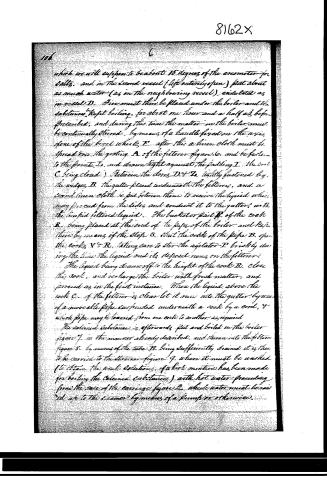
which we will suppose to be about 15 degrees of the areometer for salts, and in the second vessel (left entirely open) put about as much water (as in the neighbouring vessel), acidulated as in vessel D. Fire must then be placed under the boiler and the substances kept boiling, for about one hour and a half as before prescribed, and during this time the matter in the boiler must be continually stirred by means of a handle fixed on the axis, done of the brass wheels F. After this a linen cloth must be spread over the grating A of the filter figure 60, and be fastened to the points I, and drawn tight against the padding I. The cock C being closed, between the doors D & D, tightly fastened by the wedges B, the gutter placed underneath the filters, and a second linen cloth is put between them to receive the liquid which may proceed from the sides, and conduct it to the gutter, with the impure filtered liquid. The bucket or pail P of the cock R, being placed at the end of the pipe of the boiler and kept there by means of the stop S, shut the cocks of the pipe B, open the cocks V & R, taking care to stop the agitator P briskly during the time the liquid and its deposit runs on the filters.
The liquid being drawn off to the height of the cock R, close the cock, and recharge the boiler with fresh matter, and proceed as in the first instance. When the liquid above the cock C of the filter is clear let it run into the gutter by means of a movable pipe suspended underneath a cock by a cord, & which pipe may be lowered from one cock to another as required.
The coloured substances are afterwards put and boiled in the boiler figure 7, in the manner already described, and drawn into the filters figure 8, by means of the tube B. Being sufficiently drained it is then to be carried to the strainer figure 9, where it must be washed (to obtain the acid solution, if such mixture has been made for boiling the coloured substances) with hot water proceeding from the case of the carriage figure 2, whose water must be raised up to the strainer by means of a pump or otherwise.
Page 10.
8162X
7
The prussiate waters of the two boilers of the calcined matter being brought into the common solution in the reservoir figure 10, by means of the pumps of the reservoir figure 11, let it fall into the Boiler T, figure 1, by the cock C, and the pipe O.
The solution of the prussiate being concentrated in this Boiler until it forms a pellicle (confluence of any part of the 11. Decm. for 1832) on the surface of the boiling liquid, open the cock in the pipe V (which is to be about 4 inches diameter) and the solution will fall into the crystallizer figure 12.
When the prussiate is crystallized and the solution cooled, open the cock B of the crystallizer figure 12, break the crystals opposite to the tube, and the mother waters will flow (that is, to say, the solution of carbonate of Potash) into the reservoir figure 13, after which the crystals are to be thrown on to the filter figure 14, to be drained, and the solution conducted (by the pumps belonging to the reservoir) to the boiler figure 14, for the purpose of being concentrated. When the calcined substances are sufficiently leached and drained in order to obtain the required weak water, close the registers V and V, of one of the stoves figure 15, in order to divert the heat and smoke into the other stove.
Place the calcined substances on the hurdles E, of the food stove and when the required number of hurdles are placed in it, shut the door A, of which the projecting ledge I, will enter into the groove B, running all round and filled with sand, open the registers, and when the matter has become dry, shut them again and take out the hurdles.
Having concentrated the solution of Potash in the Boiler figure 14, &c., the calcined matter being kept as hot as possible, it is to be carried to the vessel figure 16, placed close to the boiler 14, and mixed as it has been described in the first patent. The liquid must be added until the calcined matter becomes dark, and is on for leaching operations.
On the second crystallization, the separation is done by suction
Page 11.
8162X
101
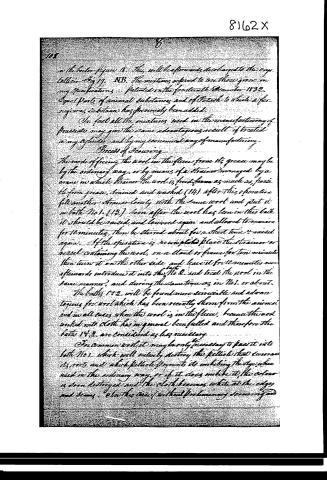
as the border figure 18. They will be afterwards discharged to the crystallizer Fig 19. NB. The mixtures referred to are those given in my Specifications, patented on the fourteenth December 1832. Equal parts of animal substance and of Potash to which a foreign substance has previously been added.
In fact all the mixtures used in the manufacturing of Prussiate may give the same advantageous result if treated in my order and by my economical way of manufacturing.
Process of Scouring.
The mode of freeing the wool in the fleece from its grease may be by the ordinary way, or by means of a strainer managed by a crane in which the strainer the wool is freed from as much as possible from grease, strained and washed (14). After this operation fill another strainer loosely with the same wool and put it in bath No. 1. (13.) Soon after the wool has been in this bath it should be raised, and lowered again and allowed to remain for 10 minutes, then be stirred about for a short time & raised again. If the operation is completed, place the strainer or vessel containing the wool, on a stand or frame for ten minutes then turn it on the other side and leave it for 10 minutes more afterwards introduce it into the No. 2. and boil the wool in the same manner, and during the same time as in No. 1. or at all.
The baths 1 & 2. will be found more serviceable and advantageous for wool which has been recently shorn from the animal and in all cases when the wool is in the fleece, because the wool worked into cloth has in general been fulled and therefore the baths 1 & 2. are considered as less necessary.
For common wool it may be only necessary to pass it into bath No. 1. which will entirely destroy the pellicle that covers its roots and which pellicle prevents its embiding the dye when used in the ordinary way, or if it does imbibe it, the colour is soon destroyed and the cloth becomes white at the edges and seams. On this case without preliminary scouring and
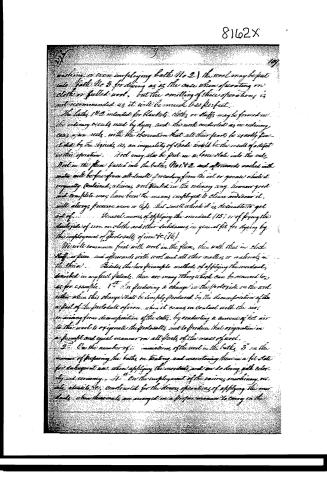
Page 12.
8162X
washing, or even employing baths No 2, the work may be put into bath No 3 for drying as is the case when operating on cloth or pulled wool, but the costliness of these operations is not recommended as it will be much less perfect.
The baths No 2 intended for blankets, cloths, or stuffs may be formed in the ordinary vats used by dyers, and the work conducted in no ordinary case open vats, with the observation that all their parts be exactly flattened by the liquids, as, an inequality of shade would be the result of a defect in this operation. Work may also be put in a loose state into the vats, No 1 or the place fixed into the baths No 1 & 2, and afterwards washed with water will be free from all smell, greasing from the oil or grease which it originally contained, whereas, wool treated in the ordinary way, however good and complete may have been the means employed to clean and scour it, will always preserve an oil or tinge, that smell which it is desirable to get rid of.
Several means of applying the mordant (15) or of fixing the black side of iron on cloth, and other substances in general fit for dyeing by the employment of ferrous salts of iron &c (16).
We will commence first with wool in the place, then with that in cloth, stuff, or fine, and afterwards with wool and all other wools or materials in the skin.
Besides the two principles methods of applying the mordant, described in my first patents, there are many others which can be resorted to, as for example. 1st. In producing a change in the ferrous side on the wool either when this change shall be simply produced by the decomposition of the acid of the ferrous salts of iron, when it comes in contact with the air, or arising from decomposition of the salts, by conducting a current of hot air to the wool to oxidize the ferrous salts, and to produce that oxidation in a prompt and equal manner on all parts of the mass of wool.
2nd. On the number of immersions of the wool in the baths, 3rd. on the manner of preparing the baths, on treating and maintaining them in a fit state for subsequent use, when applying the mordant, and on so doing with economy and economy. 4th. On the employment of the various machinery, vessels, utensils, &c. constructed for the divers operations of applying the mordants, when the vats are arranged in a proper manner to carry on the
Page 13.
8162X
112 10
work will accomplish, can and certainty. 5th. The first method of the first patent may be dispensed with; that is to say, that first soaking, etc., to decomposition, and the operation of applying the mordant or the other operations, may be varied in as if the end of this decomposition had been reached to the. The wool having been prepared by the baths 1, 2 & 3 are used as already pointed out: 1st to be put (from mordanting it by the first method of the first patent) into the vessel or strainer, which vessel has been previously placed in the bath No. 3. The wool may be placed rather close, when the quantity required is so placed, since the vessel out of the bath and lower it again almost immediately. Repeat this operation a second time. Then put the vessel on the frame. The wool thus placed (the vessel being turned on its other side during that time) will be sufficiently drained in half an hour (or at least that part which is in the upper part of the vessel) to be put into the Bath No. 4. The small quantity of wool which lies at the bottom of the vessel should be squeezed or wrung before it is put into that bath. The more the wool has been drained after its last washing, before being put into bath No. 3, the better; in fact, if it be quite dry it would be preferable, but in that case it would be water with greater difficulty, and care must then be taken not to put too great a quantity into the vessel, as it would be necessary to stir it about in order that it might be equally wetted in the bath.
For Bath No. 4: The wool placed in the strainer is treated as directed in the former specification, and, after having remained there for about ½ of an hour, take out the vessel and place it on the frame in an inverted position (17) for about 10 minutes and then change its position from 3 to 4, and vice versa, in order to equalize the distribution of the liquid upon the wool, which is to be spread afterwards on a hot stone till the per-oxidation is completed.
Being placed again in the strainer, it is conveyed to bath 5, as soon as it touches the liquid, let it be lowered as quickly as possible to a foot the middle of the depth of liquid, when the wool may be turned over with facility by means of sticks. After having remained in this bath for about 15 minutes, take out the vessel and place it on the frame, or
Page 14.
8162X
11. III.
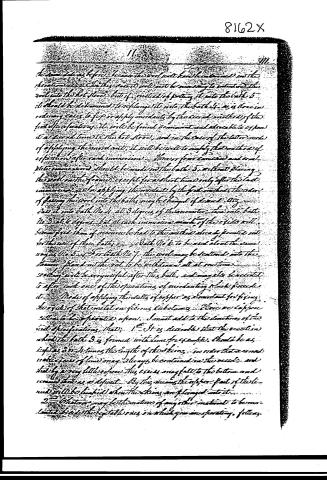
to be used as before, hence the tool will here be immersed in the solution. But this second tool will not be necessary to introduce the tool into the hot stove, but if, instead of putting it into the bath 5, it should be determined to plunge it into the bath 4, as is done in ordinary cases to fix or apply mordants by the second method of the first officia operations, it will be found convenient and advisable to expose it at second times to the hot stove, and in the course of the latter mode of applying the mordant, it will be well to apply the mordant of exposition after each immersion. Three or four decanted and complete immersions should be made in the bath 5, without placing the tool in the frame, except for a short time only after the last immersion, or else applying the mordant by the first method, the order of placing the tool into the baths may be changed if desired. Only take it into bath No. 4 at 3 degrees of the thermometer, then into bath No. 3 at 6 degrees, but at each immersion, each of these baths will be a good deal more or less hot to the method already formed, not for the use of these baths. Bath No. 6 to be used about the same way as No. 5. For bath No. 7, the tool may be heated into the frame, placed on the pot to be withdrawn all at one time.
The tool will be very useful after this bath, and may also be used at it after each one of the operations of mordanting which precedes it.
Mode of applying the salts of copper as a mordant for fixing the gold of the metal on fibrous substances. There are no differences to be operated upon. I must add to the directions of the first officia operations, that: 1st. It is desirable that the vessel in which the bath 3 is formed with lime for example, should be as large as 3 or 4 times the length of the skins, in order that a normal space of lime may always be contained in the vessel, and that by a very little surface, the excess may fall to the bottom and remain there as a deposit. By this means the copper part of the liquid will be kept free when the skins are plunged into it.
2nd. Whatever may be the nature of any other materials to be mordanted, beside the vegetable ones, in which you are operating, follow.
Page 15.
8162X
112
the same directions, but in general operating the first method with a combined alkaline bath, making No. 3, and by the second method as for the other textile substances. No. 3. The last bath into which the substance should be passed may be either 3 or 4. It will depend on No. 3, and whether the material is washed or not after removing plenty of water (but I recommend washing). The fibrous substance is mordanted by the acid, and to be placed into the proper bath to obtain a produce a black of such a shade as to resist the action of the air and washing.
4. The grades of iron and of copper may both be fixed on the substance at the same time, by means of the bath No. 4, composed of the salts of iron and of copper. In many, the operation being performed with a bath of iron or a bath of copper, as it will be thought more convenient.
5. An mordanting by the salts of copper, the alkaline bath No. 3, may be omitted, or, instead of the early alkaline caustic, may be omitted if it is chosen to use a bath at the ordinary temperature. The wool being now in a state ready to receive a green color, is to be fixed. For fixing colors extracted from dyestuffs, as in any dyehouse. If it is intended for blue, the fixed iron must be saturated by means of prussic acid as follows:
A requisite quantity being placed into a stoneware vessel, perfectly into bath No. 3, without the vessel quickly, just above the surface of the bath, and let it immediately infiltrate, be plunged into it, and let it be immersed for a short time, and after this immersion, at intervals of 15 minutes, but the vessel must not then be raised entirely out of the bath, but only partly. This mode of proceeding will cause a sufficient agitation of the liquid to keep up the quality on all parts of the bath. The wool being now made blue, let it be. The following bath, giving to it iron and only to give more brilliant shades, or redness to the blue, and may be omitted to avoid such combinations as will insure the better result. They may also be omitted, or it is to be observed that, for
Page 16.
8162X
13 119.
No. 15 is only a preliminary bath when solubles are required.
Oxides, itself, may be employed before, during, or after the detonation of the oxide of iron by means of prussic acid, to give to it a peculiar taste (22). The same may be said of many other substances which it is unnecessary to enumerate here, as it will be apparent to the competent operator.
Observations and notes referred to:
The observations from No. 17, inclusive, are intended to elucidate some of the articles on which my claims are founded. The numbers to be looked for in the explanations inserted with the plates, also in my number deposited on the Patent Office.
1st. The forms of the vessels are not obligatory, and they may be constructed of wood or of metal, except such of them as are intended to contain acids, for which wood is preferable.
2nd. After a force operation is finished, the baths should be brought into the states already indicated in speaking of their formation, before commencing another operation. By baths are understood, all sorts of liquids, gas, vapor, or steam, to the action of which the liquid substances are exposed. All the baths should be heated by steam.
3rd. The air may be heated by means of the hot stove bath, or by passing it through a cast iron cylinder placed by the fireplace, or in a double chimney of a furnace, or by steam passed through a double conductor or pipe, as indicated on the plates, or by any other convenient mode. In all cases, when a current of air is forced in by a fan of bellows, they should be placed at such a distance from the place where the heat proceeds, as will ensure a perfect and a general diffusion of air on the exposed plates.
4th. It is advisable that the stones should be covered at their upper parts, and be covered with some woolen cloth. This will leave a free passage for the humidity to pass without losing much of the heat which has been introduced. This will be found a very advantageous mode, and superior to the ordinary fitting up of stoves, where the humidity traverses massive buildings, and creeps through openings in the roof, and when once heat, then humidity passes off that way.
Page 17.
8162X
14
5. The gilding and lining rollers may be made of different materials, and in various manners; for example, the gilding roller is supported upon an axle having a small wheel in front and behind, on which other bags, feeders, and small pieces must be tied in to guide them. The one of these small pieces near the roller should be of linen, the other of some material which does not adhere to the roller.
The small pieces must be previously filled with a small quantity of lead, either of glass, lead, or iron, and afterwards be attached to the rollers for proper contact of the rollers.
6. See reference 3.
7. In the place of the tube, a disk may be placed similar to that marked 1, which must not be fixed to the cylinder until after it has been charged.
8. When it is required to render the supports 2, 11, and their accessories movable, the carriage A, figure 11, must be employed, which having its own supports on its platform 11, the carriage must be rolled on the rails, figure 12 and line B, affixed to the ground. The carriage A, figure 11, is movable and slides its supports, but when it is desired to render it fixed, it is fixed to only one piece, without its feet. The carriage ought to be on the rails.
9. When the movable supports are not made use of, the agitator must be sufficiently long from the stuffing box to the floor in order to prevent the fixed supports 2, 11, from being or attempting to charge and discharging of the cylinder at the same time.
10. The operation of agitating the water on the cylinder may be employed without forming the volatile and gaseous products to become a liquid. One that uses the tube it must be conducted under the fire place of the furnace, in order that the effluence products may be burnt, or the tube may be prolonged so that the steam enters the chimney in the same way. This last method may also be employed for the direct calcination, which produces very little of their volatile substances.
11. The base of the carriage may be filled with soil or other substances, of the kind of figure 16, and placed under the broken gators B, the furnace A being removed after the cylinder has been
Page 18.
8162X
15
115
unloaded, the water must be drawn off from the rear of the carriage by the block C, and then be a filled with cold water before another carriage is ready, and again drawn off from the case. When the ends R C take hold of the carriage at the parts I, by the hooks B of the cross figure 3, and when the carriage must be raised to a convenient height, and then be turned over, the cold water will then fall out of the box E, and be from thence carried to the room (figure 22 (or some other convenient place) and be thrown through the conveying gate A, which is to be closed immediately after.
12th. Further references of the former Specifications.
13th. Having given the construction of the baths in my former Specifications I will now add, adding only that the bath alluded to must be in the described state, makes the contrary be stated.
This limitation may be understood for every bath that will be used hereafter. It is absolutely necessary that words intended to be used should be well marked. The system hitherto, and at present employed is very defective. From many instances, first of the wood, being creased and pressed into small pellets, by the sticks actually employed in turning it over, becomes unfit to receive the dye, or receives it so imperfectly that different shades of color, are, so often, observable in withdrawing it from the baths. But the employment of the machine now invented, will most completely obviate this difficulty, and its advantages independently of which a much greater quantity can be washed in the same given time. These can be done by any of the means now employed for that purpose (see plate 3.)
The machine being placed in a current of water, put the wool on the spindle or roller A, then put the machine into regular movement by means of the handle N and the rope H. The wool will then fall into the water, the current of which will conduct it towards the spiker M, and thus successively from one spiker to another, until it be conducted towards the handle N, which on consequence of the movement it receives from the roller I, put into motion by the rope H, will raise the wool (when washed) so that it may fall into the carriage or basket W.
Page 19.
The course of water in this machine can be regulated by a gate placed when the water flows from it as required so that the vessel may be emptied to a certain height of water in the two required facility and quickness in all cases regulating the delivery of water under the machine when it is in operation. The two valves are the two wheels the double axis and in fact all kinds of movement from susceptible of going on creating certain motions may be substituted in lieu of the system of levers or handle of this machine of plan shown below, or on the sides of the axis of the first mentioned D G or M. It is to cause a regular backward and forward motion of that part of an axle which acts on the spindles M which lay parallel of the wheel.
This machine may be substituted entirely of metals or in part of metal and in part of wood. The only object of showing it is always to be understood that this machine is used for that purpose.
15th. The operation of manufacturing of any particular kind of form upon the textile substances may be considered as a particular color of the matter upon which you are operating is not intended to be passed into both No. 6 or others.
16th. The dust or all of iron may also be employed and will be dissolved in the textile substances as the latter is. If the liquid is to be liquid, it will be necessary after each operation to place the vessel containing the vessel as a force or force which may be placed around the axis containing the ball. The vessel should be placed in its side and be extremely toward one to the opposite side, so that the liquid may flow freely from one side of the vessel to the other and thus prevent an irregularity of color and in order to avoid at this end there should be taken to prevent the vessel which was at the bottom or again the sides of the vessel in the first mentioned form remaining there at the subsequent axis which should be either be brought as near to possible as possible, turning the vessel around the axis as described will generally accomplish this point and when you are operating on wool in the place change the position of the vessel from side to side as from 3 to 4 and the vessel. This operation of agitating the liquid
Page 20.
8162X
216 17 17.
will be much more ready after the baths Nos 3, 4, 5, 6, have been used, than when operating with the other baths. It regards the use of the latter bath No 6. It may be well to shew that the liquid should be well and equally distributed, but that the wool should be drawn, as much as possible when it is put into bath No 7. If it is woven dry, so much the better. 22. The prussiate of iron may be fixed upon cloth or other substances intended to be dyed black by various means. To give to them, what is practically termed a black tint, it may be done by way of double decomposition, by using any of the alkaline prussiates which have been spoken of, the nitrate of iron or ferric nitrate. No 8. or by saturating the oxide of iron in an acid bath formed with a soluble prussiate for instance, before or after producing black in the order. This black, has hitherto been produced by indigo and it can be so done yet, with the application of the oxide of iron by any process, and again the double decomposition in using the alkaline prussiates, in order to obtain the blue shade, can be obtained on applying the protoxide or basic oxide of iron by the process already in use.
Other Observations
All the materials of the acids, or alkalis employed in the acid baths should be ramified to defend them against the action of the acids, and the same should be renewed from time to time.
Instead of using liquid ammonia in order to defen the blue shade, you may employ ammonical gas, more or less dry in the store. In fact the ammonia may be introduced in such quantities as produces the best results, and the same be continually applied to the acid bath. The oxide of iron may be ferric oxigated after bath No 6, without taking the wool out from the strainer. If introducing a current of warm air into its interior as described in the plates and explanations inserted with them.
The oxide of iron may also be applied by legeration (see the plates and explanations) after the mordant has remained about a quarter of an hour in the vessel, let it out and when it is nearly dry, introduce the current of warm air, as above for ¼ of an hour.
Page 21.
8/62X
The most important and the most difficult of the operations is the one which is to be performed on the side of the vessel which is to be filled. This operation may also be performed on the side of the vessel which is to be emptied, and the same may be applied to the side of the vessel which is to be filled with a liquid which is to be kept in the vessel for …
Page 22.
8162X
19 119
Observations on the Baths. All the acids, except nitrous acid, their price is not agreed, and some acid salts, as the salts of iron, alumina &c, are fit for this bath. No. 27. Repeat for a short time, ordering the bath to be kept more than before, taking care to stir it about and to take only the small part for use. No. 3. A bath composed of caustic ammonia, well with sal ammoniac, the same degree as the other alkaline, is alkaline enough for bath No. 3. The alkaline bath must be used as soon as possible after preparing, and animal substances, especially for bath No. 3.
If the bath may be rendered neutral before it is employed as well as in the course of operation. This is done by an excess of the oxide of iron, by excesses of the alkalies or carbonates, but more particularly by the carbonate of iron. Here it may be necessary to remark as a thing of much importance, and as establishing a test of clear distinction between my process and those already known, or practiced for fixing the oxide of iron, or fudge ing with the ferrocyanate of iron, that by my process the baths are usually kept constantly neutral to produce the effect of fixing the oxide of iron in a more regenerated state. Whereas by the other processes the bath becomes more and more acid during the process of their use.
No. 4. I prepared in a more than neutral gelatin with common soap, in solution of about 20 degrees of the exhalator for 2467 1/5 of which must be neutralized by an acid. Then add to this solution when about 16 to 212 degrees of Fahrenheit, a well carbonized alkali, for example, soda, the alkaline principle of which represents about the one half of the same proportion of which the soap is composed. Then add to this solution.
The bath may be employed to neutralize this bath, by, after having added the alkaline carbonate, boil the solution with a sufficient quantity of oil or gum to saturate the alkali, so that after this saturation shall have taken place, a very trifling quantity of oil or gum may remain in the bath. Instead of employing soap, neutralize the neutral gelatin, or more easily, with a neutral alkali, employ that which has been conducted with the alkaline carbonate. Instead of employing a defecating solution, you may use the weak solution of an alkaline carbonate or of a caustic alkali which must be boiled with the animal substance (waste woolen cloth or white
Page 24.
8162X
121.
of the legs of the vats, but a band made with several pieces of strong linen. This frame may be supported by a single or by 5, two masts, and be sufficient for the bottom of the masonry, to prevent its drawing off any portion of the deposits which may be formed there. This deposit must be withdrawn from time to time. The leading pipes of the furnace must be placed sufficiently high to allow the liquids to be conducted to the dead vessels, by means of pipes or channels, because the liquids can be transported much more quickly and without the waste occasioned, by transporting them by head.
See masonry Figures 11, 13, 26, 27, and 11, Figures 10, 12, 19, 26.
It should be about three feet high. The first one being built on the ground about 6 feet. The masonry should be flagged, especially near the cylinder. It should be marked often and kept clean.
Every practical man will readily perceive the difference between the manner for treating dyers' colors and others by the products of iron, and the one described in this invention (being aware of the entirely different nature and properties of the products, and of the faults of iron) and understand why a process that seems to work well on these two materials, does not succeed on one that must be submitted to so many trying operations in order to its being transformed into cloth. Although nothing precisely by the means indicated is not obligatory, yet experience has taught one that the more literally they are followed, either for the conformation of baths, their degree of saturation, and their degree of temperature, the construction of machinery described in the plates and its arrangement and employment, the more advantages will be the result demanded. But I do not mean to say that, by some combination of the former or apparatus, or various improvements, cannot be obtained to some of the advantages of the new principles, to some, its investigation has about unbounded fields; But only as regards the fixation of practical results. But also for the obtaining of new colors by substituting two numbers not to be exhausted here. I shall mention here but one example to show that these improvements may be extended without outliving the application to the use of dyeing. Two processes of wool dyeing are known to me, one in the fleece, the other in the piece. By my process I can produce a cloth dyed in the piece, that will exhibit all the characters of having been
Page 25.
8162X
222
The following is a transcript of the text from the document image. The text is handwritten and somewhat difficult to decipher due to the quality of the image. The transcription is based on the best interpretation of the visible text.
[Text begins]
...the following is the text of the document:
...the text is not fully legible due to the poor quality of the image. The visible portions suggest that the document discusses some form of legal or administrative matter, possibly related to patents or property rights. The text includes references to dates, names, and possibly legal terms.
...the text continues with additional details that are not clearly readable.
...the document appears to be a formal record or affidavit, possibly related to a legal proceeding or property transaction.
...the text ends with a signature and date, which are partially visible.
[Text ends]
Published accounts: journal notice
Notice in the monthly list of patents
Journal of the Franklin Institute, new ser., vol. 14 (1834), p. 334 · View the page
The patentee does "not claim to be the inventor of hollow cylinders surrounded with paddles, or floats, nor to be the inventor of hollow trunks to give buoyancy to a boat; nor to be the first who has found out the means of making unsinkable boats;" but what he does "claim, is the combination and arrangement of the several parts, as above described and specified, in order to obtain buoyancy, velocity, and safety." 34. For improvements in the Apparatus and Process for Manufacturing the Prussiates of Potash and Soda, and for other purposes; Felix Fossard, city of Philadelphia; an alien who has declared his intention to become a citizen of the United States, April 23.
About this record
- Patentee
- DATAMP
- Date
- the Name and Date index of patents, DATAMP, USPTO records
- Invention
- DATAMP
- Listed in
- the Name and Date index of patents, DATAMP, USPTO records, Jim Shaw's X-patent list, the Journal of the Franklin Institute, Burke's List of Patents (1847)
- Burke's 1847 Patent Office list gives the same patent.