

Drawings and documents
National Archives restored drawings: drawing
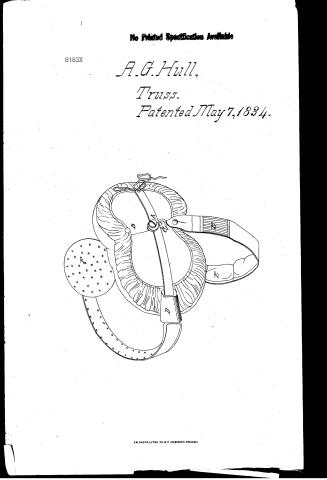
Dr. Hull's Patent Drawing for a Surgical Apparatus for the Relief and Cure of Procendtia

National Archives, Restored Patent Drawings (Record Group 241) · Full-size scan at the National Archives · Catalog record
Show the text on the drawing Hide (193 words)
Words on the drawing as machine-read by the National Archives; not checked. Useful mainly for searching.
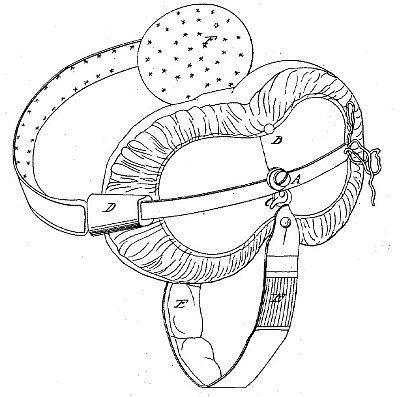
128 SURGERY. / Srusses Sung / D. HULL'S / [156] Trusses / Surgical Apparatus for the relief & cure of Procidentia & I, / #2 Uteri &c. / Patented May 1834. / 8/83 83. X / Sat. may 7-1834 / DIVISION. / Drawn by J.B. Wood. / EXPLANATION. / A Is the point at which the pad is attached the spring / BO / Is the margin of the larger wing or section of the pad where the two sections / form a joint. / C. Is a circular wedge moveable round its centre, cul off at the edoe 80 as to / make a spiral inclined plane the use of which is to depress and increase the / pressure at the lower side of the pad. / D. Is a corkwedge placed upon the spring on which it is intended to move easily, / the object being to give inclination to the smaller wing or section of the pad / to equalise the pressure of the whole pad. / E E. Is the strap passing over the perineum,- the other straps will be / understood sufficiently from the written description. / F. 1s the small pad which is to rest on the back.
USPTO scan
The patent as scanned by the USPTO
-
 Page 1
-
 Page 2
-
 Page 3
-
 Page 4
-
 Page 5


U.S. Patent and Trademark Office · Google Patents
Show the transcription Hide (1,518 words)
Machine transcription (LightOnOCR) of the pages as scanned by the USPTO, most of them the handwritten copies made when the records were restored after the 1836 fire. Not checked; it can misread handwriting, so compare it with the scan.
Page 1.
No Printed Specification Available
8183X
A.G. Hull,
Truss.
Patented May 7, 1834.
A.M. PHOTO-LITHO. CO. N.Y. (OSBORNE'S PROCESS)
Page 2.
May 7, 1834
Amos B. Ball
Patented May 7, 1834.
Letters Patent.
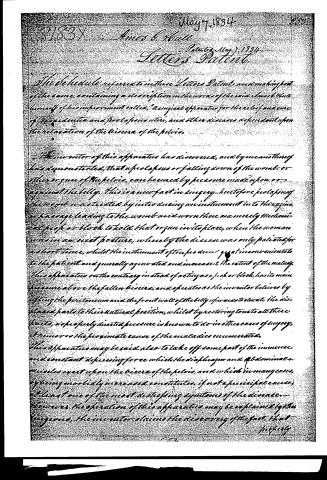
The Schedule referred to in these Letters Patent, and making part of the same, containing a description in the words of the said Inventor himself of his improvement called, "a unique apparatus for the relief and cure of Prolapsus uteri and prolapsus recti, and other diseases dependent upon the relaxation of the viscera of the pelvis."
The inventor of this apparatus has discovered, and by means thereof has demonstrated, that a prolapsus or falling down of the womb, or other organ of the pelvis, can be cured by pressure made upon or against the belly. This is a new fact in surgery—hitherto prolapsus of the womb was treated by introducing an instrument into the vagina or passage leading to the womb and worn there as a merely mechanical pad or block to hold that organ in its place, when the woman was in an erect posture, whereby the disease was only palliated for a short time, whilst the instrument often produced great inconvenience to the patient and generally aggravated and increased the extent of the malady. This apparatus on the contrary instead of acting as a pad or block, has its main pressure above the fallen viscera, and operates as the inventor believes by lifting the peritoneum and the front wall of the belly upwards to elevate the diseased parts to their natural position, whilst by restoring tone to all these parts, as properly directed pressure is known to do in other cases of surgery, it removes the proximate cause of the maladies enumerated.
This apparatus may be said also to take off some part of the immense and constant depressing force which the diaphragm and abdominal muscles exert upon the viscera of the pelvis, and which in many cases, by being morbidly increased constitutes, if not a principal cause, at least one of the most distressing symptoms of the disease—however the operation of this apparatus may be explained by the surgeons, the inventor claims the discovery of the fact that properly
Page 3.
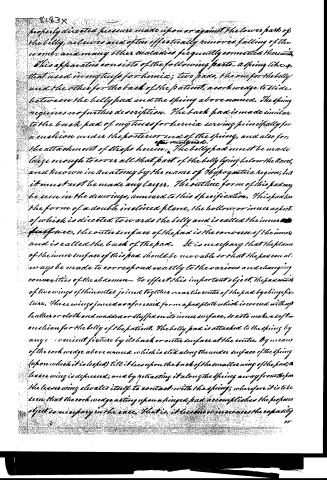
properly directed pressure made upon or against the lower part of the belly, relieves and often effectually removes falling of the womb, and many other maladies frequently connected therewith. This apparatus consists of the following parts: a spring like, that used in my truss for hernia; two pads, the one for the belly, and the other for the back of the patient, a cork wedge to slide between the belly pad and the spring above named. The spring requires no further description. The back pad is made similar to the back pad of my truss for hernia serving principally for a cushion under the posterior end of the spring, and also for the attachment of straps here. The belly pad must be made large enough to cover all that part of the belly lying below the navel, and known in anatomy by the name of Hypogastric region; but it must not be made any larger. The outline form of this pad may be seen in the drawings, annexed to this specification. This pad has the form of a double inclined plane, the hollow or inner aspect of which is directed towards the belly and is called the inner surface. The outer surface of the pad is the converse of the inner, and is called the back of the pad. It is necessary that the planes of the inner surface of this pad should be movable so that the pad can always be made to correspond exactly to the various and changing convexities of the abdomen. To effect this important object, the pad consists of two wings of thin metal joined together near the centre of the pad by a hinge fixture. These wings joined as aforesaid form a pad plate which is covered with soft leather or cloth and wadded or stuffed on its inner surface, so as to make a soft cushion for the belly of the patient. The belly pad is attached to the spring by any convenient fixture by its back or outer surface at the centre. By means of the cork wedge above named which is slid along the under surface of the spring (upon which it is looped) till it lies upon the back of the smaller wing of the pad, the lesser wing is depressed; and by retracting it along the spring away from the pad the lesser wing elevates itself to contact with the spring; wherefore it is to be seen that the cork wedge acting upon a hinged pad accomplishes the purpose object so necessary in the case, that is, it lessens or increases the capacity or
Page 4.
8183x
a single of the double placed inner surface of the pad, so as to make the force with perfect exactness to the variable convexity of the surface of the belly and besides as the spring is so shaped, terminates upon the back of the larger wing of the pad and thus presses harder upon that wing than it does upon the lesser wing, the wedge being placed between the lesser wing and the spring in fact any quantity of the force of the spring to that wing that may be required to render the pressure of the spring equal upon the two wings of the pad, by which means both sides of the hypogastric regions of the belly are equally pressed by the apparatus, a result which is very important to the cure of those maladies enumerated. For the full and entire understanding of the inventor's meaning in regard to the construction and operation of the belly pad of the apparatus recourse must be had to the model thereof which is herewith transmitted. The apparatus is to be applied by placing the back pad upon the spine just above its junction with the hip bones, and the belly pad as aforesaid upon the entire lower part of the front surface of the belly, the spring embracing the body closely from one pad to the other, in the same manner as it does in the tussies now in use. In some cases, it is necessary to have the inner surface of the belly pad very soft and yielding on account of the great sensibility of the belly. For this purpose a sack is made of india rubber cloth, or other material impervious to air, and inflated with air; it should be about one inch thick when inflated, and about one inch larger in superficial extent than the belly pad of the apparatus. This cushion or sack of air as is worn next the belly of the patient under the belly pad. See the model of the air pad.
In certain instances in which there is great relaxation of that part of the belly known in anatomy by the term perineum it is necessary to have pressure made upon that part. This is effected by conveying a strap of convenient size and material from one pad to the other, under the bottom of the belly of the patient.
Page 5.
patient between the thighs. This strap is attached to the pads by means of snap buttons, or hooks which are fixed for that purpose to the backs of the pads. The strap can be made to keep more or less tightly, that is can be shortened or lengthened, by means of button holes near the ends of it. In order to render the pressure more effective a cushion must be placed against the perineum, over which the strap is drawn. The best cushion for this purpose is made in the same manner as the air sack above described; it must however correspond in size and shape to the size and shape of the perineum. In some cases it is necessary to make a counter pressure to this strap to prevent it from dragging the pads of the apparatus out of place. In these cases a pair of straps are carried over the shoulders from one pad to the other; these straps are fastened to the pads by the same means as the strap last described. Finally in some cases it may be advisable to make a very much stronger pressure than can be conveniently made by the spring above, when a strap can be carried from one pad to the other around the body on the side opposite to the spring so as to form a complete circle around the body. This strap is fastened to the pads as the foregoing straps are. For the better understanding of the operation, and fixture of these straps reference must be had to the Model of the apparatus.
Amos G. Hull.
For Mitropes
N. Colson Sheldon.
Henry O. Paine.
Drawing 1508 words.
Published accounts: journal notice
Notice in the monthly list of patents, with remarks
Journal of the Franklin Institute, new ser., vol. 14 (1834), p. 390 · View the page
6. For an Apparatus for the relief of Procidentia, Prolapsus Uteri, &c.; Amos G. Hull, M. D., city of New York, May 7.
Remarks. The Doctor states that he has discovered a new fact in surgery, namely, that a prolapsus of the womb, or other organ of the pelvis, can be relieved, or cured, by pressure made upon the belly. The instrument used by him, is in the general form of a truss for hernia, but the front pad is made much larger, and so as to press centrically upon the region to which it is applied. The description given is very full and distinct, and the instrument is well represented in the drawing. The claim made is to the apparatus, founded upon "the discovery of the fact, that properly directed pressure made upon, or against, the lower part of the belly, relieves, and often effectually removes, the falling of the womb, and many other maladies frequently connected therewith." None but medical men are aware of the amount of suffering which would be prevented, should the facts be as stated by Dr. Hull; and, in that case every friend of humanity would rejoice to learn that his remuneration was commensurate with the benefits conferred.
Published accounts: journal notice
Notice in the monthly list of patents
Journal of the Franklin Institute, new ser., vol. 18 (1836), p. 39 · View the page
16. For an improvement in the Truss for the cure of relaxation of the Vagina, and prolapsus of the Uterus; patented by Amos G. Hull, May 7, 1834.
DATAMP: illustration
Illustrations from DATAMP

DATAMP (Directory of American Tool and Machinery Patents), via the Internet Archive · Archived DATAMP page
About this record
- Patentee
- DATAMP, Burke's List of Patents (1847)
- Date
- the Name and Date index of patents, DATAMP, USPTO records
- Invention
- DATAMP
- Listed in
- the Name and Date index of patents, DATAMP, USPTO records, Jim Shaw's X-patent list, the Journal of the Franklin Institute, Burke's List of Patents (1847)
- The name conflict was settled by Burke's 1847 list.
- Burke's 1847 Patent Office list gives the same patent.