

Drawings and documents
National Archives restored drawings: drawing
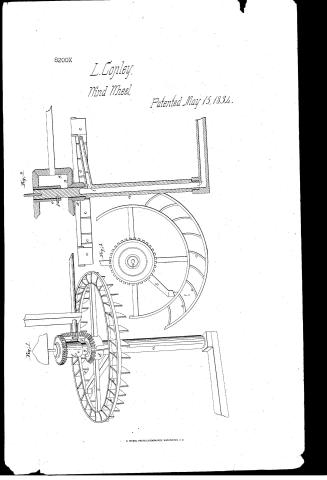
Luther Copley's Patent Drawing for an Improvement in the Construction of a Mill or Machine Wheel

National Archives, Restored Patent Drawings (Record Group 241) · Full-size scan at the National Archives · Catalog record
Show the text on the drawing Hide (104 words)
Words on the drawing as machine-read by the National Archives; not checked. Useful mainly for searching.
138. HYDRAULIC MOTORS / Turbins, / Top & Side Direct Supply. / ASSINICATION / Luther Copley / 8200-X / Improt. in the construction of a mill or Machine Wheel / DIV ISION. / Patinted Volis they 16g 1834. / and / reading / Fig. / Tigs. / Proferences. / upright shaft, tubular. / longated aperture. / KTTP / Patent affice noth September / floats / And under the direction of the Commissioner of Gar / in conformity with act of 3' Inarch 1837 / rical shaft. / the pin / the gearing. / 1 perspective viewofthe the wheel. / section of eltto. / Commisioner of Patents / Top view ofa part of the wheel. / ch. L. Heischmann feet / Water Wheel -
USPTO scan
The patent as scanned by the USPTO
-
 Page 1
-
 Page 2
-
 Page 3


U.S. Patent and Trademark Office · Google Patents
Show the transcription Hide (771 words)
Machine transcription (LightOnOCR) of the pages as scanned by the USPTO, most of them the handwritten copies made when the records were restored after the 1836 fire. Not checked; it can misread handwriting, so compare it with the scan.
Page 1.
8200X
L. Conley.
Wind Wheel.
Patented May 15, 1834.
Page 2.
May 15, 1834 8200X 169
Suther Copley, of New Lebanon, N.Y.
Letters Patent.
The schedule referred to, in these Letters Patent, and making part of the same, containing a description in the words of the said Suther Copley himself, of his improvement in the construction of a mill or machine wheel, and the application of water, wind, or steam thereto, as the propelling power—
Specification of the improvement, of Suther Copley, one of the United Society commonly called Shakers, of the Town of New Lebanon, in the County of Columbia, and State of New York, in the construction of a mill or machine wheel and the application of water, wind or steam, thereto as the propelling power, by which the same power is used twice, and a double power obtained—The following is the method of its construction and application of either of the powers above mentioned—An upright shaft is made tubular at the lower end, permitting either water, wind or steam to enter at the centre of the gudgeon, and passing up the shaft to a square tube firmly fixed at right angles in the main shaft—This latter tube is made to any required size and in length equal to the inner periphery of the wheel or floats—The power used is made to escape laterally at the end of this tube, by means of an elongated aperture or mouth, so as at the instant it so escapes, the power strikes the pendant or wing floats on the main wheel—The main wheel may be constructed, in the ordinary way, with the exception of the floats, and to any required strength or dimension—The floats are placed pendant under the outer periphery of the wheel also made to any required size—The faces to which the power is applied, are constructed so for curvilinear, as to have the angle of resistance, of the moving power always the same, until its final escape from the outer edges of the floats this wheel when so constructed is secured firmly, to a cylindrical or hollow shaft and placed around the first described or inner shaft, or it may be attached to the inner shaft, with a suitable collar or necking, to keep the two shafts and the main wheel and tubular arm all in their proper positions and relations—When the two shafts
Page 3.
so constructed and put together, and the power applied as above described, the outer shaft will have a counter direction to the inner shaft, a one shaft will turn to the right and the other shaft to the left. These two opposite motions are united or concentrated as follows: another detached hollow or cylindrical shaft is placed round the upper end of the inner shaft and secured to it, by inserting a steady pin passing through the centre of the outer & inner shafts, two pinion wheels of equal diameters are then placed on and secured, one below on the outer lower shaft and the other above at such a distance as will permit a rack to mesh between and in both the pinions. This gearing concentrates and combines the forces of the two opposite motions, and without which the force or power of one of the opposite motions would be entirely lost. The invention and improvement which the said Suther Copley herein claims, is the construction and application of the main wheel with pendant or wing floats, the construction & application of the two shafts as above described, the concentration of the two opposite forces, and the two fold or double use of the same power or momentum, whereby twice the amount of power is obtained from the same or any given momentum. In the construction and adaptation of the above described invention and improvement, the ordinary materials, wood or metal may be used, or both combined, at the will or choice of the builder: The size and dimensions in all respects, calculated and determined by the amount of power required, to perform the intended business.
In testimony whereof, and in conformity with the laws of the Congress of the United States of America, I have hereunto subscribed my name in the presence of two subscribing witnesses, at the City of Albany this 29th day of April A.D. 1834.
Witnesses
J. L. Cole
W. W. Daugherty
Suther Copley
Exd.
M. C.
Published accounts: journal notice
Notice in the monthly list of patents, with remarks
Journal of the Franklin Institute, new ser., vol. 14 (1834), p. 400 · View the page
25. For a Double Power Mill, or Machine; Luther Copeley, New Lebanon, Columbia county, New York, May 15.
Remarks. This contrivance, the petition informs us, is made by one of the people called Shakers, a people who are in the habit of making many good things, but who, like those of other sects, are also capable, as it plainly appears, of making mistakes; and we think, in more senses than one, sometimes cheat, or attempt to cheat, nature out of her dues, notwithstanding their proverbial honesty. We have before us one example of this, "in the construction of a mill or machine wheel, and the application of water, wind, or steam, thereto, as the propelling power, by which the same power is used twice, and a double power obtained." We shall not attempt to give the construction of this machine in detail, but only explain the principle upon which it is to violate all principle, by generating double power. There is to be a horizontal wheel which is to have floats, or buckets, pendent from its lower side. The shaft of this wheel is to be double, the outer part forming a tube within which the inner shaft is contained, so that they are capable of revolving in reversed directions. The water, wind, or steam, is to be passed through the step, or lower gudgeon, which is hollow, into a space between the hollow and the tubular shaft; and from the latter, it is to pass through a trunk, or tube, at right angles to it, and from which it issues upon the floats of the wheel, escaping laterally; so that this hollow trunk shall operate like that of Barker's mill, whilst the water, &c. issuing from it, propels the float wheel in the opposite direction. We have not time to attend to those who do not know enough of mechanics to see the fallacy of this contrivance.
About this record
- Patentee
- DATAMP
- Date
- the Name and Date index of patents, DATAMP, USPTO records
- Invention
- DATAMP
- Listed in
- the Name and Date index of patents, DATAMP, USPTO records, Jim Shaw's X-patent list, the Journal of the Franklin Institute, Burke's List of Patents (1847)
- The Franklin Institute's journal spells the name differently.
- Burke's 1847 Patent Office list gives the same patent.