

Drawings and documents
USPTO scan
The patent as scanned by the USPTO
-
 Page 1
-
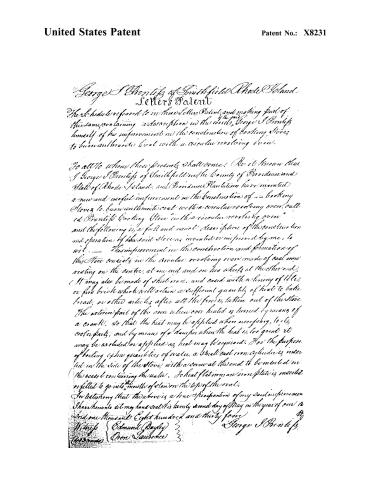 Page 2


U.S. Patent and Trademark Office · Google Patents
Show the transcription Hide (432 words)
Machine transcription (LightOnOCR) of the pages as scanned by the USPTO, most of them the handwritten copies made when the records were restored after the 1836 fire. Not checked; it can misread handwriting, so compare it with the scan.
Page 2.
United States Patent
Patent No.: X8231
George S. Brently of Smithfield Rhode Island
Letters Patent
The Schedule referred to in these Letters Patent and making part of the same, containing a description in the words of the said George S. Brently himself of his improvement in the construction of cooking stoves to burn anthracite coal with a circular revolving oven.
To all to whom these presents shall come, Be it known that I George S. Brently of Smithfield in the County of Providence and State of Rhode Island, and Providence Plantations have invented a new and useful improvement in the construction of a cooking stove to burn anthracite coal with a circular revolving oven, called "Brently's Cooking Stove" with a circular revolving oven" and the following is a full and exact description of the construction and operation of the said stove as invented or improved by me, to wit: — This improvement in the construction and formation of this stove consists in the circular revolving oven made of cast iron resting on the centre, at one end and on two wheels at the other end. It may also be made of sheet iron, and lined with a lining of tiles or fire brick which will retain a sufficient quantity of heat to bake bread, or other articles after all the fire is taken out of the stove. The exterior part of the oven when ever heated is turned by means of a crank, so that the heat may be applied when necessary, to its cooler parts, and by means of a damper when the heat is too great it may be excluded or applied as heat may be required. For the purpose of boiling or for quantities of water, a small cast iron cylinder is inserted in the side of the stove, with a screw at the end to be mounted in the vessel containing the water. A heat flat iron or iron plate is inserted or fitted to go into the mouth of the stove on the top of the oval.
In testimony that the above is a true specification of my said improvement I have hereunto set my hand and seal this twenty second day of May in the year of our Lord one thousand eight hundred and thirty four.
George S. Brently
Witness: Edmund Dayley
Chen Lawrence
Published accounts: journal notice
Notice in the monthly list of patents, with remarks
Journal of the Franklin Institute, new ser., vol. 15 (1835), p. 27 · View the page
Were we to attempt to urge all the objections to this contrivance which present themselves, we should fill a large space to little purpose, as we think that no practical man, who knows what is necessary to a well-operating saw, will need any argument to convince him that, however well this chain saw may be made, it will still be a very shackling affair, operating very indifferently at the best, making a kerf of unnecessary width, be extremely liable to get out of order, costly in its construction, &c. &c. 3. For a Cooking Stove; George J. Prentiss, Smithfield, Providence county, Rhode Island, June 3.
Remarks. The description of this stove is signally imperfect; we are told, however, that it is "to burn anthracite coal, with a circular revolving oven, made of cast iron, resting on the centre at one end, and on two wheels at the other. It may also be made of sheet iron, and cased with a lining of tile, or fire brick. The exterior part of the oven, when overheated, is turned by means of a crank, so that the heat may be applied, when necessary, to its cooler parts." According to the drawing, the oven is to be placed towards the back of the stove, and is to consist of an exterior case, which is stationary, and an interior, cylindrical, revolving oven, about one-fourth part of the circumference of which is exposed to the action of the fire. There are shelves within it, upon which the articles to be baked are placed, and which are to remain at rest during its revolution; how they are to be fixed, we are not informed, but could certainly invent a mode of doing it. There is no claim made, but dependence is manifestly placed upon the revolving oven, which, however good it may be, is, unfortunately for the patentee, not new. In the year 1826, the Franklin Institute offered a premium for a cooking stove, in which anthracite coal should be burnt; and this was awarded to Mr. Joseph R. Page, of Philadelphia, who obtained a patent for his stove, on the 24th of March, 1827. The oven consisted of a rotary cylinder, different sections of which might be exposed to the fire, exactly as in that above described, the articles which were being baked remaining at rest upon the shelves or bars used to sustain them. The patentee was not a stove maker, and not so situated, therefore, as to bring this stove into general use, and its merits were, probably, never fairly tested, excepting by himself.
About this record
- Patentee
- DATAMP
- Date
- the Name and Date index of patents, DATAMP, USPTO records
- Invention
- DATAMP
- Listed in
- the Name and Date index of patents, DATAMP, USPTO records, Jim Shaw's X-patent list, the Journal of the Franklin Institute, Burke's List of Patents (1847)
- Burke's 1847 Patent Office list gives the same patent.