

Drawings and documents
National Archives restored drawings: drawing
Jotham Chase's Patent Drawing for a Washing Machine

National Archives, Restored Patent Drawings (Record Group 241) · Full-size scan at the National Archives · Catalog record
Show the text on the drawing Hide (89 words)
Words on the drawing as machine-read by the National Archives; not checked. Useful mainly for searching.
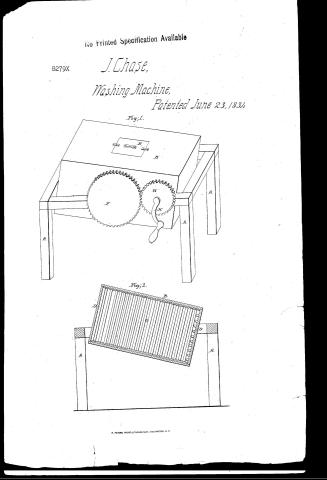
LAUNDRY. / [81] WASHING MACHINES / ylinder. / Jotham Chase. / Pat June 23-1834 Vol.19.1 / $2. / CLASSITIC ATION / Washing Machine, / 8279 / Patented 23June 183/4 / NOISTANT / Fig.1, / Fidza / to / 10 / References / Fifed. Perspective view, / Patent Cfice beary / Fifi2 vertical section, / Made under the direction of the Commifraur f Patents / A.A. frame, B. box, C, fluted lining, / inconformity with act of bougrefs. I March 1837, / D,barsat the end of the box, Ei cover, / Ecod wheel, Gdriving wherl, Herank, / HL Sumorth / Cammission of Patents,
USPTO scan
The patent as scanned by the USPTO
-
 Page 1
-
 Page 2
-
 Page 3


U.S. Patent and Trademark Office · Google Patents
Show the transcription Hide (743 words)
Machine transcription (LightOnOCR) of the pages as scanned by the USPTO, most of them the handwritten copies made when the records were restored after the 1836 fire. Not checked; it can misread handwriting, so compare it with the scan.
Page 1.
No Printed Specification Available
8279X
J. Chase,
Washing Machine,
Patented June 23, 1834.
Fig. 1.
Fig. 2.
A. PETERS, PHOTO-LITHOGRAPHER, WASHINGTON, D. C.
Page 2.
8079X
June 23, 1834
Jotham Chase of Waterville, Maine
Letters Patent.
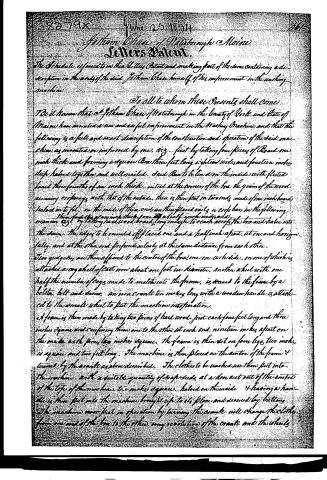
The Schedule of patent to this Letter Patent and making part of the same containing a description in the words of the said Jotham Chase himself of his improvement in the washing machine.
To all to whom these Presents shall come
Be it known that Jotham Chase of Waterville in the County of York and State of Maine have invented a new and useful improvement in the Washing Machine and that the following is a full and exact description of the construction and operation of the said machine as invented or improved by me, viz.: first by taking four pieces of Board one inch thick and forming a square Box three feet long eighteen inches wide and fourteen inches deep hinged together and well nailed. Said Box to be lined on the inside with fluted board three fourths of an inch thick, fitted at the corners of the box the grain of the wood running crossways with that of the outside. There is then fitted in two ends made of one inch boards hinged on to fit on the inside of the ends with the fluted rails or cross bars in the following manner viz: by taking hard wood board long enough to reach across the box and halve into the same. The edges to be rounded off placed one and a half inch apart at one end horizontally, and at the other end perpendicularly at the same distance from each other. Two gudgeons are then affixed to the centre of the box one on each side, on one of which is attached a cog wheel of cast iron about one foot in diameter. Another wheel with one half the number of cogs made to match into the former, is geared to the frame by a belting, belt and screws. An iron crank ten inches long with a wooden handle is attached to the small wheel to put the machine in operation.
A frame is then made by taking two pieces of hard wood just each four feet long and three inches square and confining them one to the other at each end nineteen inches apart on the inside each piece, ten inches square. The frame is then set on four legs two inches square and two feet long. The machine is then placed on the centre of the frame & turned by the crank as above described. The clothes to be washed are then put into the machine with a suitable quantity of soap suds, at a door cut out of the centre of the top of the machine ten inches square hinged on the inside & having a handle is then put into the machine brought up to its place and secured by buttons. The machine is now put in operation by turning the crank: will change the clothes from one end of the box to the other, any revolution of the crank and the wheels
Page 3.
we do put together that when the handle of the crank is moved... the operator the bar will be in a perpendicular direction. By this method the clothes are kept warm being confined from the air, are constantly changed from one end to the other stirring with sufficient force on the flutes and rails, or cross bars, to cleanse them thoroughly in less time and with much less labour, than any other machine that I have examined. Coats, Quilts or woollen garments with buttons on them may be washed clean in a few minutes without sustaining any injury, and with equal facility of those of cotton or linen. I claim as my improvement the general form and operation of the machine with the rails or cross bars as above described, and the particular operation of the crank and cog wheels, will be satisfied by actual experiments that it possesses many advantages over any other machine in operation, and that its simplicity and cheapness and peace of cleaning will make it a valuable improvement.
Exd. Witness
N.C. Richard M. Clarke
Wm. Clarke
Drawing
660 words
A. Chase
Published accounts: journal notice
Notice in the monthly list of patents, with remarks
Journal of the Franklin Institute, new ser., vol. 15 (1835), p. 45 · View the page
48. For a Washing Machine; Jotham Chase, Waterboro', York county, Maine, June 23.
Remarks. There is to be a rectangular box, three feet long, eighteen inches wide, and fourteen deep, the inside of which is to be lined entirely with fluted boards, and there are to be doors on one side to admit the clothes to be washed. The box is be suspended on gudgeons, like a revolving churn, and upon one of the gudgeons there is to be a cog wheel, whilst another wheel, one-half its size, and fixed upon the frame, mashes into it. On turning this smaller wheel by means of a handle, the box will revolve, and the clothes falling from end to end of it, will, it is said, be washed clean in a very short space of time. If so, however, there are other washing machines, already in use, which are so much like it, that we see no reason why they should not operate at least equally well.
About this record
- Patentee
- DATAMP
- Date
- the Name and Date index of patents, DATAMP, USPTO records
- Invention
- DATAMP
- Listed in
- the Name and Date index of patents, DATAMP, USPTO records, Jim Shaw's X-patent list, the Journal of the Franklin Institute, Burke's List of Patents (1847)
- Burke's 1847 Patent Office list gives the same patent.