

Drawings and documents
National Archives restored drawings: drawing
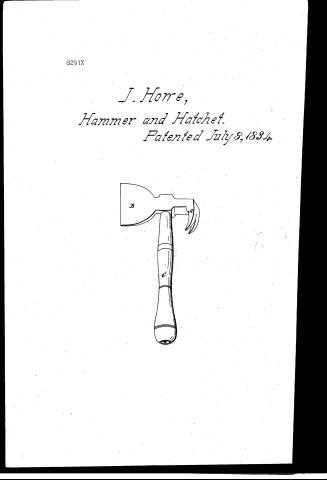
Joel Howe's Patent Drawing for a Hammer-hatchet

National Archives, Restored Patent Drawings (Record Group 241) · Full-size scan at the National Archives · Catalog record
Show the text on the drawing Hide (98 words)
Words on the drawing as machine-read by the National Archives; not checked. Useful mainly for searching.
45. WOOD WORKING. / 4. TOOLS. / [29] Hammers & Hatchets. / 50$ / CLASSIFICATION / 8291X / Joel Howe S / DIVISION. / Hammer-hatchet / Patented: July 8th 1834 / References / A.HammoClaw. / B.Hatchet. / C'Hanclle. / This is to certify that this drawing was made under the direction of the / Commifrianer of Patents in conformity to the provision of the act of 3d / sect 1st from and in accordance with the specification, on which Letters Patentwere / granted 1838. to said Joel Home, 8th July 1834, and recorded ancw on they th day of April / Commissioner of Patents.
USPTO scan
The patent as scanned by the USPTO
-
 Page 1
-
 Page 2


U.S. Patent and Trademark Office · Google Patents
Show the transcription Hide (289 words)
Machine transcription (LightOnOCR) of the pages as scanned by the USPTO, most of them the handwritten copies made when the records were restored after the 1836 fire. Not checked; it can misread handwriting, so compare it with the scan.
Page 1.
8291X
J. Horre,
Hammer and Hatchet.
Patented July 8, 1834.

Page 2.
July 8, 1824
J. H. Stone, Princeton, Massachusetts
Letters Patent July 8, 1824.
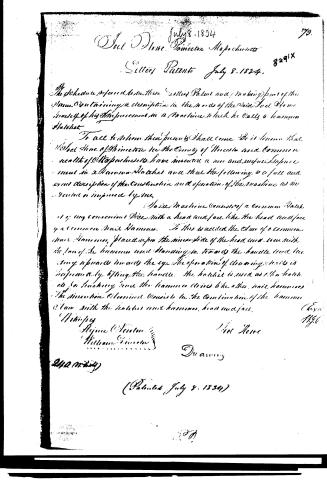
The Schedule referred to in these Letters Patent and making part of the Same containing a description in the words of the said J. H. Stone himself of his Improvements in a Machine which he calls a Harmon Hatcher.
To all to whom these presents shall come, He it known that J. H. Stone of Princeton in the County of Worcester and Commonwealth of Massachusetts have invented a new and useful Improvement in a Harmon Hatcher and that the following is a full and exact description of the Construction and operation of the machine as invented or improved by me.
Said Machine consists of a common Hatchet of any convenient Size with a head and face like the head and face of a common Nail Hammer. To this is added the claw of a common Nail Hammer, placed upon the inner side of the head and even with the face of the hammer and standing in towards the handle, and the eye upwards towards the eye. The operation of drawing nails is performed by lifting the handle. The hatcher is used as the hatchet is for hatching, and the hammer acts like the other nail hammers. The invention claimed consists in the combination of the hammer claw with the hatcher and hammer, head and face.
Witness
Hiram C. Peirson
William Lincoln
J. H. Stone
Drawing
(Patented July 8, 1824)
79.
8291X
Ex. 1896
Published accounts: journal notice
Notice in the monthly list of patents, with remarks
Journal of the Franklin Institute, new ser., vol. 15 (1835), p. 96 · View the page
9. For a Hammer Hatchet; Joel Howe, Princeton, Worcester county, Massachusetts, July 8.
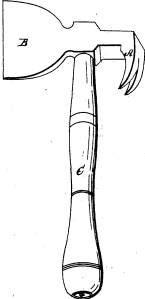
Remarks. If to the hammer part of a shingling hatchet, you add a claw projecting back from the hammer face, in a line with the handle, you have this machine. "The operation of drawing nails is performed by lifting the handle. The hammer drives like other nail hammers. The invention claimed consists in the combination of the hammer claw with the hatchet, and hammer head and face."
DATAMP: illustration
Illustrations from DATAMP

DATAMP (Directory of American Tool and Machinery Patents), via the Internet Archive · Archived DATAMP page
About this record
- Patentee
- the Journal of the Franklin Institute, Journal
- Date
- the Name and Date index of patents, DATAMP, USPTO records
- Invention
- DATAMP
- Listed in
- the Name and Date index of patents, DATAMP, USPTO records, Jim Shaw's X-patent list, the Journal of the Franklin Institute, Burke's List of Patents (1847)
- The patentee's full name comes from the Franklin Institute's journal.
- Burke's 1847 Patent Office list gives the same patent.