

Drawings and documents
USPTO scan
The patent as scanned by the USPTO
-
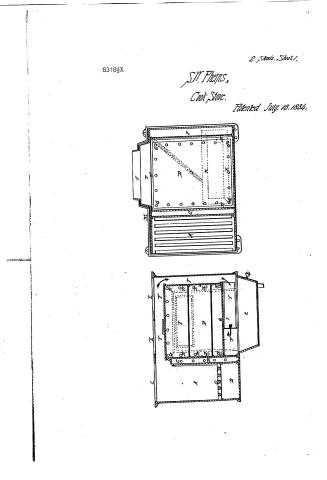 Page 1
-
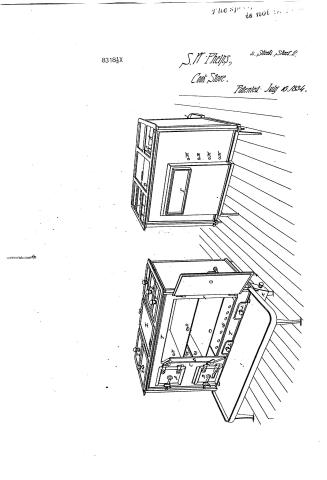 Page 2
-
 Page 3
-
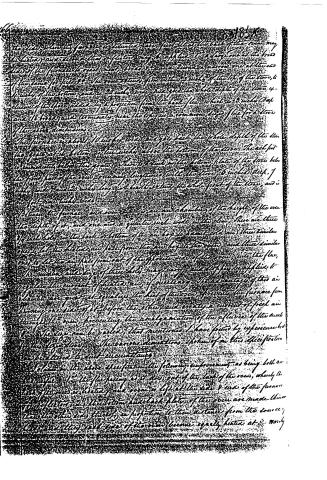 Page 4
-
 Page 5


U.S. Patent and Trademark Office · Google Patents
Show the transcription Hide (1,036 words)
Machine transcription (LightOnOCR) of the pages as scanned by the USPTO, most of them the handwritten copies made when the records were restored after the 1836 fire. Not checked; it can misread handwriting, so compare it with the scan.
Page 1.
8318½X
2. Sheets. Sheet 1.
S. W. Phelps,
Cook Stove.
Patented July 16, 1834.
Page 2.
8318½X
S. W. Phelps,
2 Sheets. Sheet 2.
Coal Stove.
Patented July 16, 1834.
Page 3.
July 16, 1854
Samuel W. Phelps of City of Cincinnati State of Ohio.
Letters Patent.
The schedule referred to in these Letters Patent and making part of the same containing a description in the words of the said Samuel W. Phelps, himself of his improvement in cooking stoves, called Phelps' Patent rarefying cook stove.
To all persons to whom these presents shall come,
Be it known that I Samuel W. Phelps, of the city of Cincinnati in the county of Hamilton and State of Ohio, have invented, constructed, made, and applied to use a new and useful improvement in cooking stoves, called "Phelps' Patent rarefying cook stove," specified in the words following, to wit:
The said stoves are intended for steam boats, hotels &c. and vary in size to suit circumstances; they are made of wrought or cast-iron, the second size is large enough to accommodate from eighty to one hundred persons, it is three feet long two feet high and two feet wide, one of the broad sides is the front of the stove, and presents to view the fire place, the air chamber, the oven, and the ash pit. The boilers are placed upon the top of the stove, and drop into it from one and a quarter, to one and a half inch. The flue from the furnace extends beneath the boilers, and over the top of the oven, thence down the side of the oven, farthest from the furnace, thence beneath the bottom of the oven, thence against the back of it, thence into the pipe. So that the oven is heated on every side except the front. The bottom plate of the oven, and the back plate, are made of fire bed iron, supported by cast iron frames or otherwise. The advantage of this is, that the bottom and back of the oven, being subject to less heat than the sides near the furnace, may be thinner than those sides, and thus all sides get equally heated in the same time. The bottom portion of the flue beneath the oven, is divided by a partition commencing at its right hand side, back, and running diagonally forward, to within nine inches of the front, the object of which is to carry the hot smoke flame & air forward, and spread it well over the bottom of the oven before it takes to the back plate.
The advantage of having the flue pass out of the back of the stove, and not at
Page 4.
to the heat when the furnace is situated, and first that the back of the hear may be heated more than that of the front, may be effected by placing one at the back end of the furnace to each oven, which are each times as narrow one at the end of the same for fuel as the rest extend from within 3 inches of the top of the stove, to 4 inches of the bottom, and is 20 inches wide, which is the whole depth of the stove. 4- elum of the hear placed by a projection from the back flue, which is 3 inches deep and 18 inches wide, terminately near the top in a common shape of flue for a stove of the above dimensions.
The furnace is about 10 inches wide and 4 feet back the whole depth of the stove, the grate at the bottom is two inches above the bottom of the stove. The ash pit is immediately below this grate. There is a sink in the bottom plate of the stove below the front part of the stove, commonly lengthwise with the stove, 6 inches deep. 1 inch wide, and 20 inches long, which extends the whole front of the stove, and is one foot from the back stove.
Between the furnace and oven there is an air chamber of the height of the oven the depth of it, and one and a quarter inch wide in the clear. There are three 3/4 inch holes in the back or bottom of the air hop to admit cold air, three similar ones to let the heated air pass from the air hop to the oven, and three similar ones to let the air pass from out of the opposite side of the oven, into the flue. The number and size of these holes may vary, and it is for the purpose to regulate the current of heated air, if overlarge. The advantage of this air chamber is great, it equalizes the heat of the oven, prevents the furnace from burning one side of it before the other, and creates a current of fresh air through the oven, preventing the amalgamation of the ashes of the meal.
The size can be varied, that mentioned I have found by experience best for the large stoves. The various dimensions of stoves for this specification can be altered to suit circumstances.
I claim in the above specification the following improvement as being both new and useful: 1st. The flue passing as it does, out of the back of the oven, whereby the heat of the oven is heated, and soon as life at the side 4 ends of the furnace 2nd. The bottom and back plate of the oven are made thinner than the other sides thereby in proportion to their distance from the source of heat, and they and ends of the oven become equally heated at a nearly
Page 5.
the same time. 3. The air chamber, interposed between the furnace & the oven
4. The convenient combination of these advantages, in the most condensed and
simple form for the use of steam boats, and hotels, &c.
In testimony that the above is a true specification of my said
improvements I have hereunto set my hand and seal, this 7th day of July 1834.
Witness:
Thos. Wright
Isaiah Forbes
S. W. Phelps
Drawing
July 16 1834
1029 no.
8318½X
Ex.
Clyr.
Published accounts: journal notice
Notice in the monthly list of patents, with remarks
Journal of the Franklin Institute, new ser., vol. 15 (1835), p. 104 · View the page
32. For a Cooking Stove; Samuel W. Phelps, Cincinnati, Hamilton county, Ohio, July 16.
Remarks. The claims made by the patentee are the following: "1st. The reflecting oven being attached to the stove, and its sides being composed of movable doors, which can be managed to open or shut, to regulate the heat in the oven. "2d. The small flue from said oven into the smoke flue, which carries off the effluvia of the meats, and prevents their amalgamating flavours. "3d. The position, plan, and construction, of the furnace and smoke flue, being such as to burn either wood or coal, and the manner in which the front grate may be slid up or down.
About this record
- Patentee
- the Journal of the Franklin Institute, Journal
- Date
- the Name and Date index of patents, USPTO records, Burke's List of Patents (1847)
- Invention
- the Name and Date index of patents
- Listed in
- the Name and Date index of patents, USPTO records, Jim Shaw's X-patent list, the Journal of the Franklin Institute, Burke's List of Patents (1847)
- The sources give different dates; the date shown is the one most of them agree on.
- The Name and Date index has a note on this number.
- The patentee's full name comes from the Franklin Institute's journal.
- The Franklin Institute's journal confirms the date shown.
- Burke's 1847 Patent Office list gives the same patent.