

Drawings and documents
National Archives restored drawings: drawing
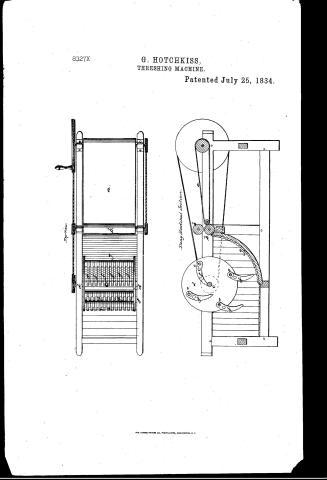
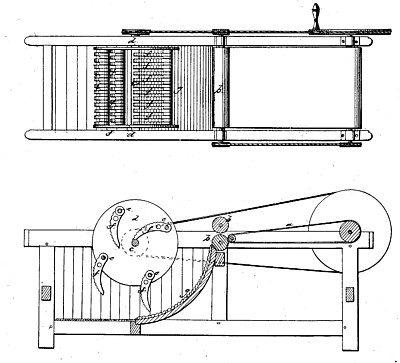
Gideon Hotchkiss' Patent Drawing for a Thrashing Machine

National Archives, Restored Patent Drawings (Record Group 241) · Full-size scan at the National Archives · Catalog record
Show the text on the drawing Hide (83 words)
Words on the drawing as machine-read by the National Archives; not checked. Useful mainly for searching.
130. THRASHING. / Thrashing Machines. / A. Cylinder Machines. / $2.- / Tideon / Cyl-Mach. / CLASSI O ITATION / Thrashing Markin / 8327x / DIVISION. / Patented: 25 July: 1834. / References / a apron / b. Feeding rollers. / c axle or whaft. / d. Heads / e Rods / A. Beaters / I Bed piece / Top view / 01 / dongitudinal section / AN / be / Patent Office Aug 13th 1839 / Made under the direction of the Commifrioner of Patents in / conformity with act 3a March 1837 / M L / Comm of Patent
USPTO scan
The patent as scanned by the USPTO
-
 Page 1
-
 Page 2
-
 Page 3
-
 Page 4
-
 Page 5


U.S. Patent and Trademark Office · Google Patents
Show the transcription Hide (1,130 words)
Machine transcription (LightOnOCR) of the pages as scanned by the USPTO, most of them the handwritten copies made when the records were restored after the 1836 fire. Not checked; it can misread handwriting, so compare it with the scan.
Page 1.
8327X
G. HOTCHKISS.
THRESHING MACHINE.
Patented July 25, 1834.

THE NORRIS PETERS CO., PHOTO-LITHO., WASHINGTON, D.C.
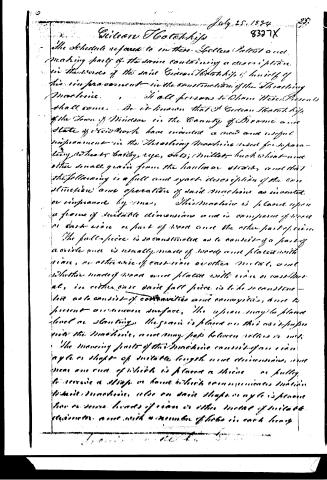
Page 2.
July 25, 1834
Gilson Hatcheships
The Schedule refers to in these Spelled Patent and making part of the same containing a description in the words of the said Gilson Hatcheships of himself of his improvement in the construction of the Thrashing Machine. To all persons to whom these Presents shall come, Be it known that I Gilson Hatcheships of the Town of Windsor in the County of Bromley and State of New York have invented a new and useful improvement in the Thrashing Machine used for separating wheat, barley, rye, oats, millet, buckwheat and other small grain from the hulls or straws, and that the following is a full and exact description of the construction and operation of said machine as invented or improved by me.
This machine is placed upon a frame of suitable dimensions and is composed of iron or dark iron or part of wood and the other part of iron. The fall-piece is so constructed as to consist of a part of a circle and is usually made of wood and placed with iron, or otherwise of cast-iron or other metal, and the other made of wood and placed with iron or cast-iron, in either case said fall piece is to be so constructed as to consist of convexities and concavities, due to present an uneven surface. The apron may be placed level or slanting. The grain is placed on this apron and into the machine, and may pass between rollers or not.
The moving parts of this machine consist of an axle or shaft of suitable length and dimensions, and near one end of which is placed a stone or pulley to receive a strap or band which communicates motion to said machine, also on said shaft or axle is placed two or more heads of iron or other metal of suitable dimensions and with a number of holes in each head.
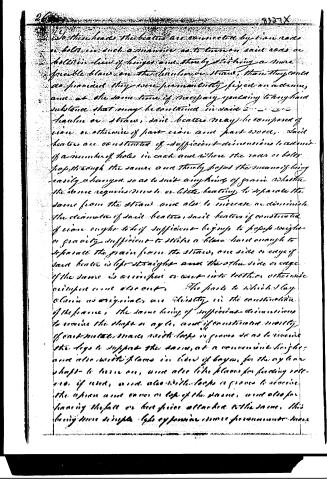
Page 3.
To these heads the beaters are connected by iron rods or bolts, in such a manner as to turn on said rods or bolts in lieu of hinges and thereby striking a more forcible blow on the hair or straw, than they could do provided they were permanently fixed on a drum, and at the same time if necessary speaking to any kind substance that may be contained in said hair or straw, said beaters may be composed of iron or otherwise of part iron and part wood. Said beaters are constructed of sufficient dimensions to admit of a number of holes in each and where the rods or bolts pass through the same and thereby passed the means of being easily changed so as to suit any kind of grain whether the same requires much or little beating to separate the same from the straw and also to increase or diminish the diameter of said beaters, said beaters if constructed of iron ought to be of sufficient length to possess weight or gravity sufficient to strike a blow hard enough to separate the grain from the straw, one side or edge of said beater is left straight and the other side or edge of the same is or is not or went into tetter otherwise or is not cut out. The parts to which I lay claim as originals are chiefly in the construction of the frame, the same being of sufficient dimensions to receive the shaft or axle, and if constructed mostly of cast-metal, made with loops or grooves so as to receive the legs to support the same, at a convenient height and also with places in lieu of bayonets for the axle shaft to turn on, and also like places for feeding rollers, if used, and also with loops or grooves to receive the upper and lower or top of the same, and also for having the fall or knee piece attached to the same, this being more simple less expensive more permanent more
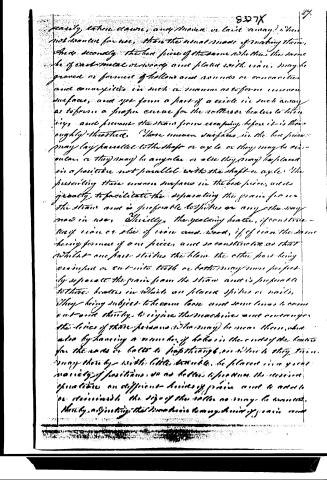
Page 4.
separately taken alone, and may move or twist away, when not wanted for use, than the usual mode of making them, which, secondly, the bed piece of the same nature as the same, if cast in metal or wood and plated with iron, may be grooved or formed of hollow and rounds or concavities and convexities in such a manner as to form uneven surfaces, and yet form a part of a circle in such a way as to form a proper curve for the rollers or heaters to turn in, and prevent the steam from escaping before it is thoroughly thrust. These uneven surfaces in the bed piece may lay parallel to the shaft or axle or they may be circular, or they may be angular or else they may be placed in a position not parallel with the shaft or axle. The presenting these uneven surfaces in the bed piece, adds greatly to facilitate the separating the grain from the steam and is preferable to spikes or any other way now in use. Thirdly, the yielding heater, if constructed of iron or else of iron and wood, if of iron the same having grooves of one piece, and so constructed as that whilst one part slides the blade the other part being an inch or cut into teeth or both may more perfectly separate the grain from the steam and is preferable to those heaters in which are placed spikes or nails, they being subject to become loose and sometimes to come out and thereby to injure the machines more seriously than the lines of these persons who may be near them, and also by having a number of holes in the ends of the heater for the ends or bolts to pass through, as which they may vary thereby with little trouble, be placed in a great variety of positions, so as better to secure the desired operation on different kinds of grain and to adapt to or accommodate the size of the roller as may be required. Fourthly, adjusting the machines to any kind of grain and
Page 5.
greatly assisting to the performing the operation of separating the grain from the straw in a short space of time. Also the heads being formed with a number of holes in each for the rods or bolts to pass through greatly adds to the convenience of adjusting the headers to different kinds of grain.
Witness
Els. Pratt
A. M. Moore
Gideon Hootenhill
1840
Published accounts: journal notice
Notice in the monthly list of patents, with remarks
Journal of the Franklin Institute, new ser., vol. 15 (1835), p. 109 · View the page
43. For a Thrashing Machine; Gideon Hotchkins, Windsor, Broome county, New York, July 25.
Remarks. Although a very laboured description is given of this thrashing machine, and certain distinct claims are made, there still is not, in our apprehension, any thing presented which is new. The machine is of the cylinder and concave kind, with beaters which swing upon bolts passing through circular heads, in a way that is well known. Among other things claimed, is the frame, which, we are informed, may be of cast iron, or partly of iron, and partly of wood: and we are told of many other variations that may be made in other parts, of which there can be but little doubt, as we believe they have all been actually made, and that more than once.
DATAMP: illustration
Illustrations from DATAMP

DATAMP (Directory of American Tool and Machinery Patents), via the Internet Archive · Archived DATAMP page
About this record
- Patentee
- DATAMP
- Date
- the Name and Date index of patents, DATAMP, USPTO records
- Invention
- DATAMP
- Listed in
- the Name and Date index of patents, DATAMP, USPTO records, Jim Shaw's X-patent list, the Journal of the Franklin Institute, Burke's List of Patents (1847)
- The Franklin Institute's journal spells the name differently.
- Burke's 1847 Patent Office list gives the same patent.