

Drawings and documents
National Archives restored drawings: drawing
Phineas Davis' Patent Drawing for a Car Wheel

National Archives, Restored Patent Drawings (Record Group 241) · Full-size scan at the National Archives · Catalog record
Show the text on the drawing Hide (110 words)
Words on the drawing as machine-read by the National Archives; not checked. Useful mainly for searching.
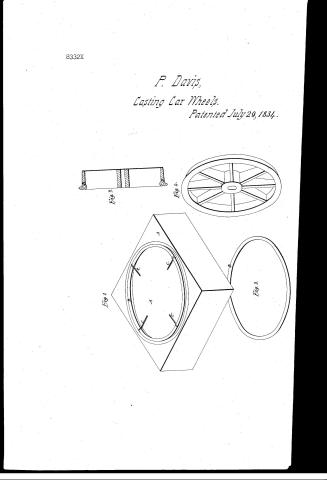
22. METAL FOUNDING. / IN MOLDED MOLDS. / Phincas Davis / Vehicle Wheels. / $150 / CLASSIFICATION / Car What, / 8332. / Patented 29thJuly1834 / DIVISION. / Fid References. 1, mould. Fid,2, ironred, / Mole of prim this / Fid.3, section of wheel, / the can Emleye of / I'ig. 4 Perspective of wheel. / Fig.1. / throate Coul by easy / A. Mould. B. Wrought iron ring. / Fifers, / C. supports holding ring in would / 3 Thmp popelled & / the write Steaming / First, / Fig.2, / cast / in / mugh / Trank / Patent office / Vehicle Whools. / December 19ᵗʰ,19ᵗʰ / 22. METAL FOUNDING, / Made under the direction of the Mommiproner of / Patents conformity with the Act of Bodmarch 1837 / no Sumor / Commupiner of Patents
USPTO scan
The patent as scanned by the USPTO
-
 Page 1
-
 Page 2
-
 Page 3


U.S. Patent and Trademark Office · Google Patents
Show the transcription Hide (868 words)
Machine transcription (LightOnOCR) of the pages as scanned by the USPTO, most of them the handwritten copies made when the records were restored after the 1836 fire. Not checked; it can misread handwriting, so compare it with the scan.
Page 1.
8332X
P. Davis,
Casting Car Wheels.
Patented July 29, 1834.
Fig. 1.
Fig. 2.
Fig. 3.
Fig. 4.
Page 2.
7/29/1834 8332X
July 29, 1834 69.
Phineas Davis Baltimore & Co.
Letters Patent July 29, 1834.
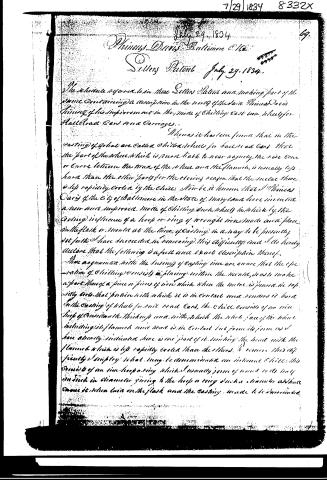
The schedule annexed to this Letters Patent and making part of the same containing a description in the words of the said Phineas Davis Davis of his improvement in the mode of Chilling Cast Iron Wheels for Rail Road Cars and Carriages.
Whereas it has been found that in the casting of what are called Chilled Wheels for Railroad Cars that the part of the wheel which is most liable to wear namely the side cone or curve between the track of the wheel and the flange, is usually less hard than the other part for the obvious reason that the metal there is less rapidly cooled by the chill; Now be it known that I Phineas Davis of the city of Baltimore in the State of Maryland have invented a new and improved mode of chilling such wheels in which by the casting influence of a hoop or ring of wrought iron made and placed in the flask or mold at the time of casting in a way to be presently set forth I have succeeded in removing this difficulty and I do hereby declare that the following is a full and exact description thereof.
Those acquainted with the business of casting iron are aware that the operation of chilling consists in placing within the mold, so as to make a part thereof a piece or pieces of iron which when the metal is poured in rapidly cools that portion with which it is in contact and renders it hard in the casting of what is called road cars, the chill consists of an iron hoop of considerable thickness and with which the wheel face of the wheel including its flange and tread is in contact but from its form as I have already indicated there is one part of it touching the tread with the flange which is less rapidly cooled than the others. I remove this difficulty I employ what may be denominated an internal chill; this consists of an iron hoop or ring which I usually form of round rods half an inch in diameter giving to the hoop or ring such a diameter as shall cause it when laid on the flask and the casting made to be surrounded
Page 3.
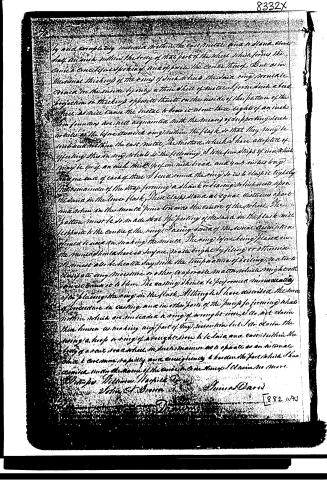
ly and completely immersed within the cast metal and to leave about half an inch within the tray of that part of the wheel which forms the rim and one half of the head of any of the spokes the centre thereof. But as in the usual thickness of the ring of such wheel the said ring would be crimped on the inside by only a thin shell of metal of from such a bad projection or thickness opposite thereto on the inside of the pattern of the wheel as will cause the metal to flow in about three eighths of an inch when foundry are well acquainted with the means of supporting such articles as the before described ring within the flask so that they may be cast and within the cast metal, the method which I have adopted of effecting this in my wheel is the following, I take four strips of iron which may be 1/4 of an inch thick 1/4 of an inch broad, and 4 or 5 inches long and one end of each of these I bend round the ring so as to clasp it tightly the remainder of the strip forming a shank or learing which rests upon the rim in the lower flask. These claps stand at equal distances apart and when in the mould point towards the centre of the wheel. The pattern must be so made that the parting of the sand in the flask will be opposite to the centre of the ring. Having fixed the several description should be used in making the mould. The ring before being placed in the mould should have its surface made bright by filing or otherwise. It must also be heated day into the temperature of boiling water to disperse any moisture or other improper matter which might be caused to be thrown. The casting should be performed immediately after placing the ring in the flask. Although I have described the mode of procedure in casting and in other parts of the process for forming wheels within which are included a ring of wrought iron, I do not claim the same as making any part of any invention but I do claim the using a hoop or ring of wrought iron to be laid and cast within the body of a cast iron wheel in such manner as to operate as an internal core and become rapidly and consequently to harden the part which I have omitted in the name of the invention and thing I claim no more.
Witnesses: William Harfield & John C. Brown
[882 wts]
Published accounts: journal notice
Notice in the monthly list of patents, with remarks
Journal of the Franklin Institute, new ser., vol. 15 (1835), p. 110 · View the page
47. For an improvement in the mode of Chilling Cast Iron Wheels for Rail-road Cars; Phineas Davis, Civil Engineer, city of Baltimore, July 29.
Remarks. (See the specification.)
Published accounts: journal notice
Notice in the monthly list of patents, with remarks
Journal of the Franklin Institute, new ser., vol. 15 (1835), p. 113 · View the page
To economize time and labour, there must be a series of such vats and platforms as have been described, thus enabling the workman to proceed readily from a weaker to a stronger solution, these varying according to the nature of the skins; and requiring to be regulated by the judgment of the workman. Specification of a Patent for an improvement in the mode of Chilling Cast Iron Wheels for Rail-road Cars. Granted to PHINEAS DAVIS, Civil Engineer, city of Baltimore, July 29th, 1834.
Remarks. Whereas, it has been found that, in the casting of what are called chilled wheels, for rail-road cars, that the part of the wheel which is most liable to wear, namely, the rise, cone, or curve, between the tread of the wheel and the flanch, is usually less hard than the other parts, for the obvious reason that the metal is there less rapidly cooled by the chill: Now, be it known, that I, Phineas Davis, of the city of Baltimore, in the state of Maryland, have invented a new and improved mode of chilling such wheels, in which, by the cooling influence of a hoop, or ring, of wrought iron, made and placed in the flask, or mould, at the time of casting, in a way to be presently set forth, I have succeeded in removing this difficulty; and I do hereby declare that the following is a full and exact description thereof. Those acquainted with the business of casting iron, are aware that the operation of chilling consists in placing within the mould, so as to make a part thereof, a piece, or pieces, of iron, which, when the metal is poured in, rapidly cools that portion with which it is in contact, and renders it hard. In the casting of wheels for rail-road cars, the chill consists of an iron hoop, of considerable thickness, and with which the whole face of the wheel, including its flanch and tread, is in contact; but from its form, as I have already indicated, there is one part of it, uniting the tread with the flanch, which is less rapidly cooled than the others. To remove this difficulty, I employ what may be denominated an internal chill; this consists of an iron hoop, or ring, which I usually form of round rods, half an inch in diameter, giving to the hoop, or ring, such a diameter as shall cause it, when laid in the flask, and the casting made, to be surrounded by, and completely imbedded within, the cast metal, and to stand about half an inch within the body of that part of the wheel which forms the curve, or cone, before spoken of, and opposite the centre thereof. But as, in the usual thickness of the rims of such wheels, the said ring would be covered on the inside by only a thin shell of metal, I form such a bead, projection, or thickening, opposite thereto, on the inside of the pattern of the wheel, as will cause the metal to cover it, about three-eighths of an inch. Iron founders are well acquainted with the means of supporting such articles as the before described ring, within the flask, so that they may be embraced within the cast metal. The method which I have adopted of effecting this in my wheels, is the following. I take VOL. XV.-No. 2. - FEBRUARY, 1835. 15 four strips of iron, which may be one-tenth of an inch thick, one-fourth of an inch broad, and four or five inches long, and one end of each of these I bend round the ring, so as to clasp it tightly, the remainder of the strap forming a shank, or bearing, which rests upon the sand in the lower flask. These clasps stand at equal distances apart, and, when in the mould, point towards the centre of the wheel. The pattern must be so made, that the parting of the sand in the flask will be opposite to the centre of the ring. Facing sand, of the usual description, should be used in making the mould. The ring, before being placed in the mould, should have its surface made bright, by filing, or otherwise. It must also be heated, say to the temperature of boiling water, to dissipate any moisture, or other evaporable matter, which might otherwise cause it to blow. The casting should be performed immediately after placing the ring in the flask.
Published accounts: journal notice
Notice in the monthly list of patents
Journal of the Franklin Institute, new ser., vol. 15 (1835), p. 114 · View the page
Although I have described the mode of procedure in casting, and in other parts of the process for forming wheels within which are imbedded a ring of wrought iron, I do not claim these as making any part of my invention; but I do claim the using of a hoop, or ring, of wrought iron, to be laid, and cast, within the body of a rail-road wheel, in such manner as to operate as an internal chill, to cool more rapidly, and consequently to harden, the part which I have described under the name of the curve, or cone thereof; I claim no more. PHINEAS DAVIS. Specification of a Patent for Promoting the Combustion of Anthracite in Locomotive, and other Steam Engines. Granted to PHINEAS DAVIS, Civil Engineer, city of Baltimore, July 29th, 1834.
About this record
- Patentee
- DATAMP
- Date
- the Name and Date index of patents, DATAMP, USPTO records
- Invention
- DATAMP
- Listed in
- the Name and Date index of patents, DATAMP, USPTO records, Jim Shaw's X-patent list, the Journal of the Franklin Institute, Burke's List of Patents (1847)
- Burke's 1847 Patent Office list gives the same patent.