

Drawings and documents
National Archives restored drawings: drawing
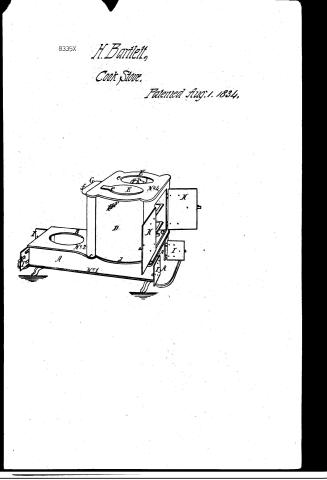
Horace Bartlett's Patent Drawing for a Stove

National Archives, Restored Patent Drawings (Record Group 241) · Full-size scan at the National Archives · Catalog record
Show the text on the drawing Hide (91 words)
Words on the drawing as machine-read by the National Archives; not checked. Useful mainly for searching.
126. STOVES do F JRNACES / 18 [154] Cooking Stoves. / $150 / HORACE BARTLETT'S / CLASSIFICATION / 8335X / STOVE. / 'NOISIART / Patented 1st August. 1834. / E. / N°4 / hoF / D. / H. / I. / No2 / A. / N°1 / REFERENCES. / A,A, Fire chamber. B, hole for a boiler. C, opening in the bottom / of the oven. E,E, openings for boilers. F, dampers. G, smoke-pipe. / H, oven doors. I,I, doors of fire chamber. / The reference$ in the Specification apply to the numbers, / and the small letters. / b13.
USPTO scan
The patent as scanned by the USPTO
-
 Page 1
-
 Page 2
-
 Page 3


U.S. Patent and Trademark Office · Google Patents
Show the transcription Hide (650 words)
Machine transcription (LightOnOCR) of the pages as scanned by the USPTO, most of them the handwritten copies made when the records were restored after the 1836 fire. Not checked; it can misread handwriting, so compare it with the scan.
Page 1.
8335X
H. Bartlett,
Cook Stove.
Patented Aug. 1, 1834.

Page 2.
Aug. 1, 1834
Horace Bartlett, Carmel, New York
Letters Patent.
The schedule referred to in these Letters Patent and making part of the same containing a description in the words of the said Horace Bartlett, himself, of his improvement in the cooking stove.
To all to whom these presents shall come
Be it known that I, Horace Bartlett, of Carmel, in the county of Putnam and state of New York, have invented a new and useful improvement in the form and construction of my present patented cooking stove, and that the following is a full and exact description of the construction and operation of the said cooking stove as invented or improved by me. The bed for the fire lies up the stove from front to rear, see plate 1:1, letter A. A plate forming the remaining part of the bottom, turning in a horizontal form from the top of this bed to the full length of the stove; which, for the sake of description, I call the wings see plate 1:1. Plate 1:3, forms the bottom of the oven, over the bed for the fire or plate 1:1. In between these plates the blaze is cramped suddenly off, forming thereby a more powerful draft. The 1:1 plate, in the bottom of the oven, and back of the main body of the stove, are holes for boilers plate 1:2 letter B at each corner of this plate, is a hole for the smoke, over which stands a pipe, in the form of a half circle, letter C. Between these pipes, connected with them in a circular form, is a piece forming the end of the stove. Having these pipes is a piece forming the length of the oven, leaving an opening for the smoke, letter D. Upon the top of these pipes is a plate forming the top of the oven, plate 1:3. Over this is another, raised rim, letter E, forming what I call the chimney, plate 1:4; through which, at each end, is a hole for boilers, letter E. From the back part of this chimney extends the pipe letter F, through the bottom plate of the stove, which forms the top of the oven, in
Page 3.
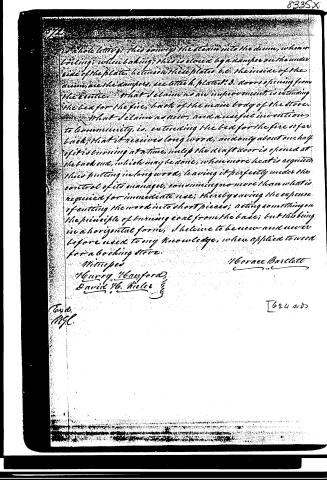
is a whole letter; this conveys the steam into the drum, when boiling; when baking, this is closed by a damper on the under side of the plate, between these plates i.e. the inside of the drum, are the dampers, see attached plates. 3. doors opening from the center. What I claim as an improvement is extending the bed for the fire, back of the main body of the stove. What I claim as new, and a useful invention to community, is, extending the bed for the fire so far back, that it receives long wood, and only about one half of it is burning at a time, unless the draft door is opened at the back end, which may be done, when more heat is required, then putting in long wood, leaving it perfectly under the control of its manager, consuming no more than what is required for immediate use; thereby saving the expense of cutting the wood into short pieces; acting something on the principle of burning coal from the base; but this being in a horizontal form, I believe to be new and never before used to my knowledge, when applied to wood for a cooking stove.
Witnesses
Henry Banford
David H. Hiles
Horace Barclatt
[624 and 5]
Published accounts: journal notice
Notice in the monthly list of patents, with remarks
Journal of the Franklin Institute, new ser., vol. 15 (1835), p. 181 · View the page
1. For a Cooking Stove; Horace Bartlett, Carmel, Putnam county, New York, August 1.
Remarks. The claim in this patent is to the "extending the bed of the fire so far back that it receives long wood, in such a way that only about one-half of it is burning at the same time, unless the draft door is opened at the back, which may be done when more heat is required; thus putting in long wood, and leaving it perfectly under the control of the manager, consuming no more than what is required for immediate use, thereby saving the expense of cutting the wood into short pieces; thus acting somewhat like the principle of burning coal from the base, but applied to wood for a cooking stove."
About this record
- Patentee
- DATAMP
- Date
- the Name and Date index of patents, DATAMP, USPTO records
- Invention
- DATAMP
- Listed in
- the Name and Date index of patents, DATAMP, USPTO records, Jim Shaw's X-patent list, the Journal of the Franklin Institute, Burke's List of Patents (1847)
- Burke's 1847 Patent Office list gives the same patent.