

Drawings and documents
National Archives restored drawings: drawing
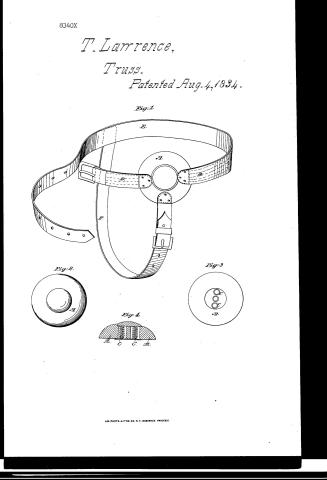
Thomas Lawrence's Patent Drawing for a Truss

National Archives, Restored Patent Drawings (Record Group 241) · Full-size scan at the National Archives · Catalog record
Show the text on the drawing Hide (93 words)
Words on the drawing as machine-read by the National Archives; not checked. Useful mainly for searching.
128 SURGERY. / Thomas Laurence / Vol 19.p.369, / [156] Trusses, / Frusses- Surg - - Trup, / #1- / Patented 4aug1834, / classification / 8340-X / Fig.1. trass, References, Fid,2, ovalside of block, / LIVISION. / Feady latside of block. FiR4, section, / Fufl. / A.block. B.pin Espiral spring's / D. fune elastec springs E. strap passing / Fifes, / round the body. F. lower strap. / Fif.1. / Fig 4 / Batent office beeng Houl. / Made under the direction of the of Patents / in conformity with the Act of you march 1837 / Hd Sumath / Patents
USPTO scan
The patent as scanned by the USPTO
-
 Page 1
-
 Page 2
-
 Page 3


U.S. Patent and Trademark Office · Google Patents
Show the transcription Hide (749 words)
Machine transcription (LightOnOCR) of the pages as scanned by the USPTO, most of them the handwritten copies made when the records were restored after the 1836 fire. Not checked; it can misread handwriting, so compare it with the scan.
Page 1.
8340X
T. Larrence,
Truss.
Patented Aug. 4, 1834.
Fig. 1.

Fig. 2.

Fig. 3.

Fig. 4.

A.M. PHOTO-LITHO. CO. N.Y. (COBURNES PROCESS.)
Page 2.
8340X
Aug. 4, 1834
Thomas Lawrence, Clarke County, Kentucky
Letters Patent
The Schedule referred to in these Letters Patent and making part of the same containing a description in the words of the said Thomas Lawrence himself of his improvement in a truss for the cure of hernia or ruptures.
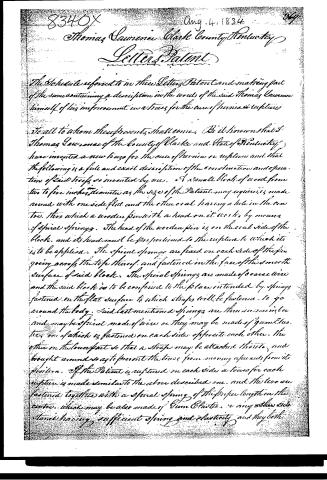
To all to whom these presents shall come, Be it known that I, Thomas Lawrence of the County of Clarke and State of Kentucky, have invented a new truss for the cure of hernia or ruptures and that the following is a full and exact description of the construction and operation of said truss so invented by me. A small block of wood from two to five inches in diameter as the size of the Patient may require, is made round with one side flat and the other oval having a hole in the center, through which a wooden pin with a head on it works by means of spiral springs. The head of the wooden pin is on the oval side of the block, and its head must be proportioned to the rupture to which it is to be applied. The spiral springs are fixed on each side of the pin going across the top thereof, and fastened in the face of the smooth surface of said block. The spiral springs are made of coarse wire and the said block is to be confined to the place intended by springs fastened on the flat surface to which straps will be fastened to go around the body. Said last mentioned springs are then in number and may be spiral made of wire or they may be made of gum elastic, one of which is fastened on each side opposite each other. The other on the lower part so that a strap may be attached thereto and brought around so as to prevent the truss from moving upwards from its position. If the Patient is ruptured on each side a truss for each rupture is made similar to the above described one, and the two are fastened together with a spiral spring of the proper length in the center, which may be also made of Gum Elastic, or any other substance having sufficient spring and elasticity and they both
Page 3.
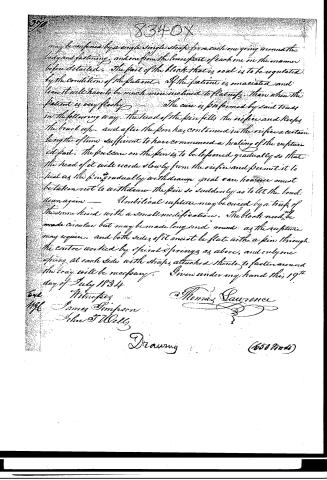
may be confined by a single single strap from each one going around the body and fastening, and one from the lower part of each one in the manner before detailed. The part of the block that is soal is to be regulated by the condition of the patient. If the patient is emaciated and lean it will have to be much more inclined to flatness than when the patient is very fleshy. The cure is performed by said truss in the following way. The head of the pin fills the orifice and keeps the tract up, and after the pin has continued in the orifice a certain length of time sufficient to have commenced a healing of the ruptured part. The foramen on the pin is to be loosened gradually so that the head of it will recede slowly from the orifice and permit it to heal as the pin gradually withdraws. Great care however must be taken not to withdraw the pin so suddenly as to let the wound down again. Umbilical rupture may be cured by a truss of the same kind with a small modification. The block need not be made circular but may be made long and round as the rupture may require, and both sides of it must be flat with a pin through the centre worked by spiral springs as above, and only one spring at each side with straps attached thereto to fasten around the body will be necessary. Given under my hand this 19th day of July 1834
Thomas Lawrence
Witnesses
James Simpson
John J. Wells
Drawing (650 Words)
Published accounts: journal notice
Notice in the monthly list of patents, with remarks
Journal of the Franklin Institute, new ser., vol. 15 (1835), p. 183 · View the page
6. For a Truss for the cure of Hernia; Thomas Lawrence, Clarke county, Kentucky, August 4.
Remarks. A pad is to be made of wood, which may be round, and from two to five inches in diameter. The side intended to be worn next the body, is to be convex, and the opposite side flat; this pad, or block, is to be perforated through its centre, to admit a wooden pin to slide in it, which pin has a head of such size as shall pass into, and bear upon, the ruptured cavity. In the drawing, the sliding shank is represented as of about half an inch, and the head about an inch, in diameter. The pin is acted upon by two spiral springs upon the back of the pad, which are to press upon it, at first, with considerable force; the intention, it is presumed, is to irritate the part, so as to produce inflammation and adhesion; this, however, is not said. The pressure is to be gradually diminished as the cure proceeds. The pad is to be kept in its place by suitable straps round the body. There is no claim made.
About this record
- Patentee
- DATAMP
- Date
- the Name and Date index of patents, DATAMP, USPTO records
- Invention
- DATAMP
- Listed in
- the Name and Date index of patents, DATAMP, USPTO records, Jim Shaw's X-patent list, the Journal of the Franklin Institute, Burke's List of Patents (1847)
- Burke's 1847 Patent Office list gives the same patent.