

Drawings and documents
USPTO scan
The patent as scanned by the USPTO
-
 Page 1
-
 Page 2
-
 Page 3
-
 Page 4
-
 Page 5
-
 Page 6
-
 Page 7


U.S. Patent and Trademark Office · Google Patents
Show the transcription Hide (2,211 words)
Machine transcription (LightOnOCR) of the pages as scanned by the USPTO, most of them the handwritten copies made when the records were restored after the 1836 fire. Not checked; it can misread handwriting, so compare it with the scan.
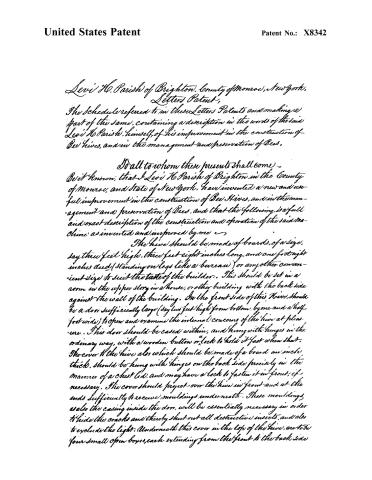
Page 2.
United States Patent
Patent No.: X8342
Levi H. Parish of Brighton, County of Monroe, New York, Letters Patent,
The Schedule referred to in these Letters Patents and making a part of the same, containing a description in the words of the said Levi H. Parish, himself, of his improvement in the construction of Bee Hives, and in the management and preservation of Bees.
To all to whom these presents shall come —
Be it known, that I Levi H. Parish of Brighton in the County of Monroe, and State of New York, have invented a new and useful improvement in the construction of Bee Hives, and in the management and preservation of Bees, and that the following is a full and exact description of the construction and operation of the said machine as invented and improved by me —
The hive should be made of boards, of a size, say three feet high, three feet eight inches long, and one foot eight inches deep (standing on legs like a bureau) or any other convenient size to suit the taste of the builder. This should be set in a room in the upper story in a house, or other building with the back side against the wall of the building. On the front side of this hive should be a door sufficiently large (say two feet high from bottom by one and a half foot wide) to open and examine the internal concerns of the hive at pleasure. This door should be cased within, and hung with hinges in the ordinary way, with a wooden button or lock to hold it fast when shut. The cover of the hive also which should be made of a board an inch thick, should be hung with hinges on the back side precisely in the manner of a chest lid, and may have a lock to fasten it in front, if necessary. The cover should project over the hive in front and at the ends sufficiently to receive mouldings underneath. These mouldings, as also the casing inside the door, will be essentially necessary in order to hide the cracks and thereby shut out all destructive insects, and also to exclude the light. Underneath this cover in the top of the hive, are to be four small open boxes, each extending from the front to the back side
Page 3.
United States Patent
Patent No.: X8342
hive, and sufficiently wide, so as in the aggregate to just fill the top of hive. They should fit so close as not to admit of the bees passing up and down around the sides of the boxes, and they should each be about ten inches deep. They should be placed in an inverted position in the hive, and should rest upon a tier of slats, or narrow strips of board, extending from end to end of the hive and placed at about half or three fourths of an inch from each other. About one foot below these slats, should be placed another tier in like manner as the first, with the exception that the last may be placed a little wider apart than those on which the boxes rest. These tiers of slats should severally rest upon two narrow strips of board nailed or screwed on to the end boards of the hive, and the slats themselves should all be fastened in their places by nails or screws. It is intended that the bees, in their accustomed manner of working, shall first fill the boxes, then work from the slats below down to the second tier of slats, and from these again down to the bottom of the hive. In the back side of the hive, should be three apertures, which should extend through the wall of the house or building, into which these tubes should be inserted of sufficient length to reach from the inside of the hive to the outside of the house the ends being cut slanting on the upper side, to make a lighting place for the bees. These tubes should be placed in a triangular position, one above and two below. The upper one should enter the hive just below the upper tier of slats on which the boxes rest. The entrance through this tube should be four inches wide, by half an inch deep. The two lower tubes should enter the hive just below the second tier of slats, and should each be three inches wide, by half an inch deep, all the tubes should be inclining a little downward from the inner, to the outward ends, that the water from without may drop off at the ends, and not run into the hive. These tubes should be the only places for the bees to pass into and out of their hive. In the four boxes above mentioned, there should be holes cut three inches wide by half an inch deep near the upper side of the boxes, so that the bees may pass freely from one box
Page 4.
United States Patent
Patent No.: X8342
into another, as occasion may require. There should also be three small apertures cut in the side of the boxes directly over the holes last mentioned to the top of the boxes three inches long by one fourth of an inch or a little more in width extending up to the cover of the Hive. These should be covered by a piece of Millenet laid loosely on the top of the boxes, to prevent the Bees passing up through them. In the cover of the hive, should be formed three grooves, extending from the apertures last mentioned, to within about an inch of the back side of the cover, and there intersecting a mortice leading from thence to the back side of the cover. This mortice it will be seen must be cut in the edge of the board forming the cover, and should be three inches long by half an inch deep, and should be covered on the out side by a piece of fine wire screen or a piece of millenet sufficiently open to admit a free circulation of air through it, but not so open as to admit of flies or other insects to pass in. This mortice and those grooves, in connection with the apertures below, are to serve as a draft through which the heated air in the hive, and the perspiration of the Bees may escape, while at the same time a constant supply of fresh air from without, is conveyed in, through the tubes. When a hive of this description is obtained, the Bees should be hived into one or more of the small boxes and placed in the hive, or if they are already in a hive of common construction, by turning it bottom side up, and placing one box at a time on the top of it they can easily be driven into the boxes and placed in the hive, where they will immediately go to work. Here they will remain perfectly secure, and neither disturb the inmates of the house, or be disturbed by them. Some of the benefits to be derived from the management of Bees in the manner here recommended may be stated as follows: viz. 1st. By keeping Bees in the house, the owner, or Bee-master may exercise absolute control over his property, and instead of having it wrested from his hands improperly, appropriated it to his own use. 2nd. The Bees would be secure from the inclemencies of the weather, neither the scorching rays of a Summers sun, or the chilling winter winds would affect them: they would also be kept both dry and
Page 5.
United States Patent
Patent No.: X8342
comfortable, and consequently healthy. 3rd They would be secure from destroying insects. The hive should be so perfectly tight within the house, that nothing could molest them; and the tubes being the only entrance from without, it is believed they will be too high and too much secluded for insects, especially the Bee-moth, that fell destroy of the Honey Bee, to enter. 4th They may be carefully examined at all times, to see if an enemy gets among them, and also how they progress in their work. 5th They will not be subject to losses by swarming, as it is well known that bees never swarm while they have sufficient room for their operations. If, however, they should become too numerous at any time to occupy one hive to advantage, they may be divided in the following manner, viz. Prepare another hive of the same size and construction, with the one the bees occupy; place it in the room where it is to stand, then, in a stormy day, or evening when the bees are all in their hive, take out all the boxes, with all the bees that may be in them, and place them in the new hive, and put the boxes belonging to the new hive into the old one at the same time. This will divide them nearly equal; and if either becomes too numerous again, divide them again in the same manner (or connect the two hives by a tube, so that the bees can pass from one into the other), remembering always to stop up the tubes of the old hive for one or two days after dividing a swarm; or until the bees in the new hive begin to work well in and out at the tubes of their new habitation; then unstop the tubes and all will work well. 6th Honey may be taken from them at any time even in the midst of summer, if the owner wishes a box of fine white honey: he has but to take a spare box with him, and take out one of the boxes, supplying its place with the spare one; then take the box out of doors and turn it bottom side up, and rap on it until the bees all leave it. The bees will all return to their hive again while the owner may enjoy in an eminent degree, the fruits of their industry. 7th The owner should be careful to leave honey sufficient in the hive for the use of the bees through the winter which
Page 6.
United States Patent
Patent No.: X8342
He may well afford to do as it is well known that 10 or 12 lbs. will winter a swarm of common size even as far north as latitude 42, or 43 degrees. Then in the spring the whole should be taken away, first by clearing the boxes above, and then by cutting the combs from the slats below. The boxes may be cleared by taking them out of the hive one at a time, turning it bottom side up, and placing an empty box on it, and driving the bees into the empty box, which place in the hive. This may be done in a cool day in the spring without any danger to the one who performs the operation. This is the great desideratum in the art of keeping bees, and with hives of this construction you can take from them all the honey they have to spare, and still preserve their valuable lives. 8th Bees work better in a hive that is empty, than in one that is full; and by clearing it out wholly once in the year and partially at other times, they will always have room sufficient for their operations. 9th Honey is far more delicate and more valuable when new, than when it has been a long time in the hive; and by this precept we may always have new honey. 10th Bees kept in this manner would be much less liable to be robbed by other swarms. Being kept in the house, they would be more secluded; other bees would not be so likely to be attracted thither by the smell of honey, and in the course of one or two years they would become so numerous as to be able to repel any invasion of ordinary swarms. 11th By keeping bees in the manner here recommended, they can as well be kept in large towns and cities, as in the country, which is not the case when kept in the open air, and on or near the ground. 12th As a matter of profit, it is confidently believed that Bees kept in this manner will pay some hundred percent more on the capital invested, than any other stock our country will produce, yet instead of producing our own, we import a great quantity of honey every year.
If this operation is performed full early, & it should be early, before the breeding season commences, otherwise a quantity of eggs or young bees might be destroyed, a little honey
Page 7.
United States Patent
Patent No.: X8342
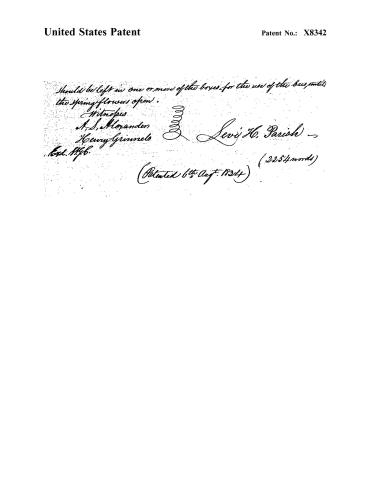
Should be left in one or more of the boxes for the use of the bees, until the spring flowers open.
Witnesses:
A. S. Alexander
Henry Grinnell
Levi H. Parish
(2254 words)
(Patented 6th Aug. 1834)
Published accounts: journal notice
Notice in the monthly list of patents, with remarks
Journal of the Franklin Institute, new ser., vol. 15 (1835), p. 184 · View the page
10. For improvements in the construction of Bee Hives, and the Management of Bees; Levi H. Parish, Brighton, Monroe county, New York, August 6.
Remarks. In the construction of the hives here recommended, there is nothing very peculiar; but they are to be large, and to be divided into separate compartments, by means of smaller boxes fitting into them, which boxes may be removed and replaced at proper periods. The main thing insisted upon is the advantage of keeping the hives within doors, in the upper rooms of a dwelling, or other suitable building. The benefits resulting from this are fully set forth, with much earnestness and good sense. The specification, in fact, would be a very good article for a journal devoted to the useful arts, but for the purpose of securing any exclusive right or privilege, it is altogether useless. The housing of bees in the manner directed is not new, nor is the dividing of a rectangular hive into compartments, by separate boxes, a thing which could be claimed at the present day; yet these two points are among the most conspicuous of those presented to us; even were they new, as they are not distinguished from other things which accompany them, and which are not so, they would not be secured to the patentee, whose business it is to distinguish his invention "from all other things before known or used," instead of which, not a syllable appears in any part of the instrument, which can lead to a knowledge of what was intended to be patented.
About this record
- Patentee
- DATAMP
- Date
- the Name and Date index of patents, DATAMP, USPTO records
- Invention
- DATAMP
- Listed in
- the Name and Date index of patents, DATAMP, USPTO records, Jim Shaw's X-patent list, the Journal of the Franklin Institute, Burke's List of Patents (1847)
- Burke's 1847 Patent Office list gives the same patent.