

Drawings and documents
National Archives restored drawings: drawing
Alfred Newton's Patent Drawing for a Spiral Screw Auger

National Archives, Restored Patent Drawings (Record Group 241) · Full-size scan at the National Archives · Catalog record
Show the text on the drawing Hide (39 words)
Words on the drawing as machine-read by the National Archives; not checked. Useful mainly for searching.
anyers ALFRED NEWTON'S / Coopat. Aug. 81834 / Spiral screw Auger. / 750 145. WOOD WORKING. / 4. TOOLS. / [29] Auger.. / Patented Aug. 8th 1854, / CLASSIFICATION / 8349+ / DIVISION. / Fig.2. / Fig.). / Fig.3. / did / of
USPTO scan
The patent as scanned by the USPTO
-
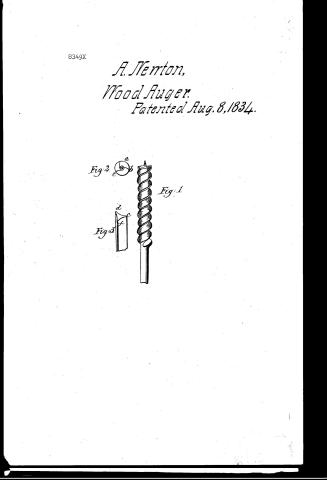 Page 1
-
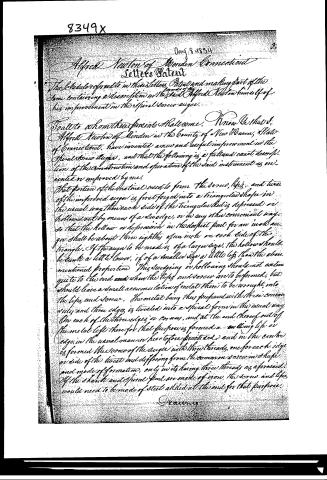 Page 2
-
 Page 3


U.S. Patent and Trademark Office · Google Patents
Show the transcription Hide (798 words)
Machine transcription (LightOnOCR) of the pages as scanned by the USPTO, most of them the handwritten copies made when the records were restored after the 1836 fire. Not checked; it can misread handwriting, so compare it with the scan.
Page 1.
8349X
A. Merrion,
Wood Auger.
Patented Aug. 8, 1834.
Fig. 2
Fig. 1
Fig. 3
Page 2.
8349X
Aug. 8, 1854
Alfred Newton of Nordan Connecticut
Letters Patent
This Schedule refers to in this Letters Patent and making part of the
same containing a description in the said Alfred Newton himself of
his improvement in the spiral screw auger.
To all to whom these presents shall come. Know Ye that I,
Alfred Newton of Nordan in the County of New Haven, State
of Connecticut, have invented a new and useful improvement in the
Spiral Screw Auger, and that the following is a full and exact description
of the construction and operation of the said instrument as invented
or improved by me.
That portion of the material used to form the screw, lips, and three
of the improved auger is first forged into a triangular shape in
the usual way, then each side of the triangular body is depressed or
hollowed out by means of a swedge, or in any other convenient way,
so that the hollow or depression in the deepest part for an inch auger
shall be about three eighths of an inch on each side of the
triangle. If the auger to be made is of a larger size, the hollow should
be sunk a little lower, if of a smaller size a little less than the above
mentioned proportion. This swedgeing or hollowing should not extend
quite to the end where the lips and screw are to be formed, but
should leave a small accumulation of metal there to be wrought into
the lips and screw. The metal being thus prepared with three concave
sides and three edges is twisted into a spiral form in the usual way.
On each of the three edges or corners, and at the end thereof out of
the metal left there for that purpose is formed a curling lip or
edge in the usual manner heretofore practiced, and in the center
is formed the screw of the auger with three threads, one for each side
or side of the twist and differing from the common screw in shape
and mode of formation, only in its having three threads as aforesaid.
If the shank and spiral part are made of iron, the screw and lips
would need to be made of steel added at the end for that purpose.
Drawing
Page 3.
Some of the advantages of the instrument thus improved, are additional strength, from the fact that there is an accumulation of metal in the centre of the auger, greater ease in boring from the fact that there are three cutting lips instead of one or two as in other augers, and more steadiness of operation from the fact that the lips are displaced so that only one acts directly across the grain of the wood at the same instant, and each one of the lips operates differently as to the manner of taking the grain at the same moment.
Figure I, in the annexed drawing exhibits a view of the screw, two of the lips, and the spiral twist and part of the shank. Fig. II. Represents an end view of the improved auger, the screw is seen in the centre, and the lips, or cutters at a-b. Fig. 3. shows a section of the auger made perpendicularly to the centre and helps to understand the shape which the metal had before it was twisted, d-e-f-g showing the edges with the hollows or concavities between them.
I claim as my improvement for which I solicit a Patent, the formation of an auger with three lips or cutters, and a triple spiral in contradistinction to the augers now made, which so far as I know have hitherto been made with not more than two lips or cutters, and a double spiral formed by twisting a flattened piece of metal. I do not claim the whole instrument as my invention, nor the triple thread as the screw of the auger, nor that I am the inventor of a screw auger or a spiral twist auger whether singly or doubly threaded, but I claim only what I have above stated as an improvement upon such spiral twist and screw augers as are now in use, by the addition and formation of a third cutter, and spiral, securing the advantages above specified and described. In testimony that the above and foregoing is a true specification of my said improvement, I have hereunto set my hand at New Haven this 30th day of July 1834.
Witnesses:
Isaac S. Hibbels
Benajah Andrews
Alfred Newton
Drawing
(Seal)
Published accounts: journal notice
Notice in the monthly list of patents, with remarks
Journal of the Franklin Institute, new ser., vol. 15 (1835), p. 187 · View the page
16. For an improvement in the spiral Screw Auger; Alfred Newton, Meriden, New Haven county, Connecticut, August 8.
Remarks. This, instead of a two, is to be a three lipped auger. The part which is to form the spiral, is to be first forged into a triangular form, and each of the sides is then to be hollowed, or fluted, by means of a suitable swage. For an inch auger, these hollows should have a depth of about three-eighths of an inch, and in the same proportion for other sizes. The cutting edge is to be so forged as to allow of the formation of three lips, and an entering screw with three threads. This auger, when twisted in the usual way, will, it is said, "be stronger, and bore more easily, than those of the ordinary construction." The claim is to "the formation of an auger with three lips, or cutters, and a triple spiral, in contradistinction to the augers now made, which have not more than two lips, and a double spiral."
DATAMP: illustration
Illustrations from DATAMP


DATAMP (Directory of American Tool and Machinery Patents), via the Internet Archive · Archived DATAMP page
About this record
- Patentee
- DATAMP
- Date
- the Name and Date index of patents, DATAMP, USPTO records
- Invention
- DATAMP
- Listed in
- the Name and Date index of patents, DATAMP, USPTO records, Jim Shaw's X-patent list, the Journal of the Franklin Institute, Burke's List of Patents (1847)
- Burke's 1847 Patent Office list gives the same patent.