

Drawings and documents
National Archives restored drawings: drawing
J. Martineau's Patent Drawing for an American Plan of Road-making

National Archives, Restored Patent Drawings (Record Group 241) · Full-size scan at the National Archives · Catalog record
Show the text on the drawing Hide (37 words)
Words on the drawing as machine-read by the National Archives; not checked. Useful mainly for searching.
34. PAVING. / [110] Stone Pavements. / $150 / J. MARTINEAU. / CLASSIFICATION / 8354-1 / American plan of Road making. / Patented 11 Aug 1834. / DIVISION. / Fig 2. / Fre 3. / F' / XXXXXXXXXXX / Fig4, / Fig5.
USPTO scan
The patent as scanned by the USPTO
-
 Page 1
-
 Page 2
-
 Page 3
-
 Page 4
-
 Page 5
-
 Page 6


U.S. Patent and Trademark Office · Google Patents
Show the transcription Hide (1,664 words)
Machine transcription (LightOnOCR) of the pages as scanned by the USPTO, most of them the handwritten copies made when the records were restored after the 1836 fire. Not checked; it can misread handwriting, so compare it with the scan.
Page 1.
8354X
J. Martineau,
Stone Pavement,
Patented Aug. 11, 1834
Fig. 1. Fig. 2. Fig. 3. Fig. 4. Fig. 5.
Page 2.
John Martinian. Olbridge N'York
Letters Patent
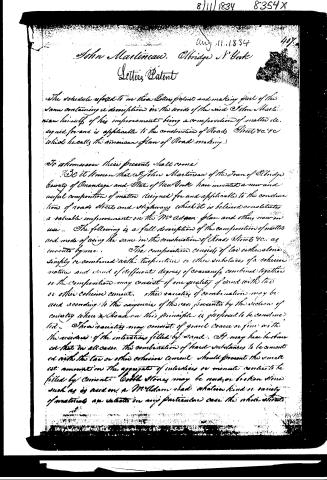
The schedule referred to in these Letters Patent and making part of this issue containing a description in the words of the said John Martinian himself of his improvement being a composition of matter designed for and is applicable to the construction of Roads Streets, etc. (which he calls the American plan of Road making.)
To whomsoever these presents shall come
BE it known that I John Martinian of the Town of Olbridge County of Orange and State of New York have invented a new and useful composition of matter designed for and applicable to the construction of roads, streets and highways which it is believed constitutes a valuable improvement on the Macadam plan and others now in use. The following is a full description of the composition of matter and mode of using the same in the construction of Roads, Streets, etc. as invented by me.
The composition consists of two substances alone, simply or combined with the substances or other substances of a cohesive nature and stand of different degrees of coarseness combined together. The composition may consist of one quality of sand with two or other cohesive cement. Other varieties of combination may be used according to the requirements of the case presented by the section of country where a Road on this principle is proposed to be constructed. The varieties may consist of gravel, coarse or fine, with the residues of the materials filled by sand. It may here be observed that in all cases, the combination of hard substances to be cemented with the two or other cohesive cement should present the smallest amount in the aggregate of interstices or minute spaces to be filled by cement. Both stones may be used or broken stone such as is used on a Millstone road, whatever kind or variety of materials are suitable in any particular case the whole should
Page 3.
8/11/1834 8354x
408
be rendered as compact and uniform as possible. If coarse materials enter into the composition in any case, finer materials should be combined therewith to fill the recesses under the mass solid and compact, and the upper surface smooth and even, so as that after it has been ground with tar or other cohesive cement, it may present a surface quite smooth and uniform.
Having described what constitutes the composition intended to be used in this improved mode of constructing Roads, Streets, etc., over those now in use, which improved mode for the sake of distinction I will designate as the American Plan of Road-making. I now proceed to describe the mode of construction. The same or similarly suitable modes are to be followed in this case as for the McAdam Road. It is first to be stated out, then graded or graduated. The necessary precautions taken by Culverts, side ditches, and drains to collect and carry off the water. The bed of the road is to be rendered firm and compact by Rolling or other suitable process, forming the shape the face of the road is intended to have. As it may be remarked, as this combination is impervious to water, much more perfectly than a McAdam covering, it is not necessary to be so much raised or convex to shed the water as his plan. Under proper and necessary
The Road or Street being laid out, graded, and rendered compact and firm, is now ready to receive the covering to be cemented. The simplest material in a large section of the United States is sand, which at the same time forms the best foundation free of expense. The sand is spread over uniformly to the required thickness, say three inches in ordinary cases. The proper thickness will somewhat depend on the nature of the soil constituting the bed of the road. If it is firm and homogeneous, not holding water easily, then the covering may be thin, reduced to a minimum. In a word, the cover to be cemented may be in thickness of from one inch to six, according to circumstances, the cover being flat, or undulating, correctly extending to the side ditches, if necessary, and even to form side walks, it is proper to be
Page 4.
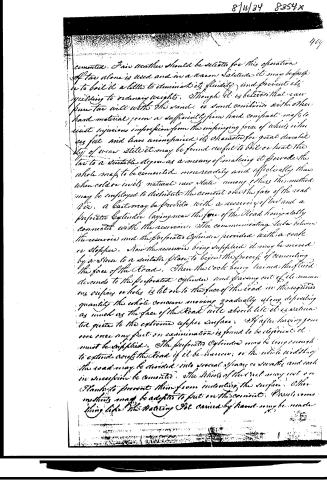
cemented. This weather should be selected for this operation. If tar alone is used and in a warm latitude it may be proper to boil it a little to diminish its fluidity and prevent its yielding to ordinary weights. Though it is believed that raw pine tar will with the sand, or sand combined with other hard material form a sufficiently firm hard compact mass to resist injurious impregnation from the impinging force of wheels either as feet and leave unimpaired its character for great durability of wear, still it may be found useful to boil or heat the tar to a suitable degree as a means of making it pervade the whole mass to be cemented more readily and effectively than when cold or in its natural raw state. Among others this method may be employed to distribute the cement about the face of the road bed. A cart may be provided with a reservoir of tar and a perforated cylinder laying near the face of the road horizontally connected with the reservoir. The communicating tube between the reservoir and the perforated cylinder provided with a cock or stopper. Now the reservoir being supplied it may be moved by a stone to a suitable place to begin the process of cementing the face of the road. Then the cock being turned the fluid descends to the perforated cylinder and passing out of its numerous orifices or holes is let on to the face of the road in the required quantity the whole concern moving gradually along depositing as much as the face of the road will absorb till it is saturated quite to the extreme upper surface. If after having gone over once any fault or examination is found to be deficient it must be supplied. The perforated cylinder may be long enough to extend across the road if it be narrow; or the whole width of the road may be divided into several spaces or swaths and each in succession be cemented. The wheels of the cart may rest on flanks to prevent them from indenting the surface. Other methods may be adopted to put on the cement. Much more thing like this watering the cement by hand may be made.
Page 5.
8/11/1834 8354X
use of others may suggest themselves. It is by no means a difficult operation.
Side walks in Cities and Towns and footways in villages and Country places walks in pleasure ground and parks may also be made on this plan. The accompanying drawing shows some of the modes or forms according to which roads and streets may be constructed. In Fig 1. & Fig 2. A A are side walks supposed to be made of the same materials as the covering of the carriage way. B B are curb stones. C in fig 1 represents a thin covering over the broken or rubble stone of a Macadamised street. D represents the natural earth inside the Figures. C C in Fig 2. represents the covering to consist of pebbly gravel and sand all cemented over D D a mass of cobble stone gravel and sand forming the Bed of the Street. In Fig 3. G G represent the cemented covering to consist of pebbly gravel and sand about three inches thick. F F represents the gutters paved with common cobble stone. The road in this fig. is raised pretty high and is supposed to be located on a springy or wet soil. Fig 4 may represent a street or Road. H H the side walks I I gutters J J the carriage way of the Street or Road covered continuously with cemented sand. Fig 5. represents a common Road when the carriage way only is covered with the cemented composition represented by K K and terminating at I I I. In this case the side ditches are formed in the common soil which overlaps a little the ends of the cemented cover to protect it from abrasion at the edges. This is the cheapest form of Road. It is proper to remark that in some situations such as Cities the bed or substation of the Street or road may be made of cemented materials such as sand and gravel cemented with a hydraulic lime or any other common cement none of which will answer well for the covering surface of the road being of a nature too friable, but by being covered in the way here proposed may form a road of additional value and durability.
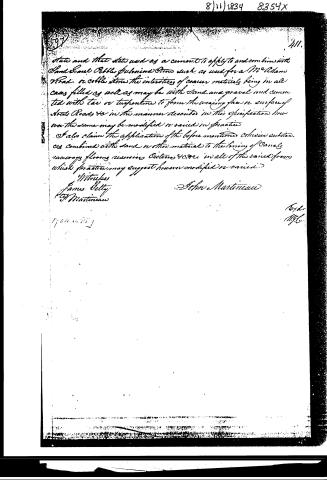
That I claim as my invention and improvement is the application of the substances or any of them, as of lime, or other substances, as above before mentioned to a paved
Page 6.
8/11/1834 8354X
597
411.
state and that state used as a cement to apply to and combine with Sand and Pebble Subsoil Stone such as used for a McAdam Road. or cobble stone the interstices of coarser materials being in all cases filled as well as may be with Sand and gravel and cemented with tar or turpentine to form the wearing face or surface of Street Roads &c in the manner described in this specification how ever the same may be modified or varied in practice
I also claim the application of the before mentioned cohesive substances combined with sand or other material to the lining of Canals raceways flooring reservoirs Cisterns &c &c in all of the varied forms which practice may suggest however modified or varied
Witnesses
James Petty
John Martineau
1704 10 22
1046
NYC
Published accounts: journal notice
Notice in the monthly list of patents, with remarks
Journal of the Franklin Institute, new ser., vol. 15 (1835), p. 189 · View the page
20. For a Composition of Matter applicable to the construction of Roads, Streets, &c.; John Martineau, Eldridge, Onondaga county, New York, August 11.
Remarks. The claim at the close of the specification of this patent, will exhibit clearly the object for which it is obtained. "What I claim as my invention and improvement, is the application of tar, turpentine, or any other of that class of cohesive sub stances, reduced before use to a fluid state, and in that state used as a cement to apply to, and combine with, sand, gravel, pebbles, pulverized stone, such as is used for a M'Adamized road, or cobble stones; the interstices of coarse materials being in all cases filled, as well as may be, with sand and gravel, and cemented with tar, or turpentine, to form the wearing surface of roads, streets, &c., in the manner described in this specification, however the same may be modified or varied in practice. I also claim the application of the before mentioned cohesive substances, combined with sand, or other material, to the lining of canals, raceways, flooms, reservoirs, cisterns, &c. &c., in all the varied forms which practice may suggest, however modified, or varied." We have, for many years, been in the habit of speaking of tar as one of the best articles which could be employed upon roads. Those who have noticed the wharves, or other places, where tar has been spilt on dusty roads, must have observed that it serves to cement the materials so firmly, that, after its incorporation with the dust, or sand, is completed, the heaviest loads actually make no impression upon it.
About this record
- Patentee
- DATAMP
- Date
- the Name and Date index of patents, DATAMP, USPTO records
- Invention
- DATAMP
- Listed in
- the Name and Date index of patents, DATAMP, USPTO records, Jim Shaw's X-patent list, the Journal of the Franklin Institute, Burke's List of Patents (1847)
- Burke's 1847 Patent Office list gives the same patent.